Uk politics

Does anyone really care how politicians look?

Charles Moore asks in this week’s Spectator what the ‘right looks’ are for a leadership contender, comparing Margaret Thatcher’s appeal to Tory backbenchers to the appeal of Yvette Cooper and Liz Kendall in the Labour contest. The obvious answer, of course, is that the ‘right look’ involves wearing clothes for working in the House of Commons, rather than a diving suit or paint-smattered overalls. It’s a ‘look’ Cooper, Kendall and their male rivals Jeremy Corbyn and Andy Burnham pull off on a daily basis, so presumably the question is quite easy to answer. I must confess what when I first read Charles’s column, I wondered why he was posing the question

Labour ‘members’ object to ‘purge’

Some Labour party members are currently finding out that they can’t vote in the leadership election after all because they’ve been picked up as being insincere members. A number of them are furious about this, understandably, but what’s also understandable, perhaps, is that the party is struggling to consider them as sincere members given they were actively campaigning for other parties until recently. Marcus Chown is angry at being purged, even though he is the ‘twitter lead’ for the National Health Action party, and stood against Labour as a candidate for the NHA in the 2014 European elections. This self-described Labour member, trade union rep and Young Fabian Emily Maiden

Labour’s bitter, bitchy battles will continue long after its leader is announced

Why is the Labour leadership contest so vile? It has been the bitterest, bitchiest battle that the party has experienced for a good long while, even though the last contest involved two brothers standing against each other in a very ill-humoured manner. Labour MPs are smarting that after years of fighting in the trenches for their party, they are being accused of being secret Tories – though some Blairites who experienced the misery of the wars between Tony Blair and Gordon Brown confess to a feeling of karmic satisfaction that Gordon Brown is also being described as a ‘Blairite’ by some on the left. One Labourite says: ‘The fact that

Kezia Dugdale appeals to the Left with personal speech about her past

Jeremy Corbyn really has made socialism trendy – at least in Scotland. We can take that from the speech that Kezia Dugdale, Labour’s Scottish leader, will make a today focusing on the ‘s’ word – something she is unlikely to have done had Mr Corbyn been languishing in the polls. Indeed, it was only a few weeks ago that Dugdale warned that a Corbyn victory would leave Labour ‘carping on the sidelines’. Then, as he started to edge ahead in the race, she started to move, first insisting they shared some similar policies and then meeting him privately at a rally in Edinburgh. Today she will edge even closer to his agenda

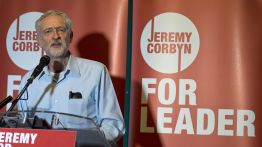
Jeremy Corbyn is far less popular with Labour MPs than he is with members. Is that a problem?

Why haven’t some Labour MPs ever met Jeremy Corbyn? Mr Steerpike picks up on the discussion between former Miliband aide Anna Yearley, and MPs Barbara Keeley and Lucy Powell about his non-attendance at PLP meetings and the fact that Powell has ‘never, ever met or spoken to him’. This is odd: Corbyn has been a member since 1983 and has managed to find time to befriend Ukip’s Douglas Carswell, who cheerily offered to introduce Yearley to Corbyn in the tearooms at some point. It’s not unusual, though: on Sunday night Tory backbencher Mark Field was singing the praises of the friendly Corbyn on Westminster Hour. But when I was discussing

Corbynomics: A path to penury

The expansion of capitalism and free markets in recent decades has led to incredible economic and social progress; the fastest fall in extreme poverty in human history, rising life expectancy and plummeting levels of global hunger. Jeremy Corbyn’s anti-capitalist economic programme seems simply to ignore that history of success. The premise of Corbynomics is therefore that free market capitalism has failed in the UK with sectors ranging from energy to housing showing that markets cannot function to the benefit of society. This is deeply misguided. As John Maynard Keynes once said, this is ‘an extraordinary example of how, starting with a mistake, a remorseless logician can end up in bedlam’. Of course

Cooper vs Burnham: ‘A panicked, desperate stunt straight out of the Ed Balls playbook’

Yvette Cooper has rounded on Andy Burnham this evening, demanding that the Labour leadership contender oppose Jeremy Corbyn or stand aside. Burnham gave a speech this morning that was widely reported as him snuggling up to Corbyn, in which he praised his rival’s ‘energy’ and said ‘I want to capture that and would involve Jeremy in my team from the outset’. Cooper and Liz Kendall have both urged their supporters to use their second and third preferences on their ballot paper to block Corbyn by supporting any of the other three candidates, but Burnham has not joined them. A spokesman for Cooper said that ‘if [Burnham] isn’t prepared to offer

Ed Miliband won’t say anything until after the Labour leadership contest is over

Why is Ed Miliband not intervening to stop Jeremy Corbyn? Some Labourites see the former leader’s silence on the issue as a dereliction of duty, and hope to increase the pressure on him to say something about the importance of not lurching further left. But sources have told Coffee House that he plans to say nothing at all until 12 September, when the new leader is announced. His spokesman says: ‘His view is that the precedent was set by Neil Kinnock and Gordon Brown. He thinks it is right that the debate about the new leaders should not involve the outgoing leaders. It is right that the candidates speak for

Exclusive: Whitehall prepares for a new cull

Government departments have started to prepare their staff for job losses ahead of this autumn’s spending review, Coffee House has learned. George Osborne wants ministers to cut as much as 40 per cent from unprotected spending pots, which means that departments are likely to shed staff – or even close. The Energy and Climate Change department, which is one such unprotected department, has started to talk to its staff about the need to have a smaller workforce in future. The department is not yet talking about specific redundancies, but it is preparing for bigger cuts due in the comprehensive spending review, which will be unveiled on 25 November. A spokesperson for

Gordon Brown’s speech provokes scuffles amongst Labour MPs

So, funnily enough, Gordon Brown’s speech about his party’s leadership election hasn’t been that well-received by some quarters of Labour. There are some interesting people who are inevitably claiming he’s a Tory, but what’s more interesting is the way it has gone down with Labour MPs. Clive Lewis, for instance, seems to be quite keen to help the Tories out by saying that the guy who was Labour Chancellor and then Prime Minister during its last time in power isn’t credible: Graham Allen thinks Brown should have been talking about something else: And supporters of rival camps are starting to do the Twitter equivalent of mud-wrestling: All of which underlines

Gordon Brown tries to save his party

Gordon Brown has just given one of his saving-the-world-at-the-last-minute speeches. He was speaking just as the ballot papers for his party’s leadership election are being sent out, and in keeping with his other saving-the-world-at-the-last-minute speeches, particularly the one he delivered shortly before the Scottish referendum, it was a barnstormer. His main theme was the importance of getting Labour into shape so that it can be in power in order to carry out its moral mission. Brown argued that ‘it is not an abandonment of principles to seek power and to use that power in government. It is the realisation of principles’. He described the party as being broken-hearted after losing

Lurch to the left or the right? Where Labour and the Tories must position themselves to win in 2020

What are the best political positions for Labour and the Conservatives to take to win back more voters? The Tories want to maintain and extend their victory, while Labour is trying to work out how to unite the left and encourage more people to turn out for the party. These two parties used to focus their attention on swing voters in the centre-ground, but politics has fragmented too much for that now. Things are, naturally, more difficult for Labour. The scale of its 2015 defeat means that just taking votes and seats from the SNP, Plaid and the Greens is insufficient to give the party a majority in 2020. The

Andy Burnham: We should/shouldn’t attack Jeremy Corbyn

At least Andy Burnham is keeping us all on his toes with his leadership campaign. If you’d stopped paying attention to the Labour leadership election for a couple of hours, you might be forgiven for thinking that the Shadow Health Secretary thinks it is a bad idea to attack Jeremy Corbyn. This is what he had to say on the matter yesterday: ‘I would say the attacks we’ve seen on Jeremy I think misread the mood of the party because what people are saying is they’re crying out for something different, they are fed up with the way politics has been, particularly the way Labour has been conducting politics in

The Tories can start celebrating the Labour leadership result now

The Conservatives are naturally very much enjoying the Labour leadership contest, and are starting to make use of it in the press, with Matt Hancock warning that Jeremy Corbyn would cost every working household £2,400. It’s the sort of thing the Tories were doing in the general election, slapping often rather arbitrary price tags on Labour’s policies, but Corbyn does make it rather easier for these attacks to gain purchase with voters. Hancock does say that any Labour leader will cost voters money. And it is not right that the Tories will only benefit if Jeremy Corbyn wins. It is too late for any leadership candidate to put the Corbyn

Why all the Labour leadership candidates have failed to deal with Jeremy Corbyn

Even though Jeremy Corbyn has the Big Mo in this Labour leadership campaign, it is fair to say that Yvette Cooper has had a pretty good few weeks too. The Shadow Home Secretary managed to produce all her passion for her speech today in which she finally rounded on Corbyn, as well as rightly attacking the idea that only those at the hard ends of the political spectrum are the ones with principles. This evening she has bagged the endorsement of the Guardian. Andy Burnham, meanwhile, has not been enjoying the campaign since his bungled handling of the welfare bill. It was striking this afternoon to hear callers on his

Will Tony Blair really help save Labour?

Will Tony Blair’s intervention into the Labour leadership contest really make a difference? The former Prime Minister argues in today’s Guardian that this is a far worse crisis for his party than the 1980s, and uses what Angela Eagle last night described as ‘apocalyptic language’ to warn members of the danger the party is in. He writes: ‘This is directed to longstanding members and those who have joined but without an agenda. They’re still a majority and they have to exercise leadership now to save the party. It doesn’t matter whether you’re on the left, right or centre of the party, whether you used to support me or hate me.

Eric Pickles interview: multiculturalism is to blame for Tower Hamlets electoral fraud

Sir Eric Pickles looks every bit the diamond Tory geezer. As we sit down in a room overlooking Big Ben for his first interview since leaving the Cabinet, the 63-year-old MP for Brentwood and Ongar has dressed for the occasion: purple braces, monogramed shirt cuffs, pocket square and a golden Rolex. Yet his demeanour does not match the bling. Pickles’ laid back Yorkshire conversational style and dry wit are not what you would expect from a politician responsible for slashing millions from the budgets of local councils. But there is nothing relaxed about Sir Eric’s attitude towards his new assignment: tackling corruption, both in finance and politics. As the government’s new

Time is running out for Labour

[audioplayer src=”http://rss.acast.com/viewfrom22/chinasdownturn-labourslostvotersandthesweetestvictoryagainstaustralia/media.mp3″ title=”Isabel Hardman and Rowenna Davis discuss Labour’s lost voters” startat=622] Listen [/audioplayer] The Labour leadership contest was supposed to be a debate about the party’s future. Instead it has oscillated between petty personality politics and bickering. Nobody is addressing the question of how to win back lost voters. The four candidates have barely mentioned the fact that Labour is not winning seats in the south of England, nor the huge challenge from Ukip in its heartlands in the north. Given that the party failed to win its majority in England, it is staggering that more attention hasn’t been paid to this at hustings and in speeches. The candidates

Flashmob rule

What should be the response of politicians to mass emailings and Twitter storms? The question is an urgent one, especially for Conservative MPs, given the general truth that mass petitions, in which complex issues are simplified to ‘for or against’ and emotion given a head start over reasoned argument, tend to come from the left. I was astonished to learn that a Tory MP decided his vote on the proposed Hunting Bill would depend on opinion polls in his local newspaper. In the event the Bill was withdrawn, largely, if Nicola Sturgeon is to be believed, as a result of online petitioning. Progressive causes such as the campaign against hunting