Uk politics

Breaking: Government loses Article 50 case

Isabel Hardman is joined by Fraser Nelson and James Forsyth to discuss the ruling: In the past few minutes, the Supreme Court has delivered its ruling in the Article 50 case on taking Britain out of the European Union. The Government has lost. It had argued that it did not need an Act of Parliament before triggering the mechanism. The Court ruled by eight judges to three that the Government did need the authority of Parliament in order to start the process. You can read the full judgement here. But the Court also ruled unanimously that Brexit is a matter for the Westminster parliament and not the devolved assemblies. This means

The Supreme Court ruling, like the Brexit vote, has defended the sovereignty of parliament

I’ve never been a big fan of the Supreme Court, seeing it as a Blairite invention and – given our position in the European Union – a misnomer. But its decision to back the High Court and remind Theresa May that only parliament can dissolve laws that parliament makes is welcome. It has issued a useful refresher on constitutional law to certain MPs who might, in the excitement of the Brexit vote, have forgotten it. The 17.4 million who voted for Britain to leave the European Union were giving advice, rather than an instruction, to Parliament. This ought not to be a controversial point. As the judgment said, David Cameron chose to hold a consultative

Robert Hannigan’s surprise departure leaves a large hole to fill at GCHQ

The early departure of Robert Hannigan as GCHQ chief, announced today, marks not so much the end of an era as the transition between eras. The agency’s famous HQ in Cheltenham, a metallic doughnut the size of Wembley Stadium, might look futuristic but was designed in the late 1990s before anyone worked out just how much data the intelligence services would have to intercept and analyse. Or how much of espionage would involve codebreaking, and on such an unprecedented scale. The workload exploded as it opened in 2003 and suddenly a GCHQ designed for 5,000 staff looked too small. New ways of working were needed. Hannigan was brought in, as outsiders occasionally are to GCHQ, to

What does President Trump do to Brexit?

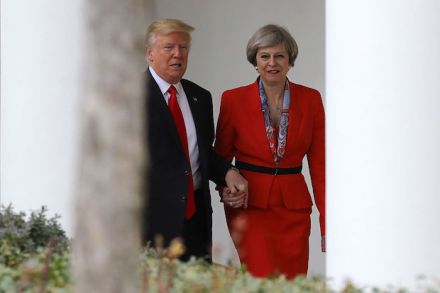
With Theresa May expected to head to Washington next week to see President Trump, I have a look at what the Trump presidency might mean for Brexit in my Sun column this morning. Despite his protectionist rhetoric, on full show again yesterday, Donald Trump is keen on a US / UK trade agreement. He has told people that he would like to get personally involved in negotiating the deal. I understand that his transition team has done more work on it than they have for any other agreement. Squaring the circle between Trump’s protectionist rhetoric and his enthusiasm for a US / UK deal isn’t as hard as it first looks.

No, Donald Trump isn’t a ‘massive, magnificent gift’ for Britain

There are certain traditional ceremonies without which the inauguration of a new American president cannot take place. Chief among them, at least on this side of the atlantic, is the opportunity such a moment provides for pondering anew the health and well-being of the ‘special relationship’. A remarkable amount of tripe must be talked on these occasions. You will recall how Bill Clinton’s supposedly-unhappy time at Oxford prejudiced him against this country and you will recall, of course, that Barack Obama’s Kenyan heritage left him temperamentally ill-disposed towards this sceptr’d isle. Obama, of course, confirmed this by removing the now famous Churchill bust from the Oval Office, an act of unpardonable

Voting ‘leave’ meant leaving the single market – and most voters knew it

The angrier, snootier sections of the Remain camp have done many bad things since 23 June. Some have suggested Brexit should be overthrown. Others have issued terrible libels against Leave voters, branding them ‘low information’ and xenophobic. Witness Nick Clegg in this Guardian video published this week having a good old laugh at Sheffield people who voted for Brexit after apparently falling for the ‘emotionally pungent’ claims of Leave leaders. But worst of all has been their sly rewriting of history. They’re engaged in a campaign to misremember the referendum, to depict it as a time of lies and idiocy, of racism unleashed. They’ve cranked up the memory holes, sharpened

Theresa May’s Twelve Steps for EU recovery

The earliest members of Alcoholics Anonymous offered their famous Twelve Steps, which the drunkard must take in order to recover, born of their own experience. The Twelve Steps are still the foundation of AA. They work because they are taken by people who have hit rock bottom and realise it. The first step says, ‘We admitted we were powerless over alcohol — that our lives had become unmanageable.’ Theresa May’s Twelve Objectives, announced in her outstanding speech at Lancaster House of Tuesday, play a similar role for national recovery, substituting the words ‘European Union’ for ‘alcohol’. Until the June referendum, Mrs May, like millions of others, barely even admitted there

A full English Brexit is on the menu

Kipling wrote about Brexit first, you know: “It is always a temptation for a rich and lazy nation, To puff and look important and to say: Though we know we should defeat you, We have not the time to meet you. We will therefore pay you cash to go away.” That, in essence, was David Cameron’s approach to the eurosceptics within his own party. Promise to pay just enough to keep them satisfied in the hope they would not then be emboldened to come back for more. But, as Kipling knew: “And that is called paying the Dane-geld; But we’ve proved it again and again, That if once you have

Theresa May’s cheery Brexit threat to EU leaders

Theresa May was at pains in her Brexit speech and in the question-and-answer session from journalists afterwards to appear as friendly as possible to European leaders. She pointedly took questions from members of the European press who were present. She told the room that ‘we are leaving the European Union, but we are not leaving Europe’, and addressed ‘our friends across Europe directly’, promising that Britain would continue to be ‘reliable partners, willing allies and close friends’. But she also took a very strong negotiating line, threatening what David Cameron either couldn’t or wouldn’t, which was to walk away if the deal offered wasn’t good enough, particularly if EU leaders

Theresa May’s Brexit speech – ten main points

‘A Global Britain’ promised the slogan behind Theresa May as she delivered her big Brexit speech. It was robust and well-judged, very much in the tone of The Spectator‘s leading article endorsing Brexit – she even used the same ‘Out, and into the world’ language we put on our cover. The referendum, she said, was ‘a vote to restore, as we see it, our parliamentary democracy, national self-determination and to and become even more global and internationalist in action and in spirit.’ She spoke so persuasively about the case for Brexit that you almost forgot that she campaigned (or, at least, voted) against it. But after a decent period of reflection, her conversion to Brexistism is

Will Theresa May finally tell us what Brexit means?

How much will Theresa May’s speech today surprise us? The Prime Minister’s promise to offer more detail on Brexit was made before Christmas, but Number 10 types seemed curiously relaxed about the prep for the speech over the holiday. And even though those briefing the speech over the weekend warned of a ‘market correction’, this is likely to have been as much to suggest that the speech was going to be big and revelatory as it was to actually warn about its content. Today we will get the 12 priorities for May’s negotiation of Britain’s exit, which will be guided by four key principles. Those are ‘certainty and clarity’, ‘a

Princess Diana understood what ‘global Britain’ meant. Does Theresa May?

So, ‘global Britain’ eh? This, we are told, will be the leitmotif for Theresa May’s Brexit speech tomorrow and, indeed, for her approach to international affairs more generally. And who could disagree with any of that? The argument will, of course, be couched in economic terms. The spirit of Britannia will be unleashed to sail the world’s oceans. Britain is back, you know. We shall show the doubters what we’re made of and by jove we’ll make a success of Brexit. Well, let us hope so. There are many kinds of internationalism, however, and I’m not sure – at least not sure yet – the buccaneers really appreciate, far less

Michael Gove’s interview with Donald Trump: main points

Michael Gove has landed the first British interview with Donald Trump for The Times (where he is, now, a columnist). This is his first interview since he spoke to Justin Welby for The Spectator – it’s online and as good as you’d expect. The ability to build such bridges won’t hurt Gove should he want to return to government. Here are the main points:- Trump congratulates Britain for Brexit.. He says: “People don’t want to have other people coming in and destroying their country. I thought the UK was so smart in getting out [of the EU]… Obama said: they’ll go to the back of the line [queue]… that was

Jeremy Corbyn needs to work on his Trump impression

‘I’m really interested about the similarities between me and Donald Trump,’ joked Jeremy Corbyn this morning on Marr. ‘Is it the hair or something?’ When the Labour leader expounded upon his Trump-esque analysis of the system that is rigged against the people, it turned out that the main difference between him and the American president was that he wants a series of constitutional reforms including overhaul of the House of Lords and more political representation of the North. Which doesn’t sound like the kind of thing you can shout at a rally, whether or not you have ludicrous hair. Corbyn managed to dodge questions on how far Labour would pursue

The PM’s national security adviser is leaving

  Mark Lyall Grant, the Prime Minister’s national security adviser, is leaving. As I report in The Sun today, the 60 year-old Lyall Grant is to retire later this year. The hot favourite to replace Lyall Grant is Mark Sedwill, the permanent secretary at the Home Office. Theresa May knows Sedwill well from her time as Home Secretary, they worked together for three years. Having him in Downing Street will mean that she has foreign policy advice from an official with whom she has developed a strong working relationship with. ‘She likes people we know and trust’, says one senior figure involved in discussions about the move. Sedwill, a former

Trump Team preparing US / UK trade deal

Boris Johnson returned from the US this week boasting that the UK was now ‘first in line’ for a trade deal with the US. He said that the Trump team and the new Congress ‘want to do it fast’. But as I write in The Sun this morning, the situation is even more advanced than this. I understand that the Trump team is already working on the outlines of a US / UK trade deal. Interestingly, they want the deal to be pencilled in before the UK leaves the EU, though the UK could not formally sign it until it has left the bloc. The US’s keenness for a trade

What happened after I ‘voted’ twice in the EU referendum?

Kind readers sometimes ask what has happened to the case against me for electoral fraud. In these Notes on 20 August, I revealed that I had drawn attention in the EU referendum to the ease with which one could vote twice. Legitimately registered to vote in Sussex and in London, I had voted Leave in Sussex, and then gone to London, collected my ballot paper unchallenged, and spoilt it by writing on it that it was ‘my protest at how lax the voting rules are’. The Electoral Commission then publicly announced that it was referring my case to the police. Just before Christmas, I was dismayed to receive a letter

Leak suggests EU will seek ‘special’ deal to access the City post-Brexit

The Guardian has a very significant story on its front page tomorrow. It has obtained notes of a meeting that Michel Barnier, the EU’s chief negotiator, had with senior MEPs this week. These notes show that Barnier told them that he wanted a ‘special’ deal that would guarantee access for the EU firms and countries to the City of London’s financial markets. Interestingly, Barnier also said—according to The Guardian’s account—that ‘There will need to be work outside of the negotiation box … in order to avoid financial instability.” This suggests that Barnier shares Mark Carney’s view that there are financial stability risks for Europe if the EU cuts itself off

The SNP’s dominance in Scotland is complete

Like the past, Scotland is a different country. Things are done differently here. What might be thought eyebrow-raisingly inappropriate in a larger polity is considered normal here. Consider these three examples: In 2015, Scottish Television decided it was a good idea to make Nicola Sturgeon, together with her sister and her mother, the star of its Hogmanay broadcast. New Year with the Sturgeon’s was in turn hosted by Elaine C Smith, the comedienne who was, conveniently, also a member of Yes Scotland’s advisory board during the 2014 independence referendum. Earlier this month, the SNP rolled-out the first ‘baby boxes’ that will be delivered to every new-born infant in Scotland. The

May might not give much away in Brexit speech

How much detail does Theresa May need to give in her much-anticipated Brexit speech on Tuesday? The Prime Minister will presumably have to say more than ‘Brexit means Brexit’, and odd phrases about what colour Brexit should be (red, white and blue) won’t pass muster either. But remember that the original big Brexit speech at the start of a year was the Bloomberg speech that David Cameron gave in 2013 – and he gave so much detail about what he wanted from a renegotiation of Britain’s relationship with the European Union that he was inevitably going to disappoint, which he then did, taking Britain out of the EU as a