Three Choirs Festival

Don’t miss this dark Hansel and Gretel

From our UK edition

The Three Choirs Festival always feels so nourishing, so eternally English, that you sometimes forget how much history has been made there. It was in Gloucester in 1910 that the young Herbert Howells and Ivor Gurney heard the world première of Vaughan Williams’s Tallis Fantasia while Elgar, in rented digs, tried out his Violin Concerto with Fritz Kreisler. Three years later you’ve got Sibelius despatching Aino Ackte to première Luonnotar, and Saint-Saëns, at 77, playing Mozart by day, then cracking out his celebrated musical impersonations at the post-show party. Apparently his Cosima Wagner was quite the knockout. The point is that there have been moments when the musical universe pivoted around this quiet cathedral close.

Three cheers for the Three Choirs Festival

From our UK edition

The Welsh composer William Mathias died in 1992, aged 57. I was a teenager at the time, and the loss felt personal as well as premature. Not that I knew him; and nor was he regarded – in the era of Birtwistle and Tippett – as one of the A-list British composers (John Drummond, the Proms controller of the day, was particularly snobbish about Welsh music). But Mathias was a composer whose music I had played; whose music, indeed, me and my peers actually could play. His Serenade was a youth orchestra staple. It felt good to know that its creator was alive and well and working in Bangor, and when he wrote his Third Symphony I listened to the première in my bedroom, live on Radio Three. Like I say, it felt personal.

Forget the Proms and Edinburgh – the Three Choirs Festival is where it’s at

From our UK edition

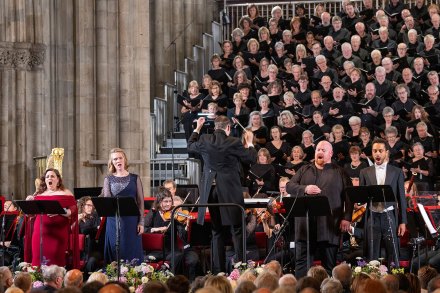
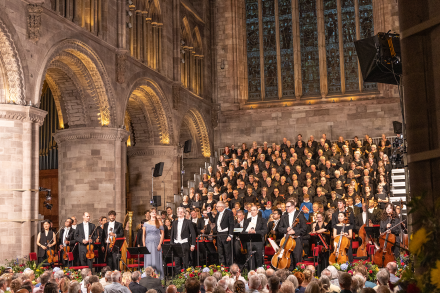
The Proms have started but there is a world elsewhere, and in Worcester Cathedral the 296th Three Choirs Festival set sail with a concert that couldn’t have happened anywhere else. A few years back I caused grave offence when I described the Three Choirs as a ‘home of lost causes’; as if, coming from The Spectator, that could ever be anything but a compliment. In truth, there’s still no classical music festival that provides such a sense of being plugged into a vital and ancient tradition – of being so close, as Elgar put it to ‘the living centre of music in Great Britain’.