Teaching

First, Shoot All the Teachers*

From our UK edition

Our local paper, the Southern Reporter, reports that "2,000 public service workers" took the day off work yesterday. Sorry, withdrew their labour to protest against a monstrous government regiment that should horrify and disgust all sensible people. Soon, you know, armed resistance will be necessary. Fine. But, in these parts at least, it is interesting to see which taxpayer-funded workers struck. The Southern reports that: 1,200 teachers were on strike (78% of all teaching staff). 400 non-teaching staff (45% of all non-classroom staff). 68 of 1,400 people in the social work department did not report for work. 23 of 900 workers in the infrastructure department were out. 28 of 400 staff in "white-collar" jobs in Finance, IT etc withdrew their labour.
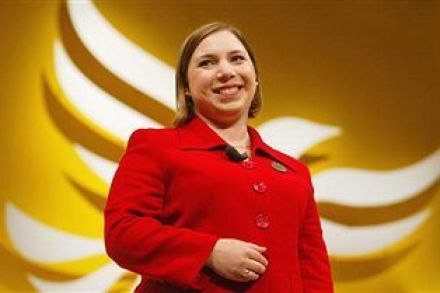
Teather pledges to double the pupil premium

From our UK edition

Assorted acolytes from the teaching unions are padding around the Lib Dem conference, fomenting discontent around activists who are opposed to the coalition’s adoption of academies and free schools. Officials from NASUWT and the NUT have pricked the airwaves with tales of concern and frustration. Education minister Sarah Teather addressed the conference earlier this morning and she was unrepentant. She eviscerated Labour’s record on education and, by extension, the system that has been dominated by the teaching unions. She also pledged to double the pupil premium next year to £1.25 billion, which will allow schools to increase their expenditure on tuition, parental support, after school clubs and so forth.

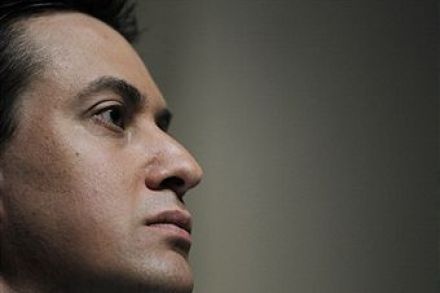
Miliband: We can’t spend our way to a new economy

From our UK edition

David Cameron and IDS have been promoting the Work Programme this afternoon and they reiterated that jobseekers must learn English to claim benefits if their language difficulties are hampering their job applications. It’s another indication of the government’s radical approach to welfare reform. Aside from that, the main event in Westminster today was Ed Miliband’s speech to the TUC. Miliband was widely heckled by the Brothers, especially when he told them: “Let me just tell you about my experience of academies as I’ve got two academies in my own constituency. They have made a big difference to educational standards in my constituency and that is my local experience of that.

Cameron’s well-schooled argument

From our UK edition

When Michael Howard offered David Cameron the pick of the jobs in the shadow Cabinet after the 2005 election, Cameron chose education. Howard was disappointed that Cameron hadn't opted to shadow Gordon Brown but Cameron argued that education was the most important portfolio. A sense of that commitment was on display today in his speech on education, delivered at one of the new free schools that have opened this term. His defence of the coalition’s plans to make it easier to sack bad teachers summed up its refreshing radicalism. He simply said, "If it's a choice between making sure our children get the highest quality teaching or some teachers changing career... I know what I choose.

Beating Labour’s education legacy

From our UK edition

If it is GCSE results day, there must be a row about government education policy. True to form, the NASUWT — a union whose role often appears to be to make the NUT look moderate by comparison — has come out with a comically hyperbolic statement accusing the coalition of a ‘betrayal of young people’ because of its decision to reform the educational maintenance allowance. What the NASUWT statement ignores is that the real betrayal of young people has been pushing them into doing courses and qualifications that condemn them to a life of low-skilled labour at best. Last year, only 16 per cent of pupils achieved a C or above in English, Maths, a foreign language, a science and one of history of geography.

A victory for common sense

From our UK edition

For years, teachers have been increasingly reluctant to restrain unruly pupils — for fear of being slapped with a lawsuit. But now, it seems, the government is trying to ease those concerns. Its guidance today may not change any laws, but it does encourage schools to change their approach. Among the directions is that "schools should not have a 'no touch' policy": teachers can use reasonable force to restrain pupils, remove disruptive children from the classroom or prevent them from leaving the classroom when they shouldn't.

It’s not just pensions, say teachers

From our UK edition

As any CoffeeHouser knows, the Spectator enthusiastically supports Michael Gove’s education reforms. But it’s always important to listen to opposing views – so we stepped outside our offices in Westminster to talk to some of the striking teachers. Some of their points, it must be said, were a little peculiar. “It was wonderful under Balls, a golden age,” said one “we’d like to get back to that.” But others were more realistic in their concerns. For example, they criticised Michael Gove’s inconsistency: the official government policy is that modular exams will remain, but he appeared on television this weekend saying that he intended to remove modular exams by 2012.

Breaking strikes

From our UK edition

Shortly before Michael Gove organised a strike for journalists in Dundee, I crossed a school picket line with my mum, a teacher at my local school (Nairn Academy). She was a member of a teaching union, the PAT, that didn't believe in strikes, so when the school closed the two of us went in. It was a perfectly friendly affair: my teachers (and her colleagues) were at the gate, with no one else around. One of her colleagues handed her a leaflet and we went on inside. We never discussed politics at home, and I still have no idea what my mum thought about Thatcher (it was 1985). But then, she and thousands of teachers like her took the basic view that kids should not be dragged into disputes between adults.

The unions dip their toe into the water

From our UK edition

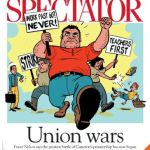
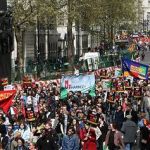
It's strange to think of the biggest, national walkout for years as a prelude to something even larger — but that's how some of the union bosses would have it today. Schools are shutting, civil servants are downing their keyboards, UK Border Agency staff are pausing their vigilant watch over our shores, and all the while the talk is of more to come. Christine Blower, the head of the NUT, tells the Times (£) that today is the "first phase" of a "coordinated campaign". Mark Serwotka — who appeared opposite Francis Maude on the Today Progamme earlier — warned yesterday that these are just the "opening skirmishes," and that, "If you won’t talk to us we will ensure the next national strike has three to four million of us.

Miliband keen to relieve the squeezed middle from Thursday’s strikes

From our UK edition

Ed Miliband is learning. He has written a blog on Thursday’s strikes and it is plain that he has learnt from the errors he made during the March against the Cuts by associating himself with militancy. First, he places himself firmly on the side of parents who will be inconvenienced by Thursday’s strikes: “The Labour Party I lead will always be the party of the parent trying to get their children to school, the mother and father who know the value of a day’s education.” Miliband gives the unions and their members pretty short-shrift to be honest. He writes: “I understand why teachers are so angry with the government.

Strike Thursday nears

From our UK edition

After the failure of today’s meeting between union leaders and Francis Maude and Danny Alexander, Thursday’s strike now seems certain to go ahead. It’ll be the biggest test so far of the coalition’s ability to withstand industrial action. The coalition has constantly emphasised that it has contingency plans in place to deal with strikes. This Thursday will show us how good these plans are. Certainly, the more schools that are kept open, the less powerful the bargaining position of the unions will be. I understand that David Cameron will use his speech to the Local Government Association tomorrow to emphasise that the deal that the government is proposing on public sector pensions is reasonable and fair.

Britain’s future economic challenge

From our UK edition

Wen Jibao’s performance at today’s press conference was typically diplomatic. He declined to say that the UK was going too far in Libya and was emollient on the question of human rights. But his honeyed words can’t obscure the true nature of the Chinese regime. But Wen Jibao’s presence here was also a reminder that the economic competition Britain is going to face in the future is going to come increasingly from the east. If Britain is going to thrive in this world, then it is going to have to produce a huge amount of intellectual property. It is in this context, that Michael Gove’s educational reforms should be seen.

Gove turns on the education establishment

From our UK edition

Michael Gove is tenacious. With strikes set to close one in four schools on Thursday, Gove has launched a direct assault on the left-wing teaching unions. In a consultation published today, Gove has announced that exceptional graduates in maths and science will be paid bursaries of up to £20,000 to undertake teaching training. He also indicates that responsibility for teacher training will shift from universities to schools; teachers will predominantly learn on the job, as they do under the successful Teach First scheme. Also, ministers will attempt to close failing training courses, which they see as the cause of extraordinary levels of wastage.

Gove strikes to ease the removal of bad teachers

From our UK edition

The quality of teaching in schools is one of the main determinants of how well a child does. But, shockingly, in almost half the local authorities in England a teacher hasn’t been sacked for being incompetent in the last five years. Retaining sub-standard teachers has harmed the life chances of goodness knows how many children. So the news that Michael Gove is now consulting on rules that will make it far easier to fire bad teachers is welcome. The Gove proposals give heads much more control and enable them to get rid of a poor teacher in a term; at the moment it takes at least a year and is a bureaucratic minefield which is why so many schools shy away from taking action against those who aren’t up to the job.

The changing face of Andy Burnham

From our UK edition

Here’s a thing. What’s happened to Andy Burnham? The affable scouser's leadership manifesto had an appealing tone: the red background enlivened by a blue streak on law and order, aspiration and tax reform. But Burnham lost the race and since then he has been matching Ed Balls for bellicosity, opposing each of Michael Gove’s education reforms out of an antediluvian tribal loyalty.  In recent weeks, Burnham has attacked cuts to the Educational Maintenance Allowance and the Building Schools for the Future fund. He’s at it again today. He will speak to the NASUWT teaching union later and he is expected to say: ‘This Tory-led Government’s education policy consists of broken promises, incompetence and wrong-headed reforms.

The Brutal Bigotry of Low Expectations

From our UK edition

Bagehot has a properly righteous post lambasting teachers who complain that it's too difficult to teach their charges to read and write and count properly. A week later, a BBC Radio 4 phone-in programme, Any Answers, featured a pair of state school teachers, both with 30 years of experience, again pouring scorn on the dangerously “academic” bent of the English baccalaureate, and Mr Gove’s related desire to see a more rigorous syllabus in history, involving such things as learning a framework of important dates and events to give children a sense of the essential chronology of British and world history. Such history is never going to be relevant to many pupils, one of the teachers said. What do you mean by relevant, asked the radio presenter.

Time for a history lesson

From our UK edition

"Now, with the best teaching force and the best school leadership ever, we are poised to become world class if we have the courage and vision to reform and invest further and put the parent and pupil at the centre of the system. Our reforms must build on the freedoms that schools have increasingly received, but extend them radically. We must put parents in the driving seat for change in all-ability schools that retain the comprehensive principle of non-selection, but operate very differently from the traditional comprehensive. And to underpin this change, the local authority must move from being a provider of education to being its local commissioner and the champion of parent choice.

Gove starts the revolution

From our UK edition

The Spectator has been a long-term fan of Michael Gove – indeed, we named him the single best reason to vote Tory at the last election. His ‘free school’ reforms are laudable and the emphasis on improving standards is imperative. Under the previous government, Britain slid down the international rankings of educational attainment. A tide of politically correct initiatives robbed teachers of their classrooms and discipline suffered. The post code lottery under which state education operates sentences the poorest and most vulnerable in society to rot in under-funded sink schools. Reform is both a moral crusade and a necessity if Britain is to continuing punching above its weight in the future.

Gove the bully?

From our UK edition

There has been a telling development in the resistance against ‘free schools’ this morning. The Evening Standard reports that Brian Lloyd, the headmaster of a school in Bromley, claims he is being ‘bullied’ by Michael Gove into adopting academy status. In a matter of weeks then, Gove has morphed from ‘miserable pipsqueak’ into Judd Nelson in The Breakfast Club – an odd transformation even in caricature. But depicting Gove’s schools revolution as the agent of draconian central government is a cunning ploy by local education establishments.   However, test Lloyd’s case and the real picture emerges.