Schools

Clegg sweetens the pill with a fairness premium

From our UK edition

Only five days to go until the spending review – and after weeks of emphasis on the cuts we're about to see, the government has today unveiled a new spending commitment. It comes courtesy of Nick Clegg: a new "fairness premium" targeted at the least well-off young people. Lib Dem Voice has full details here, but the basic point is that £7 billion will be spent, across 4 years, on programmes for disadvantaged 2 to 20 year-olds. Much of this will go towards the "pupil premium" that we've heard so much about, and which should advance school choice in the most deprived areas. Putting aside his genuine commitment to it, Clegg is facing two ways with this announcement: the public and his own party.

Returning to the fray

From our UK edition

I am travelling to Conservative Party conference in Birmingham today and thought this would be a good time to return to this blog. Thanks to everyone for your thoughtful comments in my absence. As ever, I will try to respond where I can. I should be up to full speed during the week. Meanwhile, I thought I would lay out the five themes I will be addressing over the coming weeks. So do feel free to  provide me with ideas. I'm sure you will. 1. Ed Miliband may not be the answer, but he is a pretty good question for Labour. The new Labour leader is neither their equivalent of William Hague nor Iain Duncan Smith. The party needs a period of reflection in opposition to work through a thoughtful response to the Coalition government. Will he provide the necessary leadership?

Cameron, more ideological than he appears

From our UK edition

The Tory conference in Birmingham is the last big political event before the cuts come. After the 20th, every time a senior Tory appears in public for the next few years they will be about why this or that is being cut. As the row over defence shows, these questions will come from right across the spectrum. For this reason, Simon Schama’s interview with Cameron in today’s FT is probably one of the last that will start with the assumption that Cameron is genial, non-ideological fellow. Once the cuts are happening, it will be harder to cast Cameron as a consensual figure. His edges will appear harder, more defined.  But when Schama asks Cameron what he wants his legacy to be we get a reminder of how non-ideological Cameron is.

Another obstacle in the way of free schools

From our UK edition

A few weeks ago, I wrote a cover story about how teachers' unions are trying to strangle the Gove schools agenda at birth. But I fear it is facing an even greater, more immediate threat: basic bungling by government departments. The FT today says that the Department of Transport wants to make sure that local authorities keep the right to veto a new school. Armed with such a weapon, it is a sure way of crushing any competition. The DoT's argument is staggeringly banal: that a new school may play havoc with the traffic. If you're a local authority, wanting to use any means possible to stop a new school competing with the ones you run, it's all the excuse you need.

Live-blogging from the fringe: “Whose schools are they anyway?”

From our UK edition

So where will the tension be at the Lib Dem conference? Easy: the free schools agenda. Clegg backs it, and when David Laws took over the agenda he backed Gove's market-based reform. But the teaching unions are in a fight to the death against it. The Gove agenda would put power in the hands of parents, whereas it currently rests with unions and local authorities. The latter two have beaten everyone who has spoken about reform, from Callaghan to Thatcher to Blair. But Gove represents an existential threat. Luckily he is in coalition with the Lib Dem MPs, with whom both unions and local authorities have massive influence. The NUT and NASUWT have huge stalls here, and plenty staff to canvass Lib Dem members.

How I learned to stop worrying and rate Nick Clegg

From our UK edition

If Nick Clegg was a weak-willed, crowd-pleasing charlatan the the front page of yesterday's Independent would not have read “Clegg: there is no future for the Lib Dems as a left party”. Turning up to a Lib Dem conference and saying there's no point in being a party of lefty protesters is like William Shatner telling delegates at a Star Trek convention to "get a life". He wants them to be a mature party of reform – many of them prefer to throw stones. His stance at conference is certainly courageous. And it fits a theme. For weeks now, Clegg has been surprising those (myself included) who did not take him seriously, by emerging as one of the boldest and most articulate advocates of reform.

Today’s GCSE results prove that academies work

From our UK edition

Today's GCSE results demonstrate the tremendous success of City Academies, a hugely heartening trend given that this formula - which was so slowly rolled out under the Labour legislation which introduced them - can now be rapidly implemented under the new Academies Act. It's always been a con to look at the absolute results of Academies, as under Labour the only schools given such status were schools that were doing poorly. What matters is improvement. Let's take the three Academies groups and look at the ratio of  pupils winning five good GCSEs (i.e. A-C including English and Maths). In the The Harris Federation, which now runs nine schools, there was a 10 point increase. In the ARK academies, a 13 point increase. In the ULT Academies, an 8 point increase.

The return of traditional subjects

From our UK edition

Today’s A-level results once again see the pass rate continuing to rise, in this instance for the 28th year in a row, with 97.6% of entries gaining an E or above, up from 97.5% in 2009. While not wishing to detract from the efforts of students and teachers, unfortunately such a rise has become all too expected, to the point where there would almost have to be a public inquiry if it were not to happen. Nor should the introduction of the A* at A-Level warrant particular attention, except perhaps to say that it serves as a symbol of how far we have allowed grade inflation to go.     Crucially, however, this year’s A-Level cohort have distinguished themselves in one particular regard.

What you need to know ahead of the Spending Review

From our UK edition

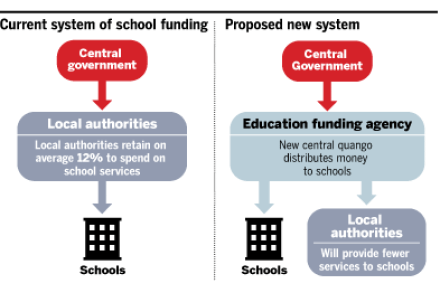
This is the second of our posts with Reform looking ahead to the Spending Review. The first, on health, can be found here. What is the budget? Education is the biggest area of government spending after welfare and health, totalling £89 billion in 2010-11. This budget increased by 64 percent in real terms between 1999-00 and 2010-11. Total, per-pupil school spending doubled in real terms over the same period. Where does the money go? Expenditure on schools was £46 billion last year. The vast bulk of school spending goes on people: the average school spends 78 percent of its budget on staff.

Why Gove’s school reforms could go further

From our UK edition

The latest issue of the magazine is out today and, with it, all of the articles from last week’s edition have been made available online to non-subscribers. Among them is Toby Young’s column which raises some important points about, and criticisms of, Michael Gove’s school reforms. Toby, if you hadn’t heard, is working to set-up a free school himself – so he’s very much operating at the coalface on this, and his thoughts deserve attention. In which case, here’s the entire article for CoffeeHousers’ benefit: It has been described as the most radical overhaul of the school system since the introduction of comprehensives.

Cameron’s refreshing honesty on schools

From our UK edition

David Cameron has today told the News of the World that he is "terrified" about the prospect of sending his children to an inner-London state school. This is quite some statement, given how many tens of thousands of parents are in the same predicament. Isn't it the classic politician's error? To betray how his aloofness from voters by showing how he fears what ordinary parents have to put up with? That's what Tony Blair thought – so he'd pretend to be happy with state schools while sending his kids to the ultra-selective Oratory School. That is hypocrisy. What David Cameron has said represents honesty. After all, why shouldn't he be terrified? As I say in my News of the World column today, the record is appalling.

That’ll learn ‘em

From our UK edition

At last, some will cry, teachers are to be given increased disciplinary powers to moderate unruly children’s behaviour. Rather than tear up the statute book, the measures aim to change perceptions and practices and redress the balance of rights in favour of the teacher. Force can be used to restrain pupils at present, but teachers rarely resort to force for fear of prosecution. The government will lessen what it terms ‘vilification’ by protecting teachers’ anonymity against complaints unless a criminal prosecution is brought. Search and confiscation powers will be extended and summary penalties imposed on transgressors. Currently, schools have to write to parents and give 24 hours notice to detain a pupil.

Gove puts democracy ahead of bureaucracy

From our UK edition

Michael Gove's welcome freeze on Building Schools for the Future will invite tomorrow's press to claim only that this means 715 various building projects are not being carried out. In fact, what it means is that the fund will be open for the Swedish-style new schools. The budget will be transferred from bureaucratic priorities to those of communities, as expressed by those who wish there to be a new school. One of the great tragedies of the politicians' stranglehold over education is that they just love huge, shiny buildings to point at, complete with new whiteboards and all the latest gadgets. The Swedish experiment has shown the parents care not one jot about how grand the building is: their value is placed on the importance of teaching.

The coalition’s spending cuts are forcing Labour into a corner

From our UK edition

It's becoming a familiar drill: another morning in Westminster accompanied by new spending cuts from the government.  Today, it's the schools budget which is being trimmed to the tune of £1.5 billion, with the cancellation of Labour's plan to rebuild some 700 schools.  But there are also reports of cuts to civil service pay-offs, and even of legislation to make it tougher for the unions to protest those cuts.  After yesterday's news, the Treasury is clearly on a roll. Of course, the main political reason for all this early activity is that the coalition hopes to get much of it out of the way while the public is still on side.  But I'm sure it's also designed with an eye on the Labour leadership contest.

The schools revolution is under way

From our UK edition

There's an historic tinge to proceedings this morning, as Michael Gove prepares to release an application form by which parents, charities and other groups can establish free schools.  In effect, this is zero hour for the policy that The Spectator described as "reason enough to vote Conservative” a couple of months ago. The coalition is hoping that the first of the new breed of schools will appear in September next year. Much of it will come down to take-up: how many schools are set up, and when. So it's encouraging that people and organisations are already expressing heavy interest in the government's plans.

School days

From our UK edition

There it is: Winder, one of the most imposing peaks across all the Howgill Fells. Whenever I visit my brother, a teacher at Sedbergh School, we make a habit of climbing it. Up you march, through grass kept short by wild horses and paths kept alive by other walkers, until you round back on yourself and see the entire town of Sedbergh contained within in the valley below. The school. The houses. The shops. The lives and cluttered history that make a community what it is.    Now two current Sedbergh pupils, Ben King and George Head, have done the literary equivalent of climbing up and looking down. In a collection of interviews with Old Sedbergians, they map the peaks and troughs of life at this hardy school.

Gove must guard against the vested interests

From our UK edition

Polly Toynbee was on ‘mute’ on Sky News in my office, the remote wasn’t working, which is frustrating because I’d love to hear how someone mounts a passionate defence of why local government should have monopoly control of state schools. Very few things in politics are indefensible, but a system which doles out sink schools to sink estates is one of them. When Michael Gove was a journalist, he described comprehensive education as the greatest betrayal of the working class. And now, as Education Secretary, he is outlining a system that will give the poor the same choice of schools that the rich have. Who on earth could be against that?

The big week ahead

From our UK edition

After the historic events of the past two weeks, it seems odd to say that the next few days are the most important of the coalition government so far.  But, until the emergency Budget on 22 June, there's little that will hold quite so much significance as tomorrow's announcement on spending cuts and the Queen's Speech on Tuesday. This will be a major chance for the coalition to get more of the public onside for a programme which is set to last years. In which case, it's unsurprising to read that the government will sweeten the medicine of cuts by hastening through some of its most radical, positive policies before summer recess.  School reforms, a Great Repeals Bill, and Parliamentary reform – all are expected to be introduced in double-quick time.

The Tories still need to do more to sell their school reforms

From our UK edition

It is quite telling that David Cameron's first newspaper article since becoming Prime Minister is for the Daily Mail, and even more telling that its central message is, "you still have a Conservative Prime Minister".  There then follows a series of reassurances about Dave's political motivations ("I believe the state is your servant, never your master. I believe in the common sense and decency of the British people") and about the policies contained in the coalition agreement. One line that jumped out at me, though, is this rather inspid description of the Tories' radical school reform agenda: "We're also giving parents, charities and other organisations the opportunity to set up their own new schools." Hardly inspiring, is it?

How the coalition will work

From our UK edition

The full coalition agreement, released this morning, is fascinating enough in itself.  Here we have a step-by-step guide for how two different parties will operate together, what they will do, and, broadly speaking, when they will do it.  And, perhaps to ease the general uncertainty surrounding this type of government, it is considerably clearer than party manifestos tend to be.  One thing you can say, at least, is that this coalition appears keen to make itself more accountable. Skimming through the actual document, there seem to be few surprises, and a good handful of reviews designed to punt difficult policy areas into the long grass.