Russia

Petraeus' lonely fight

At last night’s Policy Exchange lecture, General David Petraeus said he had known the former CDS, Lord Guthrie of Craigiebank, since “he was simply Sir Charles.” I met Petraeus for the first time when he was simply a colonel, serving with NATO forces in Bosnia-Herzegovina. Even then he was thought of as a rising star. His leadership in Iraq, first in Mosul and then in Baghdad has only cemented his reputation. Now, however, the scholar-warrior faces his probably greatest task – helping to defeat Taliban insurgents on both sides of the Durand Line. An effort, he said upon assuming command of CENTCOM in 2008, which might turn out to be
In Praise of Neville Chamberlain

18th March 1940: British prime minister, Neville Chamberlain (1869-1940) walking across the Horse Guard’s Parade, Buckingham Palace on his seventy-first birthday. Photo: Davies/Topical Press Agency/Getty Images. Neville Chamberlain, it is fair to say, does not receive a good press these days. The War Party – on both sides of the Atlantic – sees Munich popping up every six months or so and, for reasons that escape one, presumes that it is always better to fight a war as soon as possible. All of subsequent human history is seen through the lens of Munich. This is a baffling virus but one that is, I fear, ineradicable. To take a pair of

Mr Obama, tear down these missile sites

Today Barack Obama publicly tore down the missile installations that George W Bush put up in the Czech Republic and Poland. The system was ostensibly meant to counter threats from Iran, but given the swift creation of missile sites in Poland and the Czech Republic in the wake of Russian’s invasion of Georgia, Moscow’s elite never bought into this rationale – and perhaps rightly so. The strength of Russian feeling has always been clear. The latest Russian National Security Strategy states that the “ability to maintain global and regional stability is being significantly aggravated by the elements of the global missile defence system of the US”. So if Obama wanted

The great Russian takeaway

That the rise of a powerful coterie of Russian billionaires overlapped with Britain’s transformation into an offshore tax-haven is unlikely to escape the notice of both countries’ future historians. Indeed it is entirely plausible that had successive British governments in the 1990s been less amenable to foreign wealth, this book would have been entitled Genevagrad rather than Londongrad. Mark Hollingsworth and Stewart Lansley raise interesting questions about how the rocketing price of property, contemporary art and even private school fees of early Noughties Britain, fuelled by a steady supply of roubles, contributed to the bubble preceding the bust. While there are several excellent studies of the impact of the oligarchs

A Georgian Folly

I must say I was surprised by Fraser’s praise for Mikheil Saakashvili on Friday and his support for the stance taken by David Cameron and Liam Fox on matters Russian and Georgian. Surprised, because I’d thought Cameron’s dash to Tbilisi last year one of the more reckless moments of his leadership that demonstrated that, like John McCain, his judgement in foreign affairs was too often too open to accusations of rashness.  Apart from anything else, as Carl Thomson ably demonstrates, Saakashvili is a poor poster boy for liberalism, even by the standards of the Caucasus. If Georgia is, in Fraser’s description, “a light of democratic freedom” it’s a light that

More Trouble in the Caucasus

Clumsy. Stupid. Counter-productive. Russian policy in Georgia has moved into a new phase. As I suggested yesterday, the Russians now seem determined to answer a Georgian miscalculation with one of their own. Yes, Russia is projecting “strength” by moving into indisputably Georgian territory, but at what cost? It may be that the Russians don’t give a fig about what the West thinks, but in the longer run it seems that toppling Sakaashvili is an unnecessary over-reaction. Once the Georgians had offered their ceasefire (or been driven out of South Ossetia) a more prudent Russian response might have been to accept this. There’s much to be said for quitting while you’re

Why Georgia matters

When David Cameron flew to Georgia last year, it was perhaps the clearest and most welcome statement of foreign policy made by the party since he became leader. Liam Fox’s piece on conservativehome today pays tribute to this, and gives us a welcome reminder of the stakes. The Russian threat is growing: there are 10,000 troops there and settlements will soon start. The best the West can do is show solidarity, and there is no clearer sign than going there. As Cameron did. Like Israel in the Middle East, Georgia is a light of democratic freedom in an area with plenty of unlit candles. There is something totemic about its

Obama's bear-hug

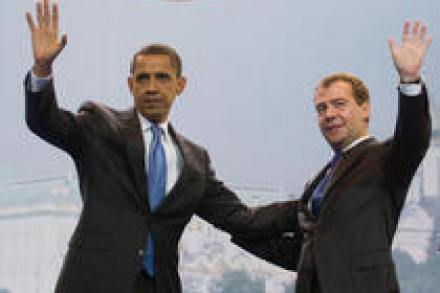
Presidents Obama, and Medvedev (and Prime Minister Putin) seem to be having a good summit. Nuclear talks look like they have gone well, there has been mention of expanding NATO’s transit for its Afghan mission through Russia, and the mood – crucial at any summit – has been reasonably good. Nobody stared into any one else’s soul, but the leaders nonetheless agreed, as Bush and Putin did a few years ago, that the US and Russia can do business. But is a rapprochement between the US and Russia really possible? Dmitri Trenin, of Carnegie Russia, says the West and Russia share many threats. But he also says that anti-Westernism is

Valery Gergiev: Pawn of Putin?

There was an interesting, if occasionally frustrating, profile of Valery Gergiev in last week’s New York Times magazine. Frustrating because the article was headlined “The Loyalist” (the cover line was “An Overture to Russian Nationalism”) that seemed to want to condemn Gergiev for being a) proud of being Russian and b) far too close to the Kremlin. The former charge seems perverse unless, that is, any expression of Russian patriotism is inherently threatening and the latter seems, in some ways, almost inescapable if the Mariinsky Theatre (formerly the Kirov) wants to be able to do business and thrive in Russia. Still, the article opens with a striking scene: Gergiev conducting

Red Star Over Russia

Winston Churchill’s cousin, the sculptor Clare Sheridan, gazes up at her bust of Trotsky, made during a trip to Moscow in 1920. Her subjects were leading Bolsheviks including Felix Dzerzhinsky, the founder of the KGB, Lenin and Trotsky. While she worked, she asked Lenin, via a translator, if Churchill was the most hated man in Russia. ‘He is our greatest enemy because all the forces of capitalism are behind him,’ he replied. Sheridan’s mother wrote to her on her return: ‘I forgive you, darling, as I would even if you had committed a murder,’ but Churchill never spoke to his cousin again. Sheridan left England for New York, where her

A strong line required

Putin and the Rise of Russia, by Michael Stuermer For many years, Professor Michael Stuermer has been one of the West’s most respected authorities both on Russia and on Germany. As at home in English as in his native German, he has pursued not only an academic career, but has brought lustre to the usually grubby trade of journalism as chief correspondent for Die Welt. Few can be as well qualified to write about contemporary Russia, to analyse the extraordinary phenomenon of Putin or to add a late addendum on Putin’s successor, Dmitri Medvedev. The resulting book is authoritative, readable and concise. Stuermer traces Putin’s rapid rise via Sobchak’s mayoral

Bush Saves Saakashvili...

Well, sort of. According to this report from Charles Bremner in the Times: With Russian tanks only 30 miles from Tbilisi on August 12, Mr Sarkozy told Mr Putin that the world would not accept the overthrow of Georgia, Mr Levitte [Sarko’s chief diplomatic advisor] said. “I am going to hang Saakashvili by the balls,” Mr Putin replied. Mr Sarkozy responded: “Hang him?” “Why not? The Americans hanged Saddam Hussein,” said Mr Putin. Mr Sarkozy replied, using the familiar “tu”: “Yes but do you want to end up like (President) Bush?” Mr Putin was briefly lost for words, then said: “Ah, you have scored a point there.” …President Mikhail Saakashvili,

Headline you won't see: "Palin Agrees with Obama"

I guess this is going to get some attention: EXCLUSIVE: GOV. SARAH PALIN WARNS WAR MAY BE NECESSARY IF RUSSIA INVADES ANOTHER COUNTRY Well, yes and no. Here’s what Sarah Palin told ABC News’s Charlie Gibson: GIBSON: And under the NATO treaty, wouldn’t we then have to go to war if Russia went into Georgia? PALIN: Perhaps so. I mean, that is the agreement when you are a NATO ally, is if another country is attacked, you’re going to be expected to be called upon and help. But NATO, I think, should include Ukraine, definitely, at this point and I think that we need to — especially with new leadership

The Lessons of the Past

Bill Keller’s piece on “Springtime for Autocrats” in the New York Times has received plenty of attention (See Yglesias’s sane response for instance) but for Russian and Caucasus commentary I’d recommend Neal Ascherson’s article in the Observer. It’s probably the best-balanced, most historically aware and, for that matter, humane piece I’d read on the whole grisly affair. As he puts it, we’ve been here before in the Caucasus and only the Russians have learnt anything from history. A foolish, counter-productive Georgian policy has failed (again) and the west should think long and hard about when and how it plans to bluff in the future… Ascherson, a veteran Black Sea hand,

Did you know Putin is really (another) Hitler?

How about this for an opening sentence? The details of who did what to precipitate Russia’s war against Georgia are not very important. Who, you ask, is this clown? None other than Robert Kagan, writing today in the Washington Post. His second sentence is also a doozy: Do you recall the precise details of the Sudeten Crisis that led to Nazi Germany’s invasion of Czechoslovakia? And how about this? Historians will come to view Aug. 8, 2008, as a turning point no less significant than Nov. 9, 1989, when the Berlin Wall fell. Russia’s attack on sovereign Georgian territory marked the official return of history, indeed to an almost 19th-century

Trouble in the Caucasus, Day 2

Edward Lucas concludes his op-ed in The Times on the Ossetian dilemma with this: The fighting should be a deafening wake-up call to the West. Our fatal mistake was made at the Nato summit in Bucharest in April, when Georgia’s attempt to get a clear path to membership of the alliance was rebuffed. Mr Saakashvili warned us then that Russia would take advantage of any display of Western weakness or indecision. And it has. Indeed, as I suggested yesterday, Russia has taken advantage of “western weakness” by responding to a Georgian offensive. Given that Saakashvili has been bold enough to send his troops into South Ossetia even though his determination

Trouble in the Caucasus

Far from Beijing, Russia and Georgia kick-off in South Ossetia. I suspect that this is going to prompt people to raise the whole “should Georgia join NATO” thing all over again. Now, perhaps putting Georgia on the road to NATO membership might have cooled tensions in the region. But the opposite seems more likely given Russia’s likely reaction to what it would see as a provocation. And, frankly, it’s a great relief that Germany, among others, stopped the move to make Georgia a member of the alliance,  given the potential for trouble if Russia and a member of the alliance start fighting one another. It’s hard to argue that South

The Importance of Being Stubborn

Charles Crawford, formerly Our Man in Warsaw, Sarajevo and Belgrade, thinks we should have told the Saudis to hop off and let the BAE corruption trial proceed. Not because anti-corruption investigations are good in themselves but because it would have been a demonstration of toughness. In the longer term, then, the national interest would have been better served by exposing the Saudis. But that’s not our style… The Russians too are outstanding negotiators, but in a different sense. They are taught negotiating technique in a way which is quite foreign to British and European methods. Russian diplomats’ First Rule of Negotiating is simple and profound: “Never move position, even when

Sell-By Dates Can Kill Too

Intro of the Day: NIKOLSKOE, Russia (Reuters) – Fourteen members of a Russian doomsday cult on Tuesday abandoned the remote underground bunker where they had been hiding for nearly half a year awaiting the end of the world. So who are these people? Alas, the story doesn’t give many details, offering just this tantalising glimspse of their beliefs: The sect is an ultra-devout splinter group of the Russian Orthodox church. They reject processed food and say bar codes on products are the work of Satan. [Hat-tip: Foreign Policy]