Roman Catholicism

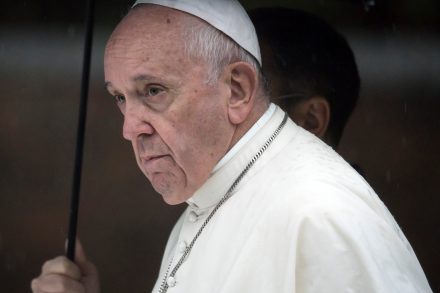
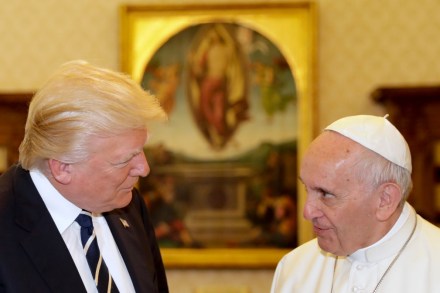
The next pope: are we facing the nightmare of a Parolin pontificate?

Vatican officials are anxious to get their hands on an advance copy of The Next Pope, a survey of 19 leading contenders to succeed Pope Francis scheduled for publication next month. The author, Edward Pentin, discusses these papabile cardinals in today's episode of Holy Smoke. The full list is still under wraps, but inevitably we talk about Cardinal Robert Sarah, the African-born apocalyptic visionary whom liberals most fear. (If you doubt that, read this despicable and semi-literate hatchet job on Sarah by Christopher Lamb in the Tablet.) Equally inevitably, we talk about the charismatic and ambitious Cardinal Luis Antonio Tagle, formerly Archbishop of Manila and now one of Francis's main allies in the Vatican.

pope

Trump needs the Catholic vote

On Twitter yesterday, Donald Trump sent out the political equivalent of a Hail Mary pass. ‘Today we commemorate the 100th Anniversary of the birth of Saint John Paul II,’ tweeted the President. ‘HAPPY BIRTHDAY!’ This was not just Trump being thoughtful about a great spiritual leader. It was an electoral appeal to Catholics on social media and a move that suggests Trump is worried about the Catholic vote. He’s right to be. There are endless debates about the extent to which America’s Catholics decide elections — or, indeed, whether the Catholic vote exists at all, given the diversity of the nation’s sprawling Catholic population.

catholic vote

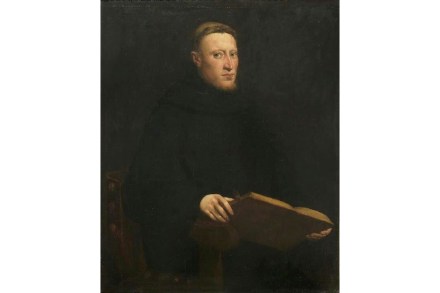
How Onofrio Panvinio made the popes history

Just over 500 years ago, in June 1519, the castle hall of the German city of Leipzig was expecting a throng of spectators. The room had been specially decorated: two pulpits stood dramatically facing each other. Under the eyes of the Duke of Saxony, Martin Luther was challenged to defend some of his writings by which he attacked abuses in the Church. The scene was set for an intellectual battle — a rebellious friar, Luther, taking on the Catholic establishment. Physical threats made the atmosphere all the more tense. Two hundred axe-wielding students accompanied Luther. His opponent, the Catholic theologian Johann Eck, protected himself with 76 armed guards. Their ensuing debate dealt to a large degree with history.

onofrio panvinio

Bill Barr and the ersatz Papal Octopus

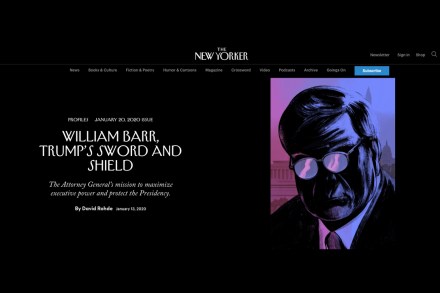
Come on now, The New Yorker. Surely one of Conde Nast’s babies famous for their cartoons should be familiar with the other Nast. Thomas Nast was the father of American cartoon and the progenitor of the conspiratorial renditions of the feared papal insurrection. Nast’s nastiest cartoons were a passionate projection of his virulent anti-Catholic beliefs, hardly unusual in the 19th century among Protestants and ethnocentric nativists, until John F. Kennedy’s era ushered in an amnesia. The American River Ganges, Nast’s 1871 caricature of Catholic bishops as reptiles ominously wading and slithering to the New York shoreline, salivating with ravenous appetites to devour the Protestant schoolteacher and children, was published in Harper’s Weekly not once, but twice!

bill barr new yorker

The Democratic party’s post-Christian America

The new Pew report doesn’t mince words in its headline: 'In US, Decline of Christianity Continues at Rapid Pace.' In 10 years, the percentage of Americans who identify as Christians of any kind has declined by 12 percent. In 2009, just over 50 percent of Americans identified as Protestant; today only 43 percent do. Catholics have declined from 23 percent to 20 percent of the adult population. The biggest declines in Christian identification by demographic group have been among millennials (down 17 points) and Democrats (down 16 points). But dwindling Christian commitments are in evidence across all categories: 'white people, black people and Hispanics; men and women; in all regions of the country; and among college graduates and those with lower levels of educational attainment.

christian

Notre-Dame is a sign of the times

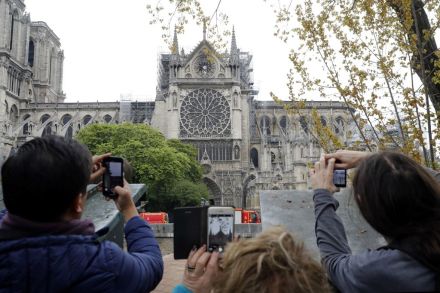
Notre-Dame is the symbolic heart of Paris and France, and a symbol of European Christianity second only to the Vatican in Rome. The apocalyptic destruction of a monument of such beauty and significance would be a sign of the times at any time. In our time, however, no one seems sure of what the sign means. I doubt I was alone in my first response. When I saw footage of the falling, burning spire, I assumed that this was an act of terrorism rather than, as seems most likely, an accident caused by renovation work. This is a sign of the times, even though it would be incautious to admit it in polite society.

notre-dame sign

The comfortable demise of Theodore McCarrick

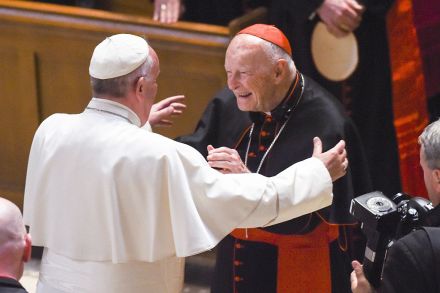
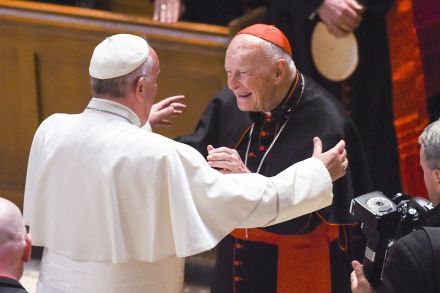
Mr Theodore McCarrick will spend his last days within the limestone walls of St Fidelis Friary in Victoria, Kansas. He’ll be able to see the stunning St Fidelis Church, ‘the Basilica of the Plains’, from his window. His quarters in the monastery will be simple, clean, and pleasant. He’ll have all the time in the world to pray, read, write, think, or just putter, as old men like to do. His meals, laundry, heating, and other necessities will be taken care of for him. There will always be a tender Franciscan nearby if he needs to talk, or cry, or play checkers. He’ll die surrounded by holy men praying for the repose of his soul.

mccarrick pope francis

American Catholicism is going back to the future

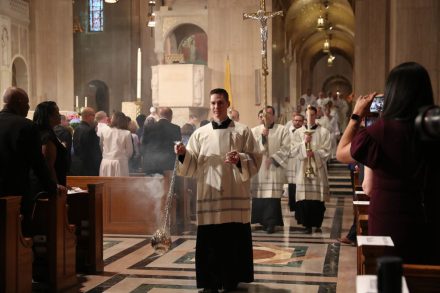
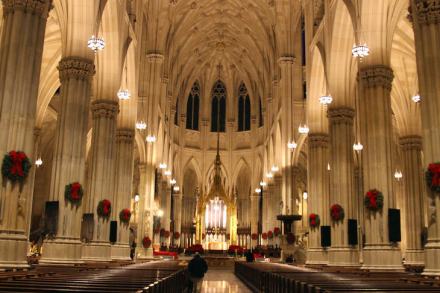
A couple of years ago, in high summer, my wife and I attended Mass in St Patrick’s Cathedral, as we do every time we visit New York. It is, in general, a bracing experience for Catholics who have been paddling in the tepid pools of Irish Catholicism. The celebrant, a middle-aged man with the physique and personality of a matinee idol, gave a startling sermon about the gospel of the day, Matthew 10:34, in which Jesus declares, ‘I have come to bring not peace but a sword.’ In his homily, the priest tore into sentimental notions of Christianity and the corruptions of concepts such as compassion and mercy.

catholicism