Recession

Failing to address the banking crisis is hampering recovery

From our UK edition

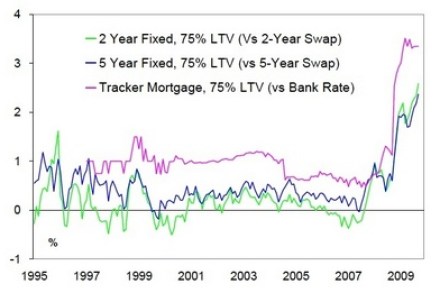
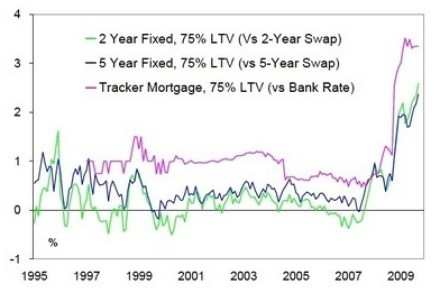
As another £30 billion of taxpayers’ money is handed over to banks, the role of banking sector in the continuing UK recession cannot be understated. 1990s Japan taught the world that developed economies with zombie banking systems don’t grow.  Crippled by bad debts, lending margins on solvent borrowers increase, credit availability declines and ongoing bailouts are needed. This hampers growth in the rest of the economy. The more indebted the private sector, the greater the damage a bust banking system inflicts. The above chart shows how margins on UK mortgages – the gap between borrowing from the Bank of England and what is then leant to mortgage holders – have soared since September last year.

Next step for banks provides further vindication of Osborne

From our UK edition

Alistair Darling has unveiled the initial phase of his plan to get the majority state owned banks back into private ownership. RBS and Lloyds will dispose of more than 918 retail branches across the country over the next four years and will receive up to £40bn of taxpayer funds to strengthen their capital bases. In exchange for this injection, both banks have deferred cash bonuses for 2009. Also, Lloyds will not join the government’s asset protection scheme by securing £13.5bn privately through a rights issue. There is an argument that the government should have gone further and demanded the complete separation of retail and investment arms, followed by additional demergers, and John Redwood makes a clear case as ever.

The Tories now have a monopoly on the language of optimism

From our UK edition

So how big a blow was the news that we're still in recession to Gordon Brown?  Well, compare and contrast his latest podcast on the Downing Street website with David Cameron's article in the Sunday Times.  Brown's effort is necessarily defensive.  Gone is the "we're leading the world" bombast of a few weeks ago, to be replaced with a crude "pledge" to get the economy growing again by 2010: "My pledge to you is to make reform of the financial sector a reality, and to see Britain's economy return to growth by the turn of the year." While Cameron's effort is considerably more agressive, and concentrates on outlining a "pro-growth, pro-enterprise agenda".

So where does this leave Brown?

From our UK edition

Most people expected this morning's official GDP statistics to show that the economy has come out of recession.  But they didn't.  In fact, they had the economy shrinking by 0.4 percent in the third quarter of this year.  So the downturn continues – and it's the longest on record. We've always maintained on Coffee House that coming out of recession won't do much good for Brown.  But, obviously, staying stuck in one has far more dangerous implications for him (not to mention the country).  Obviously, the government won't be able to deploy the green shoots strategy now.  But with other major economies already out of recession, they'll struggle to deploy it in future.  You imagine the Tories will have a field day with this.

Brown’s Northern Ireland settlement is to be commended

From our UK edition

Gordon Brown has just told the House of Commons that he is offering Stormont a financial settlement to increase funds for policing and judicial administration in Northern Ireland. Crucially, future emergency security costs in future will be met by the Treasury, and elements of the complicated settlement will stand until at least 2014.  Northern Ireland has been badly hit by the recession. Power sharing became increasingly fraught as arguments escalated over budget allocations and the timing of judicial devolution. It is not an exaggeration to suggest that the recent escalation of violence might be related to rising unemployment and open political tension.

Tracks through the wasteland

From our UK edition

Sex, and plenty of it. That’s certainly what Bunny Munro — the titular protagonist of Nick Cave’s second novel — wants. And, in a roundabout way, he gets it. In the very first chapter, he’s cheating on his wife with a prostitute; in the second, it’s a hotel waitress; in the third, he’s given to fantasies about Kylie Minogue; in the fourth … well, you get the picture. Throw in the fact that Bunny is a travelling cosmetics salesman in Brighton, and it starts to sound like one of those dreadful Robin Askwith comedies from the 1970s — you know, Confessions of a Window Cleaner. But The Death of Bunny Munro isn’t actually a mindless, priapic romp. Far from it.

Deconstructing David Blanchflower

From our UK edition

What with his new column in the New Statesman and his articles for other outlets, David Blanchflower – a former member of the MPC – really does seem to enjoy laying into the Tories.  Problem is, much of what he says fails to convince – so much so, in fact, that I thought I'd bash out a quick fisk of his Guardian article from last Friday.  Here's the full article with my comments in bold: We are in the midst of the worst recession most people alive have ever experienced, or will probably ever experience. It is already worse than the 1980s and it isn't over yet. The only comparison is to the 1930s (my parents, now in their 80s, can remember how bad it was).

Brown’s double hit

From our UK edition

What is the true price of Gordon Brown’s economic incompetence and inept bank regulation? The soaring national debt is one. And if you own a mortgage, you’ll find that you’re paying another. The gulf between the Bank of England base rate and the average mortgage rate is now at a huge high – as banks rip off their customers, trying to fill the hole in their balance sheets. This is an under-discussed topic. The “action we have taken” (a phrase Brown uses to try to lay claim to the Bank of England’s base rate reduction) would have a far greater effect on the economy if the UK banking system was not (still) so badly broken. The below graph, from Citi, shows spreads (ie, gap between base rate and retail rate) on key UK mortgages from 1995.

Did you know? Gordon Brown’s been talking about strong global regulation for years

From our UK edition

Well, that’s what he claims anyway. Brown’s extended interview on the Today programme was an exercise in deflecting blame (and the Sun coming out for Cameron) – ‘none of this would have happened if people had listened to me because, you see, I saw it all coming’ was his refrain. This exchange with Jim Naughtie was particularly telling: “JN: Let me take you back to ‘markets without morality’, which was in your speech and you’ve repeated it now. When did you decide that bankers were being greedy and excessive in their demands? GB: Well Jim, you know, I’ve always been of the view that we needed a better global financial supervisory system.

The Budget bombshells revealed

From our UK edition

An interesting spat is just breaking out over cuts. The Conservatives have a leak from the working of the Budget showing detailed projections in government revenue to 2013-14 covered by all the main Sundays. This suggests income tax rising from £140bn this year to £191bn in four years' time. The Tories say this is not explained by economic growth and that the gap - £15bn - is equivalent to 3p in the basic rate of income tax. Liam Byrne is pushing back, saying Osborne is trying to "mislead the British people" (as if the government would try to do such a thing) and that the increase was accounted for “the economy returning to growth, no more, no less”.

Why Vince Cable is not too sexy for his party

From our UK edition

For all his celebrity, Vince Cable is not exactly an economic genius - as those who have read his book, The Storm,  will know all to well (Specator review here). But he is seldom tested on this point, as he encounters broadcasters whose line of questioning is normally "tell us, Sage of Twickenham, what is happening." For those who don't regard him as the new Oracle and have wanted  see him put through his paces, Andrew Neil - Cable's former student - gives his old master a grilling on the BBC News Channel. In the interview, Cable gets steadily more irritated (and rumbled) and admits to having flip-flopped. The Cable phenomenon illustrates the gulf between economic and political reporting. As a business hack to went into politics, the contrast has always struck me.

The Good Old Cause

From our UK edition

Paul Waugh’s beaten us to it, but Ed Ball’s New Statesman article is a rallying cry to the left. He writes: ‘As we approach the most important general election for a generation, this is no time for introspection or defeatism. There's never been a moment when Labour's values and experience have been more relevant or necessary.’ And what are those values? Well, they’re not Blairite: ‘In public-service reform, we sometimes sounded as though private-sector solutions were always more efficient; and who can now doubt that, despite the tougher measures we brought in, financial regulation was not tough enough?

In defence of Hank Paulson, by Hank Paulson

From our UK edition

Did Bush or Paulson have a clue what they were doing? It’s an intriguing question. James flagged up the view of Bush’s speechwriter Matt Latimer that Paulson, not Bush, was to blame. But, in this month’s Vanity Fair, Todd.S. Purdum flips the coin. Based on interviews with Paulson, conducted as the bailout unfolded, the article’s a brilliant piece of long-form journalism: describing the chicanery on Capitol Hill as Paulson, Tim Geithner and Ben Bernancke sought desperately for a deal with Democrats Nancy Pelosi and Barney Frank. Paulson was in no doubt that Congressional Republicans were responsible for the foul up.

Cable: no budget should be ring-fenced

From our UK edition

Vince Cable has joined the cuts debate, arguing that the “time for generalities is over” and that “politicians must not shy away from explaining in detail how they will tackle the problem of deficits and debt”. He identified 9 areas for specific savings: public sector pay and pensions, centralised education, family tax credits, defence procurement, quangos, asset sales, ID cards and the NHS super computer. Crucially, he stated that no department should be “ring-fenced”, and proposed cutting fees paid to hospitals and scrapping the strategic health authority, a move backed by Michael Fallon in a Telegraph article last week.

If Britain hasn’t returned to growth by the end of the year, will it still be ‘no time for a novice’?

From our UK edition

Looking at the OECD’s latest economic forecast it seems that the UK—unlike the US and the Euro-Zone--will not return to growth by the end of this year. (Although, one can’t help but wonder if Brown will start heralding zero percent growth in the fourth growth). Indeed, the OECD projects that the UK economy will shrink by 4.7 percent over this year as a whole—although the worst appears to be behind us with the rate of shrinkage slowing since the last quarter of 2008 and the first quarter of this year.   As Kevin Maguire suggests today, Labour’s election strategy is likely to be that Britain is not out of the woods yet and so it is still no time for a novice.

Brown’s misplaced hope

From our UK edition

In his insightful article on Brown and the forthcoming G20 summit, Francis Elliot writes a sentence which should terrify Labour supporters: "[Gordon Brown] has already decided that his only hope of a comeback in the polls lies with the economy." Sure, we all know that Team Brown has been putting a lot of hope in a green shoots strategy.  But, as we've pointed out on Coffee House before, there's little reason to believe that an economic recovery will deliver a significant boost for the Government.  If that's all that the PM has, then his situation is looking more hopeless than ever.

Labour’s new dividing line is a gamble

From our UK edition

Alistair Darling has long suggested that the original dividing line between the Tories and Labour concerned Labour spending, which will stimulate growth, versus Tory inaction. And last week, Darling was quoted in the Mail on Sunday setting out a new dividing line between the parties by framing the “debate in terms of our cuts being better than their cuts”. It is a stance that presupposes Britain is returning to growth thanks to the government’s strategy. And that is the message of an opinion piece, titled ‘The cure is working’, penned by Darling in this morning’s Guardian. Here’s the key section: ‘The Tories have opposed our measures every inch of the way, but I make no apology.

Is Theresa May priming a second Freud Review?

From our UK edition

In some respects, Theresa May has delivered an effective speech on unemployment and the benefits system today.  It touches on all the tragic indicators - the 6 million people on out-of-work benefits, the high levels of youth worklessness, the shocking consequences of welfare ghettoes etc. - and re-states, in no uncertain terms, the Tories' commitment to welfare reform.  She even partially responds to those critics who thought she'd been drafted into the shadow welfare role to be "softer" on single mums than Labour, by instead attacking the state for encouraging lone parents "not to bother trying to work until their youngest child was sixteen".

A very risky strategy

From our UK edition

Labour’s attempt to create a new dividing line on cuts is intriguing because it suggests that the government reckons we are pulling out of recession – a message Alistair Darling has been stressing recently. Central to Labour’s argument is that their initial interventions, opposed by the Tories, preserved public services through the recession. By claiming that now is the time to make extensive cuts, beyond mere efficiency savings, suggests that they think the economy is robust enough to survive sweeping public spending cuts. If an economic boom couldn’t save John Major, I doubt a modest recovery will save Brown from defeat.

Confidence returns

From our UK edition

One of the most significant news stories of the day comes courtesy of the Institute of Chartered Accountants: "Confidence among business professionals has surged, suggesting the recession is at an end, a survey has said. The Institute of Chartered Accountants' index of business confidence rose to 4.8 at the end of June, from -28.2 in March, the biggest rise for two years." Economically speaking, this is encouraging stuff – it's the view from the frontline of the real economy, after all.  And these types of surveys always tend to have a self-fulfilling quality, as more confident companies adopt the measures – spending, hiring etc. – which are likely to drive us out of recession.