Pornography

Sex education now means whatever schools want it to mean

From our UK edition

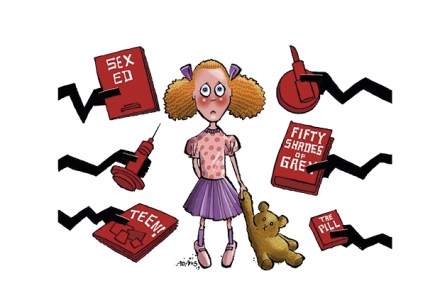
I’ve never shied away from discussing sex with my children and they’ve always been precocious enough to ask probing questions, usually in public. So when the letter came home from school announcing sex education classes for my then ten-year-old, I was relaxed. And when I later asked him, ‘Did you learn anything you didn’t already know?’, I expected a bored ‘no’. In fact, he said, ‘Yes. Oral sex and masturbation.’ Clearly sex education has moved on since I was at school. Schools have traditionally covered reproduction in science lessons and, since the 1960s, sex education as a discrete subject has dealt with contraception, sexually transmitted infections and unwanted pregnancy.

Toys for us

From our UK edition

It’s hard not to love a book that starts with its author fearing a police sting while flogging sex toys at a hen party in Texas. The year is 2004 and Hallie Lieberman is attending grad school in Austin and supporting her studies by working as a home party organiser for Forbidden Fruit, local purveyor of marital aids: ‘Christy is rattling off her order: a jelly vibrator, a cock ring, a bottle of Eros lubricant.’ Just one snag; devices that are intended ‘primarily for stimulation of the human genital organs’ are deemed illegal in the state of Texas. They’re illegal to this day in Louisiana.

If Damian Green lied I don’t blame him

From our UK edition

I first viewed pornography at the age of 12, when a school friend showed me a magazine called, I think, Razzle. The centrefold was a naked lady with what appeared to be a large and potentially ferocious rodent between her legs — a coypu, perhaps, or a capybara. I had never seen anything like that before. ‘Look at that flunge!’ my friend enthused. I had never heard the word before, either — I think it was a kind of portmanteau of ‘clunge’ and ‘flange’, both words with which I was familiar. ‘I bet your gimmer hasn’t got one like that,’ he added, spitefully. Gimmer is rural Teesside slang for a girlfriend — derived, I think, from the Scottish word for a young female sheep.

Diary – 16 November 2017

From our UK edition

Long letter from the High Mistress of St Paul’s Girls’ School, addressing me as ‘Dear Old Paulina’ (I thought we were never ‘Old Paulinas’, merely ‘Paulinas’ till the bitter end, but I will let the solecism pass). It informs me that fellow former pupils have been in touch to report sexual abuse when I was there ‘between the 1970s and the 1990s’. The letter invites #metoo to name and shame teachers — who must be well into their dotage if not dead — while insisting that the numera una assoluta girls’ school in the world is now a sterile, predator-free zone.

Angel and demon

From our UK edition

Read cover to cover, a book of essays gives you the person behind it: their voice, the trend of their thinking, their tastes and the nature of their engagement with the world. So, here are two, one from each end of the human spectrum. Think of Milton’s Archangel Raphael, intellectually wide-ranging, lucid, informative and fair, and you have Francis Spufford. Think of his darkly glittering Satan — vivid, passionate, partisan and fatally persuasive — and you have Martin Amis. Read these books together and you have, in essay terms, a Miltonic whole. These are collections of what might be called ‘pre-loved’ pieces, not originally designed to cohere, so they have been washed and brushed for resale.

Barometer | 20 July 2017

From our UK edition

Smash the orange Amyas Morse, head of the National Audit Office, said the government’s Brexit plans could ‘fall apart like a chocolate orange’. But the point of a chocolate orange is that it doesn’t fall apart easily at all. Launched by Terry’s of York in 1932, many of its TV adverts have emphasised this theme: 1978 ‘Tap it and unwrap it’ — yokel shown tapping it lightly against tree trunk. 1998 ‘Whack and unwrap’ — man shown thumping it against a wall. 2010 ‘Smash it to pieces, love it to bits’ — several people struggle to break the orange, including a secretary with a phone and man who whacks it on a glass coffee table, breaking the table.

Back to basics | 30 March 2017

From our UK edition

Tim Parks is a writer of some very fine books indeed, which makes it even more of a shame that his most recent novel is flat, grim and (like its narrator) interesting only to itself. His main theme is adultery, a subject he explored in his wonderful novel Europa (1997), in the short story collection Talking About It (2005), and in the thoughtful essays of Adultery and Other Diversions (1998). But in recent years he has become the laureate of a certain kind of seedy, middle-aged infidelity, and In Extremis is single-minded to the point of obsession: anorak and dirty mac in one. The problem might be that he is simply too productive. In Extremis is a loose sequel to Thomas And Mary (2016) a novel that explored the breakup of a marriage from a range of narrative perspectives.

According to Luke

From our UK edition

This is an odd one, not least because it claims to be a novel, which it isn’t. Emmanuel Carrère, writer and film-maker, looks back on an earlier self when, as a young man, he had a phase of being a devout Catholic, going to Mass daily, making his confession, the whole caboodle. He decides to marry his girlfriend, who is called Anne. We do not hear much about her. He later marries Hélène Devynck. Like the ‘real’ Carrère, the narrator has a house on the island of Patmos, where much of this book was written — appropriately, since it is a (sort of) commentary on the New Testament.

Low life | 6 October 2016

From our UK edition

The first and only time I went to a meeting of Sex Addicts Anonymous, this chap stood up and gave a blow-by-blow account of his sexual history. He had started life as a heterosexual, he said, and became hopelessly addicted to pornography and prostitutes. Then he decided to give gay sex a try and soon became addicted to encounters with multiple partners in public parks. I forget how many times he said he was having it off every day, but it was heroic. He was out there day and night in all seasons and in all weathers and would go without lunch and dinner. In winter, he said, he was sometimes covered in snow. Then he caught pneumonia, then HIV. HIV became full-blown Aids. Finally, he decided enough was enough.

Love for sale

From our UK edition

The premise of Kat Banyard’s Pimp State is a familiar one: sex work — a phrase the author rejects as pure euphemism — is formalised sexual exploitation, synonymous with sexual abuse and therefore both ‘a cause and a consequence of inequality between men and women’. It follows, then, that if you’re in favour of gender equality, or simply a decent human being who disapproves of sexual violence, you must oppose the sale of any and all variations of sex. If you’re not part of the solution — well, you know the rest. You don’t have to be especially interested in feminism to have heard this before.

Tragedy trumped by porn

From our UK edition

Big fuss about Cleansed at the Dorfman. Talk of nauseous punters rushing for the gangways may have perversely delighted the show’s creators but I’m firmly with the exiteers. This is barely a play and more a thin, vicious pantomime with an Isis-video aesthetic. The minuscule plot follows Grace (Michelle Terry) as she visits a prison hospital to receive news of a tortured relative. She’s immediately roped in as a victim and we’re treated to a sequence of gougings, knifings, electrocutions, rectal penetrations and tongue extractions which are bizarrely interspersed with scenes of lustful romance. Alex Eales’s design stands out.

Porn and video games: more hysteria about ‘rewiring brains’

From our UK edition

Here we go again. What effect do you think watching porn and video games have on young men? Yup, they rewire the brain. It's such a clumsy metaphor – the brain isn't 'wired' in any meaningful sense – that you'd think psychologists and neuroscientists would run a mile from it. Unless, of course they're Baroness Greenfield, who is a fellow of Lincoln College, Oxford. She was director of the Royal Institution until her post was abolished in 2010, 'amid claims that there was almost no other way to get rid of her' (thank you, Wikipedia).

The end of childhood – what we lost when we dropped the age of consent

From our UK edition

[audioplayer src="http://rss.acast.com/viewfrom22/the-death-of-childhood/media.mp3" title="Melanie Philips and Sarah Green discuss the end of childhood" startat=37] Listen [/audioplayer]In all the sound and fury about historic sex crimes against children, one crucial factor has been generally ignored. Last week, a review of the agencies dealing with the phenomenon of ‘grooming gangs’ in England said that more than 370 young girls in Oxfordshire had fallen victim to them over the past 15 years, and called for an urgent national debate into these ‘indescribably awful’ sex crimes.

Page 3 was harmless. Here’s why I’ll miss it

From our UK edition

‘I for one would be sorry to see them go,’ wrote George Orwell. ‘They are a sort of saturnalia, a harmless rebellion against virtue.’ He was writing about the seaside postcards of Donald McGill in 1941, but his defence of them and their ‘enthusiastic indecency’ could equally well apply to Page 3. Orwell’s argument was that McGill’s caricatures of women, ‘with breasts or buttocks grossly over-emphasised’, gave expression to ‘the Sancho Panza view of life’. There’s a fat little squire in all of us, he thought, although few of us are brave enough to admit it. ‘He is the unofficial self, the voice of the belly protesting against the soul,’ he wrote.

The idiot economy – behind the ‘dark web’ cyber-crime busts

From our UK edition

Spectator Money is out, with ideas on how to make it, spend it and even how to be seen spending it. Freddy Gray looks at the 'social economy' - think tax loopholes for financiers of politically favoured endeavours; while Camilla Swift peruses credit cards such as Kanye West's 'African American Express' and the Dubai First Royale, 'studded with diamonds. Bring it on, Sheikh Sugardaddy.' Spare a thought, though, for the inconspicuous consumers - or at least, the wannabes.

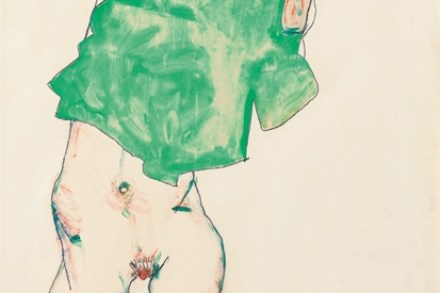
Egon Schiele at the Courtauld: a one-note samba of spindly limbs, nipples and pudenda

From our UK edition

One day, as a student — or so the story goes — Egon Schiele called on Gustav Klimt, a celebrated older artist, and showed him a portfolio of drawings with the abrupt query, ‘Do I have talent?’ Klimt looked at them, then answered, ‘Much too much!’ One gets an inkling of what Klimt was getting at from the feverishly intense work on show in Egon Schiele: The Radical Nude. From childhood, Schiele drew with manic fluency. His father, a syphilitic stationmaster, was irritated to discover that a sketchbook, a gift to the boy intended to last for months, had been filled in less than a day.

If Brooks Newmark didn’t want these photos leaked, why did he email them?

From our UK edition

So it now seems pretty clear to me that we can no longer send women photographs of our genitals without worrying that we might be the subject of some horrible sting operation and consequently suffer public humiliation and possibly lose our jobs. One by one, the harmless little pleasures in life are being withdrawn from us. It is even being said that we would be wise not to photograph our own genitals at all, let alone send the snaps to anyone, because a third party might somehow acquire them and cause us mischief. If this is true, I am not sure how I am going to pass the long winter evenings ahead, when we become enveloped in darkness. Read a book, I suppose. But that is hardly the same sort of thrill, even if the book is by Will Hutton.

A flashlight into the cellar of the lawless ‘dark net’

From our UK edition

This year marks the 25th anniversary of the world wide web, and I wonder whether its inventor, Tim Berners-Lee, would still have given it away had he known where it would be now. Had he foreseen Google and Facebook and Twitter, the conquest of web porn and the normalisation among teen-agers of misogyny and sodomy, the endless harvesting and mining of data, the surveillance, the cruelty and vulgarity and invasive crassness, the commercialisation of everything — would he still have said, ‘Have it for free, in the common good’? That’s a question that only he can answer. But the great fascination of the web lies in the near-asymptotic rate at which it has grown, not only in scope but in its domination of our lives.

No, I haven’t seen that beheading video. And it’s not right to share it

From our UK edition

I am sure we’re all in agreement that watching videos of adults abusing children is wrong. At least outside the halls of BBC light entertainment (historically speaking) such a consensus must exist. So how has it become not just right, but seemingly virtuous, to watch and then promote pictures of big bearded men chopping off children’s heads? The proliferation of torture and beheading porn is one of the social media horrors of our day. Every minute millions of people around the world send links to videos and photographs. And as world news gets darker, even if you don’t seek them out, such images find their way to you. Of course the boastful sadists of Isis and similar groups ‘produce’ most of this content.

Porn-agains: meet the middle-aged men – and women – warped by internet porn

From our UK edition

I met a nice, middle-aged, middle-class mother at a dinner party who told me  that she was very worried about the effects of internet porn on adolescent males. What, she wondered, was all this internet porn doing to the young? Did we really want a generation of teenage boys whose idea of emotional intimacy was anal sex? Weeks later we ended up in bed and it left me wondering: what is all that internet porn doing to nice, middle-aged mums you meet at dinner parties? Do we really want a generation of forty/fifty-something women whose idea of emotional intimacy is anal sex? Society’s anxiety about internet porn has been so focused on how it affects the young that its impact on the older generation has gone largely unnoticed.