Pope

The Spectator at war: The death of Pope Pius X

From our UK edition

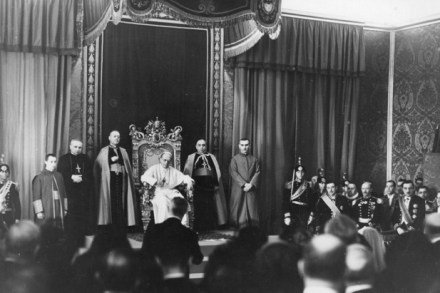
From The Spectator, 22 August 1914: Pope Pius X. died at twenty minutes past one on Thursday morning. In a moment of lucidity, just before his death, his Holiness is reported to have said: "Now I begin to think the end is approaching. The Almighty in His in- exhaustible goodness wishes to spare me the horrors which Europe is undergoing." It is stated that since the outbreak of the war the Pope showed very deep feeling, and again and again repeated "Poor children !"—alluding to the soldiers killed in action. The Pope was a man of great personal charm of character as well as of great goodness of heart, but no one but a flatterer could suggest that he had the intellectual qualities requisite for his great office.
Portrait of the week | 14 August 2014

From our UK edition

Home David Cameron, the Prime Minister, resisted calls for Parliament to be recalled to debate the crisis in Iraq. Philip Hammond, the Foreign Secretary, said that the government was not considering military intervention ‘at the present time’. Mark Simmonds resigned as a Foreign Office minister, but Downing Street hastened to say that his resignation, unlike Lady Warsi’s a week earlier, had nothing to do with government policy on Gaza, since he was complaining he could not afford to rent a flat in London for his family with the £27,000 allowance. A man sought by police investigating the theft of a fish tank from a furniture shop in Leeds hid in a bush and was attacked by a swarm of wasps. Unemployment fell 132,000 to 2.

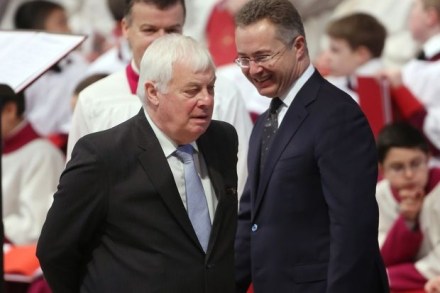
Chris Patten keeps failing upwards – now he’s advising the Pope. Poor Pope.

From our UK edition

There is a wearying inevitability to the announcement that Pope Francis’s reforms of the Vatican media will be overseen by Lord Patten of Barnes. Of course it was going to be him. It always is. The man defies the laws of political gravity. As Margaret Thatcher’s environment secretary he was responsible for the poll tax. He walked away from the disaster unscathed, explaining that it was nothing to do with him, guv, it was Thatch. As Tory chairman he presided over Major’s 1992 victory but lost his own seat. He was made governor of Hong Kong, where he stood up to China.

Portrait of the week | 29 May 2014

From our UK edition

Home David Cameron, the Prime Minister, responded to the triumph of the UK Independence Party in the European elections (which left the Conservatives in third place for the first time ever in a national poll) by having dinner with other European leaders in Brussels, which he said had ‘got too big, too bossy, too interfering’. Ukip secured 4,352,051 votes, increasing the number of its seats by 11 to 24; Labour took 20, an increase of seven; the Conservatives 19, a reduction of seven. The Liberal Democrats plummeted, narrowly capturing one seat (down from 11). Even the Greens did better, increasing their seats from two to three.

Sorry — but Pope Francis is no liberal

From our UK edition

[audioplayer src='http://traffic.libsyn.com/spectator/TheViewFrom22_9_January_2014_v4.mp3' title='Luke Coppen and Freddy Gray discuss Pope Francis'] Listen [/audioplayer]On the last day of 2013, one of the weirdest religious stories for ages appeared on the news wires. The Vatican had officially denied that Pope Francis intended to abolish sin. It sounded like a spoof, but wasn’t. Who had goaded the Vatican into commenting on something so improbable? It turned out to be one of Italy’s most distinguished journalists: Eugenio Scalfari, co-founder of the left-wing newspaper La Repubblica, who had published an article entitled ‘Francis’s Revolution: he has abolished sin’.

Why Time’s Person of the Year should be Pope … Benedict

From our UK edition

It seems that everyone agrees Pope Francis should be Time's 'Person of the Year 2013'. Better him than Miley Cyrus, at any rate, or Bashar al-Assad, and Francis deserves it, too. This year he has -- forgive the media-speak -- changed the narrative about Christianity in the liberal world. He's spreading the Good News, not just reacting to the bad. But Catholics have mixed feelings about all this acclaim for their new Pope. Peggy Noonan put her finger on the key point in the Wall Street Journal yesterday, when she suggested that Time would choose Francis because he is different 'in ways Time's editors and reporters find congenial'.

Theatre review: Fleabag’s scandalous success

From our UK edition

Suddenly they’re all at it. Actors, that is, writing plays. David Haig, Rory Kinnear and Simon Paisley Day are all poised to offer new dramas to the public. But someone else has got there first. You may have spotted Phoebe Waller-Bridge playing a secretarial cameo in The Iron Lady. She’s a rangy Home Countries brunette with rosy lips, large inviting eyes and an angular, forthright face that suggests intelligence, amusement and a hint of subversive sexual power. Her immaculate skin is as white as a snowdrop. All in all, she’s perfectly set up for a steady career in frocks and pearls playing Downton gold-diggers and hyperventilating Jane Austen virgins. But she seems to want more, something wilder, something weirder, from her profession.

Portrait of the week | 5 September 2013

From our UK edition

Home Having recalled Parliament to debate British military action over Syria, David Cameron, the Prime Minister, found the government defeated, much to his surprise, by 285-272, thanks to 30 Conservatives and nine Liberal Democrats voting with the opposition. He immediately told the Commons: ‘It is clear to me that the British Parliament, reflecting the views of the British people, does not want to see British military action. I get that and the government will act accordingly.’ Next day, Lord Ashdown, the former leader of the Lib Dems, tweeted: ‘In 50 years trying to serve my country I have never felt so depressed/ashamed.

Letters: How IQ is handed down

From our UK edition

IQ and social mobility Sir: It seems not to have occurred to our leaders that ability is not evenly distributed across the social classes. In a meritocratic society, employers will try to recruit the most able candidates into the top positions. There, they meet other bright people, pair off and have children. As Professor Plomin’s work clearly demonstrates (‘The Truth about Intelligence’, 27 July), these children inherit much of their intelligence from their parents, so like them, they succeed in the education system and end up getting top jobs. Middle-class kids therefore tend to outperform working-class kids, not because they are unfairly privileged, but because they are likely to be brighter.

Steerpike | 21 March 2013

From our UK edition

Westminster’s top amateur prize-fighter, Eric Joyce, may face assault charges after his latest unscheduled bout in the House of Commons. The Falkirk MP had to be restrained last week after an alleged unseemly set-to at the Sports and Social Club. Ex-soldier Joyce first revealed his flair for pugilism in February 2012 when he ‘went berserk’ in the Strangers’ Bar after declaring it ‘full of fucking Tories’. ‘He won’t have that problem in the nick,’ says a Conservative friend. ‘It’s full of Lib Dems.’   Panic in Whitehall! Jeremy Hunt’s decision to dump health officials in hospital wards in order to give them ‘first-hand experience’ on the front-line has caused alarm among civil servants.

Satan is back

From our UK edition

It used to be said by Catholic priests back in the 1950s that the Devil was delighted when human beings decided that he did not exist. In those days it seemed unlikely that he would disappear altogether from human consciousness because he was so well known — as Baal or Beelzebub in the Old Testament, the Prince of Lies in the New, as Lucifer in the King James Bible, as Satan in Milton’s Paradise Lost, and as Mephistopheles in the legend of Faust; but it has turned out that a subtle move from scripture into myth, folklore and finally literature has been an effective way of becoming unreal. Today we hear his name more frequently in lectures on English literature than in seminars on theology.

At last! A tango-dancing pope

From our UK edition

Just a year ago on this page I was writing about Pope Benedict XVI’s elder brother Georg and how, while ostensibly discreet and loyal to his celebrated sibling, he contrived at the same time to make him look too old and bumbling for the leadership of the Roman Catholic Church. In a book, My Brother, the Pope, this old priest from Bavaria said that his younger brother had never wanted the job, was too physically frail for it, and found it a tremendous strain. Georg Ratzinger must now be feeling somewhat vindicated, but at the time he was ‘off message’, for the Vatican was insistent that the pope was on excellent form. People in high office whose authority demands dignity are often embarrassed by their siblings, as several American presidents have found.

Papal Conclave: would a result today mean Angelo Scola is Pope?

From our UK edition

White smoke from the Vatican this afternoon may signal that the new Pope is Cardinal Angelo Scola. But the longer the papal conclave goes on, the more likely it becomes that St Peter’s next successor will be a global figure – which probably means either a North or Latin American, rather than an African or Asian. That, at least, is the prevailing consensus of the Vaticanisti this morning. And it makes sense. Scola, probably the least talked about of the heavy favourites, is the obvious choice to follow Pope Benedict: a theologian of similarly high standing (though his writings are less accessible to lay readers), he has grown in stature in the last few years, and is widely respected among – and familiar to – the Church hierarchy. He is Italian.

Breaking: Cardinal Jorge Bergoglio is the new Pope

From our UK edition

Oh, my God. It's Cardinal Jorge Bergoglio, who everybody thought was past it. It's commonly thought that he came second last time and was the popular liberal choice, only to be thwarted by Ratzinger. Is this a reaction against the papacy of Benedict? What with him being from Argentina, the mainstream media will be quick to hope that he is a progressive. The BBC is already doing it: they will ask if he will be able to 'move forward' the key issues for them: gay rights, condoms, women priests etc. Of course that isn't what he and the Cardinals who voted for him are thinking about. But there is a vital challenge: can Bergoglio overhaul the scandal-prone Curia and revive Catholicism in the face of an increasingly secular and hostile world?

Will be the next Pope will be an Angelo?

From our UK edition

Some wag has gone around Rome putting up spoof 'Vota Turkson' posters. This is a reference to the Ghanian Cardinal Peter Turkson, who has been much-tipped to be the first black Pope. Turkson has a lot of support, it seems, and not all of it sardonic. Many Catholics say now is the time for an African Pope. And there's a sense that it might take someone from the developing world to knock the Roman Curia -- widely thought to be an arcane and corrupt body - into shape. But as I've written in this week's magazine, a number of Vatican insiders think that, far from being an outsider, the next Pope must be an Italian. Only an Italian, it's said, can understand and fix the complex problems within the Curia.

Long life | 28 February 2013

From our UK edition

Eight years ago I was in Rome for The Spectator to write a piece about the election of a new pope after the death of John-Paul II. Within two days, and after only four ballots, some wispy white smoke emerged from the little chimney on the roof of the Sistine chapel. The College of Cardinals had made its decision and chosen the German Cardinal Joseph Ratzinger to be the 265th occupant of the throne of St Peter. He was already 78 years old and said to be longing for speedy retirement from his taxing job as Prefect of the Congregation for the Doctrine of the Faith, the oldest of the great Vatican departments (once popularly known as the Holy Office or the Inquisition).

Sex, lies and the next Pope

From our UK edition

In a corner of the Sistine Chapel, below Michelangelo’s hell, is a door to the little chamber they call ‘the room of tears’. Some painter-decorators are in there, frantically doing the place up. That’s because, in a matter of days, a new Pope will be led into the room. According to tradition, at that moment, as he first contemplates the magnitude of his role, he will weep. A myth, you might think. But we can be sure that the next Supreme Pontiff — whoever he is — will have plenty to sob about. Since Benedict XVI’s resignation two weeks ago, each day seems to have brought yet more bad news. Scandal is swarming around the upcoming papal conclave like a Biblical plague.

Sins of the fathers | 26 March 2011

From our UK edition

The trouble about writing a history of the popes is that there are so many of them. Usually elderly when elected, most of them have only lasted a few years. The longest reign was that of the mid-19th-century pope, Pius IX, Pio Nono, who clung on for 31 years. In our own times, Pius XII did 19 years, Paul VI 15 and John Paul II 18. But all were unusual. Closer to the average was poor John Paul I, who lasted 34 days. As a result there have been 264 popes. About some we know nothing and one or two may have been fictitious. ‘Pope Joan’ certainly was. So taking on the task of a comprehensive survey requires courage. Lord Norwich is a battle-hardened veteran of many popular histories. The Hon.

Where Warsi is right and wrong

From our UK edition

As ever, the headlines are more sensational than the speech, but marginally so in this case. Baroness Warsi has asserted that Islamophobia is rife and socially acceptable in Britain. It is a peculiarly crass statement for an ordinary politician to have made, but, then again, the gabbing Baroness is a very ordinary politician. Some of her speech is sensible, even unanswerable. She attacks the media and the arts for ‘the patronising, superficial way faith is discussed in certain quarters.’ Questioning faith is the natural and welcome adjunct of a free society, but specific criticism is morphing into general hostility.

I’d rather hear about condoms from the Pope than from the Spice Girls

From our UK edition

My problem with condoms was always a very different confusion from that which apparently afflicts the Pope. It was simply that I felt sure they would be far too large, like putting a tea cosy on a soft-boiled egg. And so I never used them, to spare the embarrassment. Also, I was never entirely certain they quite fitted in with my romantic illusions about the sexual act, especially not the prophylactics you can buy from vending machines in pub toilets and are advertised as being ‘cheese ’n’ pineapple flavour’ — not really Keats, is it? I know plenty of men who feel likewise, too, and are apt to use any number of excuses when, so to speak, push comes to shove.