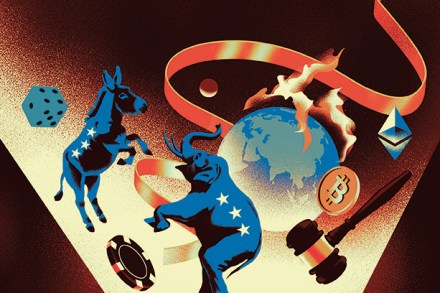
Is the government deliberately disrupting the prediction markets?
Earlier this summer, I sat barefoot in Berkeley with a dozen aspiring “geopolitical traders,” learning how to make money from war. We were at a conference billed as a “festival for predictions, and markets thereof” – that is, a celebration of prediction markets. The venue, a hippie-ish compound, mostly forbade shoes indoors. Our instructor, Mike, claimed to have grown his money eightfold on Polymarket, mostly by trading on politics. Now he would share his wisdom. Prediction markets were legalized in the United States in 2020 on the premise that they would “allow us, more often than not, to predict the future.” That, at least, is what Kalshi’s marketing copy claims.