Police

Commissioner Boris

From our UK edition

The Evening Standard reports that Boris Johnson is set to become the Tories’ first elected police commissioner. Chris Grayling told the paper: "We envisage the Mayor of London being the elected police commissioner. This would strengthen the role of the Mayor. However, I'm absolutely clear that no reform we introduce will allow any elected politician to interfere in operational policing and we will make absolutely certain that the independence of operational policing is protected in law." Under Tory proposals the mayor will be responsible for hiring and firing chief constables, tailoring police objectives to local requirements and budgeting. Naturally, the contrarians are gathering.

A debased database

From our UK edition

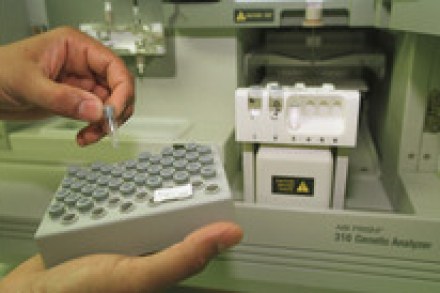
As with much police work, the questions surrounding a DNA database come down to one thing: striking a balance between civil protection and civil liberties.  Going off a new report by the Human Genetics Commission, reported on the cover of today's Times, the government are getting that balance seriously wrong: "Jonathan Montgomery, commission chairman, said that 'function creep' over the years had transformed a database of offenders into one of suspects. Almost one million innocent people are now on the DNA database... ...Professor Montgomery said there was some evidence that people were arrested to retain the DNA information even though they might not have been arrested in other circumstance.

New Police Mission: DNA-Farming

From our UK edition

Can this really be true? Apparently and alas unsuprisingly the answer seems to be yes: Police are routinely arresting people simply to record their DNA profiles on the national database, according to a report published today... The revelations will fuel the debate about the DNA database, the world’s largest. They are included in a report by the Human Genetics Commission, an independent government advisory body. It criticises the piecemeal development of the database and questions how effective it is in helping the police to investigate and solve crimes. [...]Professor Montgomery said there was some evidence that people were arrested to retain the DNA information even though they might not have been arrested in other circumstance.

Dodgy expenses referred to the CPS

From our UK edition

And so the expenses scandal rumbles on.  This morning's Telegraph lead with home-flipping allegations against Andrew Dismore, a member of the Commons Committee on Standards and Privileges.  And now it's emerged that the Met have referred the cases of four parliamentarians to the Crown Prosecution Service.  All of which makes Brown's decision not to mention expenses in the Queen's Speech seem even more unwise.

Elected police commissioners are a test of whether the Tories are serious or not about their agenda

From our UK edition

Sir Hugh Orde, the head of the Association of Chief Police officers, has issued another broadside against Tory plans for locally elected police commissioner. Orde has warned that senior police officers will resign over the plans and that, “Even the perception that the police service of this country… is under any political influence, I think that suggests you cannot argue that you are a proper democratic society.” This is an absurd argument. The idea that you are not a proper democratic society because the police commissioner is accountable to the public via the ballot box is obviously nonsense. But the Tories will face a lot of this kind of criticism as the police, a totally unreformed public service, close ranks against the idea.

Paul Clarke Update II

From our UK edition

The national newspapers may not be terribly interested in the Paul Clarke case but, happily, legal blogger Jack of Kent is. He's produced a detailed account of the case, and the law, that I highly recommend. Mr Clarke may not be the ideal poster boy for liberty but it's equally clear that this is of little to no import. What we have here, as Jack of Kent makes clear, is a case that makes a nonsense of a) strict liability offences, b) manadatory minimums, c) the police and d) the CPS. It's possible that e) the judiciary and f) the jury could also be added to this list. Mr Clarke has not been sentenced yet. He could be discharged.

Paul Clarke Update

From our UK edition

Remember the outcry after the discovery that Paul Clarke could face five years in prison for the "crime" of finding a sawn-off shotgun in his garden and handing it in to his local police station? No, me neither. Well, blog-land has not been happy about this but, as a reader points out, our friends at newspapers and the BBC have completely ignored it: This story is getting zero coverage. I've seen more coverage from American websites than I have from UK sources. I've done a search at the Times, the Guardian and the BBC News website and - unless I'm doing something very wrong - none of them seem to be touching it. It doesn't even feature on the BBC website's local coverage for Surrey. It seems to me that this is a story in and of itself, no?

Is This the Most Enraging Story of the Year? Perhaps!

From our UK edition

You might think that this story can't be true or that's been made-up to provoke everyone's inner Littlejohn. But no, not so. It is true and, alas, an enraging, dispiriting business. A former soldier who handed a discarded shotgun in to police faces at least five years imprisonment for "doing his duty". Paul Clarke, 27, was found guilty of possessing a firearm at Guildford Crown Court on Tuesday – after finding the gun and handing it personally to police officers on March 20 this year. The jury took 20 minutes to make its conviction, and Mr Clarke now faces a minimum of five year's imprisonment for handing in the weapon. In a statement read out in court, Mr Clarke said: "I didn't think for one moment I would be arrested.

Learning to let go of the police

From our UK edition

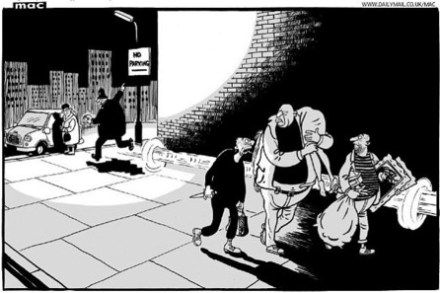
Today's Mac cartoon in the Daily Mail is, for me, a cut out and keep. It epitomises everything that has gone wrong with policing in Britain - a copper running past thieves to nick an old lady who has wrongly parked. And it touches on a wider theme: this is why regard for the police has fallen in the last dozen years. Their priorities seem to have switched from those of the public to those of the bureaucratic elite. This impression is, of course, deeply damaging and will be tough for the Tories to reverse. The plan for directly elected police chiefs, and Nick Herbert's seminal work on the subject, did seem to make sense to me. But not much has been said about it since. The Tories are, of course, in two minds about it.

The Future of Policing

From our UK edition

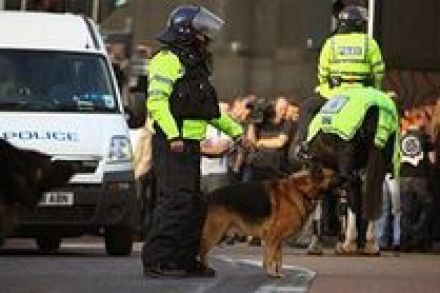
PC Heckler and PC Koch prepare for life on the beat. Photo: Christopher Furlong/Getty Images. Let us concede that there may be problems in Brixton, Haringey and Tottenham that demand new approaches from the police. Let us further accept that perhaps there really are "no-go" areas in some of the estates in these boroughs. But even if one takes the police at their word, I think one may still be worried by the news that, for the first time on the British mainland, police officers on routine patrols in parts of London will be armed. Because will it stop there? How long before there are calls for all police to be armed everywhere they go? The ongoing efforts to paramilitarise the police are not, I think, an encouraging step.

Who is to blame for the Pilkingtons’ deaths?

From our UK edition

I empathise with the jurors who decided the Pilkington case: it is impossible to make sense of this senseless episode. Yet society must ensure that the tragedy is not repeated. The jury, the Home Secretary and even the Opposition, up to a point, all blamed the police. Simon Jenkins’ piece in the Guardian savages the political Establishment’s refusal to address a democratic deficit, which has eradicated local civic leadership, a status quo that leaves the police caught between being a law enforcement force and an organisation that promotes community cohesion, a dual task that it is ill-equipped to perform. ‘Monday's Leicestershire jury verdict on the Pilkington deaths was typical of British public opinion.

Can the Afghan police be trusted?

From our UK edition

Lindsey Hilsum, Channel 4’s Helmand correspondent asked local Police Chief, Colonel Asadullah Shirzard, if the police were sufficiently free from corruption to manage the forthcoming election. The corpulent Colonel declaimed:  “We have eradicated corruption in our police force!” This is a seminal moment. Rudy Giuliani couldn’t do it, Sir Ian Blair failed, though that’s no surprise, and moving around Venezuela will confirm that even Hugo Chavez can’t stop his police taking a cut from the downtrodden population. But in war-torn Helmand, the perfect police force has been born.

Hamsterdam Britain

From our UK edition

The good news about the Drug War is that the police know it can't be won. The bad news is that the politicians, judging by their public pronouncements at least, still seem to think it can. There are times when I think it's important to question some of the assumptions made about policing; but when the police have the good sense to agree with me it's only proper to acknowledge the excellent work they're doing. So huzzahs for the UK Drug Policy Commission whose latest report the Times summarises thus: Police should switch their focus away from arresting drug dealers and concentrate on managing the harm they cause, according to an influential report. The UK Drug Policy Commission says new dealers take the place of those arrested and often bring new problems such as violent turf wars.

The Tories must be prepared to launch a reverse march through the institutions

From our UK edition

Sir Hugh Orde, the new president of ACPO, has predictably come out against elected police chiefs. Andrew Sparrow  has the key extract from his speech: “If people seriously think some form of elected individual is better placed to oversee policing than the current structure, then I am very interested in the detail of how that is going to work – and happy to have that debate. Every professional bone in my body tells me it is a bad idea that could drive a coach and horses through the current model of accountability and add nothing but confusion.

Police Brutality in Nottingham

From our UK edition

Meanwhile, in dear old Britain the paramilitarisation of our police continues. The Home Office has announced an extra £8m to help provide police forces in England with Tasers. It's only a matter of time before someone is killed by one of these weapons. Watch this footage of a police arrest in Nottingham and tell me if you think the police actions are appropriate and proportionate. Granted, some context is missing from this film. The BBC reports that the man being tasered had, it is said, assaulted a police officer. Nonetheless, when he is tasered he is a) lying on the ground and b) there are two and then four police officers on the scene to deal with him. The suspect is then tasered for a second time. We then see an officer punch the tasered man in the head. Three times.

When is Victory Really Defeat? In the Drug War, Silly.

From our UK edition

There was a crazy puff piece for the Endless War on Drugs on the BBC News tonight in which the reporter, Mark Easton, was handed a story by the Serious Organised Crime Agency full of dramatic pictres and supposedly encouraging figures. Coincidentally, this appeared the day before Soca releases its annual report and at a time when the government is said to be keen on overhauling the agency. Fancy that. According to the BBC, however, the international cocaine industry is "in retreat" and prices are rising while the purity of cocaine bought on the street has "plumeted". Well, perhaps. But the weakness of the pound is the most likely explanation for the increase in wholesale prices (up to, apparently, £45,000 a kilo) even if Soca also claim that prices are rising in other countries.

Ian Tomlinson

From our UK edition

The appalling thing - apart from his death, of course - about the death of Ian Tomlinson after he was assaulted by the Metropolitan Police during the G20 protests last week is that if it weren't for the fact that Tomlinson collapsed from a fatal heart attack moments after he was attacked by the police, there'd be very little fuss about the incident. It would just be another example of heavy-handed police thuggery and, consequently, of no news value whatsoever. (incidentally, it also shows why it is important that the public be allowed to take photographs of the police.