Police

No paramilitary link to last night’s riots in East Belfast

From our UK edition

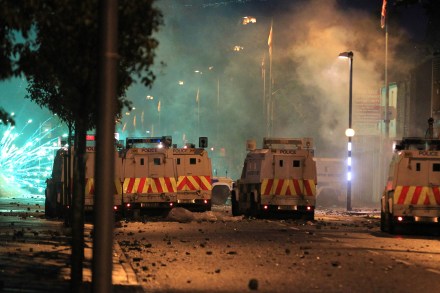
The PSNI is clear that last night’s riots on Castlereagh Street, East Belfast, were not linked to sectarian paramilitary activity. Rather, this was a ‘spontaneous demonstration’ against the police. As I wrote last week, gangs on both sides of the Ulster divide have been targeting the police in recent months; and they rely on exploiting current economic hardship and ancient sectarian divisions to further their criminal ends. The continued violence is a test of Stormont’s ability to govern without the close supervision from Westminster.

MP arrested

From our UK edition

The Metropolitan police are confirming that a 46 year old MP has been arrested on suspicion of sexual assault. The member concerned is a Tory.  UPDATE: The BBC is now naming Andrew Bridgen as the MP involved. There's been no statement as yet from CCHQ on the matter. In the last parliament, Andrew Pelling was suspended from the Consevrative party a week after being arrested on suspicion of assault. No charges were brought against Pelling.

Policing the local and the national

From our UK edition

Today’s announcement on a proposed new National Crime Agency (NCA) is a key element in the government’s ambitious police reform agenda.  Recent political attention has focused on changes to police pay and conditions and budget reductions, but the structural reforms that Theresa May and Nick Herbert are pursuing matter more in the long-term.  And before it is dismissed as another attempt to create a “British FBI”, the background and rationale for the NCA is worth exploring. The NCA is much more than a rebranding of the Serious Organised Crime Agency (SOCA) – the troubled organisation set up by Charles Clarke.

Off target

From our UK edition

Target culture. It's a pejorative phrase, and understandably so. As we discovered during the New Labour years, targets designed to encourage good public services can frequently do the opposite — replacing genuine care with box-ticking, and action with bureaucracy. I mention this now because of an article in this week's Spectator (do subscribe, etc.) by an anonymous Metropolitan Police officer. He describes how a target culture has skewed the work of the force and, in some cases, even the law itself. Here's one anecdote, which rather sums it all up: "I know of one instance in which a uniformed sergeant stole (or neglected to hand in) some confiscated cannabis.

Tomlinson Officer Faces Manslaughter Trial

From our UK edition

On the other hand, there's some good news today. The policeman who hit Ian Tomnlinson during the G20 protests two years ago is to stand trial for manslaughter. As I wrote at the time: [M]istakes happen. But the police are, rightly, supposed to be held to a higher standard. Yes, they have a difficult job. That's why we expect them to do it well. The assault on Ian Tomlinson can't be excused simply because the police were fed up. I can imagine that people in other countries might wonder what the fuss is. I mean, Tomlinson was hit with a baton once and then shoved, albeit violently, to the ground. There are plenty of places on earth where this wouldn't cause the batting of a single eyelid. But one of the good things about Britain is that this case should cause such a rumpus.

Another Taser Death

From our UK edition

Given that British police are being armed with these weapons too, it's only a matter of time before something like this happens in this country too: San Bernardino County Sheriff's Deputies yesterday punished an "uncooperative" motorist by Tasing him to death. After 43-year-old Allen Kephart was pulled over for allegedly running a stop sign, he got out of his car and failed to show sufficient deference to at least two deputies. He was subdued with a Taser, passed out, and died. Granted, British police may be more prudent or restrained than their American counterparts but, sure as eggs is eggs, they'll kill someone with these things sooner rather than later. Moroever, arming the police encourages greater violence.

The Huhne story takes another turn

From our UK edition

The Chris Huhne story has moved along a fair bit today. It is now being openly reported that it was Huhne’s estranged wife Vicky Pryce who allegedly took the points, though Huhne repeated his denial of the whole story earlier today. The BBC is also saying. that Pryce was that evening at an LSE dinner. (The fact that the BBC is now actively reporting this story shows just how much it has moved into the mainstream.) If, and it is a fairly big if, Essex Police have retained a copy of the picture taken by the speed camera then this case should be resolved fairly easily. The time and the name on the ticket can be set against the diaries of those involved. As Pryce was then a senior civil servant, there’ll almost certainly be a record of where she was and when that day.

The threat of Republican terror

From our UK edition

The Metropolitan Police has released a statement saying that they have received a bomb threat for central London today from dissident Irish Republicans. There’s no information on where in the capital or what time today the warning relates to.   The threat, for which the spurious attempt at justification is presumably related to the Queen’s visit to Ireland tomorrow, may well be a hoax. But if it is real, it would attest to the growing reach of dissident Republicans whose previous operations have been confined to Northern Ireland itself. (The best book on dissident Republicanism is Legion of the Rearguard by occasional Coffee House contributor Martyn Frampton).

The Lords punish Cameron over policing

From our UK edition

In Number 10, they are already concerned that they are losing public support on crime and punishment. David Cameron is planning to give a speech on the subject that will, in the words of one senior coalition figure, ‘throw a lot of bones to his party’s right.’   But Cameron’s words will mean little if he can’t rescue the elected police commissioners policy from its defeat in the Lords last night. By introducing police commissioners who are accountable to the public, this policy will make the police concentrate on the crimes that have the greatest impact on peoples’ quality of life rather than form filling.

There’ll always be a France

From our UK edition

The sensitive chaps at the CRS are always up for a fight. This time it's their turn to battle the French government: The notorious Compagnies Républicaines de Sécurité, or CRS, are outraged at an official decree stating they can no longer drink wine or beer with their meals. Until now, a civilised tipple was part of the daily lunch menu of the controversial force, lauded by Nicolas Sarkozy, whose trademark black body armour and riot shields are a regular feature on French streets. A glass of wine, beer or cider – but not spirits – was always permitted with lunch, including while on duty. Even packed lunches provided out of riot vans while they were patrolling demonstrations came with a can of beer or glass of wine.

Soft on crime, me?

From our UK edition

The name ‘Ken Clarke’ and the word ‘sacking’ are inseparable to the chattering classes at the moment, but so was it ever thus. There are signs though that the normally insouciant Clarke has been shaken on this occasion. He has given an interview in defence of his contentious prison reforms to the Times this morning (£). In a clear message to concerned voters, Tory backbenchers and sceptical government colleagues, he denies that he is ‘soft on crime’. For example, he will tighten community sentences: “I want them to be more punitive, effective and organised. Unpaid work should require offenders to work at a proper pace in a disciplined manner rather than youths just hanging around doing odd bits tidying up derelict sites.

Beyond the frontline

From our UK edition

Labour's cartography department has been hard at work all weekend to produce this. It is, lest you haven't heard Yvette Cooper today, an "interactive web-map" of the job losses announced by police forces so far, all across the country. You can interact with it in ways that include clicking to view a larger version. So far as web campaigning goes, this is probably fertile ground for the Opposition. No one likes the idea of more crime — and "more crime" is often conflated with "fewer bobbies" in the public debate. Yet Labour's point is diluted, somewhat, by one simple fact: that their former Home Secretary refused to guarantee that police numbers wouldn't fall under his party.

Boris’s remarkable ability to infuriate Labour

From our UK edition

Today’s Commons ding-dong on the riots that followed Saturday’s march was real, politics of the viscera stuff. The Labour benches were furious about Boris’s comments in today’s Telegraph that 'Balls and Miliband will feel quietly satisfied by the disorder' and that they 'will be content to see the police being unfairly attacked on all sides'. Yvette Cooper was so angry that when she tried to read out this section from Boris’s column that she couldn’t get the words out. Boris and Yvette, both Balliol graduates, have previous. But it was still striking quite how angrily Cooper heckled May as she refused to condemn Boris’ comments.

The threat to a British liberty

From our UK edition

It’s a funny old world. I have now been contacted by two journalists informing me that Bedfordshire Police are investigating The Spectator. Why? Because of the Melanie Philips blog where she referred to the “moral depravity” of “the Arabs” who killed the Fogel family in Israel. CoffeeHousers can judge for themselves if they agree or disagree with her language and views – but should this be illegal?  The Guardian has written this story up, claiming The Spectator is being investigated by the Press Complaints Commission. This is untrue. The PCC tell me that a complaint has been lodged, but that’s as far as it has gone. They investigate only if they believe there is a serious prospect that their code has been breached, and it hasn't.

This Country Needs More Daffodil Police

From our UK edition

You will notice that the little girl pictured here is a) in a park and b) skipping merrily through the daffodils. Being a well-brought-up type she is not c) pulling up daffodils just for fun. She is not, that is to say, one of Jane Errington's children. Miss Errington, a resident of Poole, is most aggrieved that her children - aged four, six and ten - were cautioned by police and warned that destroying daffodils in a public park could be construed as criminal damage and, were said flowers then removed from the park, theft. The Daily Mail uses the story to have a go at the Peelers who, we are meant to presume, should be doing more important things than policing this kind of juvenile vandalism. I must say that it's odd to see the Mail so relaxed about this sort of anti-social behaviour.

Some context for those police cuts

From our UK edition

What's it to be? Take a pay cut, or lose your job? That, as David suggested earlier, is the question being posed by Theresa May to police forces – and it's a question that they cannot shirk. With the police budget being cut by 4 per cent a year, there have to be reductions of one sort or another. And if they don't come from pay restraint – along the broad outlines of Tom Winsor's review today – then there will no doubt have to be extra job losses. This is the argument that George Osborne set out in his 2009 conference speech, only now it's being deployed from government. Not that there won't be job losses as well. Conveniently enough, a memo from the Association of Chief Police Officers puts a number on it all, and has been leaked to the Guardian.

Theresa May’s unenviable challenge

From our UK edition

Many political careers have met a torturous end in the Home Office. And this morning, Theresa May began her struggle. She is taking on the "last great unreformed public service" and the opposition is formidable; so much so that the official opposition barely get a look in. The Peelers are marching on Downing Street. The Police Federation has declared itself ‘fed up’ with cuts – a perfunctory warning to the government. Vice Chairman Simon Reed indicated that the Federation feels the government is abrogating its duty of care to those who serve, a dextrous line forged by those opposed to personnel cuts to the armed forces.

Tackling the last great unreformed public service

From our UK edition

The Home Office has an ambitious police reform agenda and is overseeing challenging budget reductions, but they are also forging ahead with plans to introduce real workforce modernisation.  The serious and credible reviewer, Tom Winsor, will publish his independent report next Tuesday.   Winsor’s review will cover pay, conditions and other aspects of employment that will set the framework for a new settlement when the current 3-year pay deal expires. Expect police overtime and shift patterns to be another major focus of the review.   David Cameron himself, who once boldly described the police as “the last great unreformed public service” is firmly committed to this agenda.

May’s change of emphasis

From our UK edition

Theresa May has a new soundbite: police pay or police jobs. May has been asked to find cuts of 20 percent in the police budget. May insists that the frontline must and will be protected and that therefore these ‘extraordinary circumstances’ mean that the government will have to rewrite the terms and conditions of police employment. The former rail regulator, Tim Windsor, is already conducting a review into police pay and working conditions. In addition to his recommendations, May is scrutinising overtime payments, housing and travel allowances and so forth. Estimates vary but these perks are thought to cost the taxpayer more than £500million a year. She is also overseeing a deluge of bureaucratic reforms, which she hopes will save 800,000 man hours a year.

Parliament is not sovereign

From our UK edition

Enough is enough. The British Bill of Rights is set to return: a consequence of the government’s running battle with parliament over the European Convention on Human Rights. Recent days have been filled with clues and suggestions of imminent reform: Dominic Grieve, a former advocate of the ECHR, went so far as to assert that Britain may leave the convention. Cameron let slip the news that a Bill Of Rights commission is to be convened at PMQs; at the time he was answering a question about the Supreme Court’s controversial sex offenders’ register decision. There are no details as to what the commission will consider, but Theresa May aired the guiding philosophy during her statement on the sex offenders’ register.