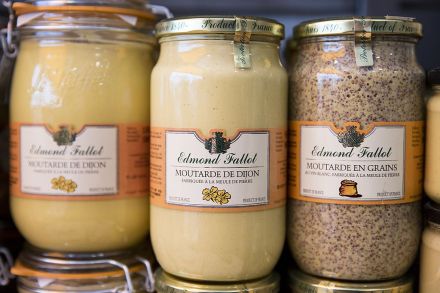
The glorious versatility of Dijon mustard
Not just salami, air conditioning and dental fillings: among their many contributions to civilization, the Romans also gave us Dijon mustard. Somewhere about the 4th century, it seems, the vinegar makers of Dijon were granted the right to use the exclusive mustard recipe composed by Palladius, son of Exuperantius, Prefect of the Gauls (or so Samuel Chamberlain informs us in his Bouquet de France of 1952). Palladius was one of those fascinating Roman gentleman-farmers who are also poets and scientists. He owned farms in Italy and Sardinia and had a particular interest in fruit trees. He penned a popular treatise on agriculture that stayed on the best-seller (or at least most-read) list until well into the Middle Ages.