Movie review

Dungeons and Dragons makes a comeback in theaters

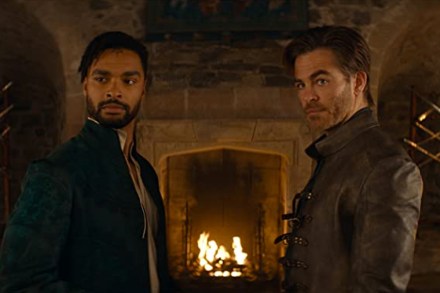
I have a confession, or perhaps a boast. I have never played the roleplaying game Dungeons and Dragons, and now, at the grand old age of forty-one, I doubt I ever shall. But there’s no doubt it’s a cultural phenomenon that has long since transcended any suggestion of being the preserve of adolescents, literal and overgrown alike. Since it was created in 1974, sales of the game have grossed billions, and it has been played by tens if not hundreds of millions of people worldwide. To be an aficionado is to find yourself in broad company — but how does that translate at the movies?  The first answer to this question came in 2000, when a film that starred Jeremy Irons as the villainous Mage Profion was released in cinemas.

dungeons

65 is a better B-movie than it has any right to be

Growing up, one of my favorite books was Gary Paulsen’s Hatchet, the story of a boy whose plane crash-lands in the Canadian wilderness and who must then fend for survival with only a single tool. 65 tries to pull off something similar, but with dinosaurs and sci-fi weapons. And bizarrely enough, it's a far better B-movie than it has any right to be. Yes, the setup of this film is seriously convoluted. Adam Driver stars as Mills, a long-haul space shipper who works for a spacefaring human civilization based on a planet other than Earth. When his vessel collides with an unexpected asteroid belt, he’s forced to crash-land on Earth — 65 million years before the present day. That’s right: this film takes place a long time ago, but in a galaxy not quite so far away.

Women Talking bludgeons itself with its message

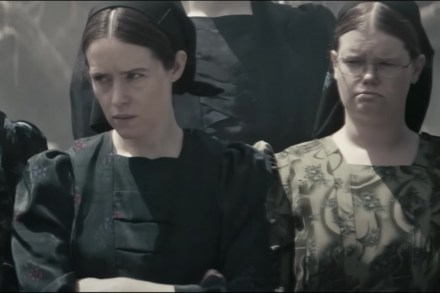
Sarah Polley’s Women Talking begins with a genuinely bone-chilling premise. Within a remote Mennonite “colony,” the women find themselves awakening from drugged slumbers, bearing the marks of violent sexual assaults in the night — blood, bruises, and mysterious pregnancies. Who’s responsible? Based on the promotional material, I expected this to be a story about secrecy and community. And that would be a very compelling story: women trapped in isolation form whisper networks among themselves, which finally reveal their common experience and allow them to bring their attackers to justice. Thematically, this would get at the intractability of human evil, even within “intentional communities,” and the harms of a subculture that treats bodies as shameful.

Violent Night is more than just Christmas carnage

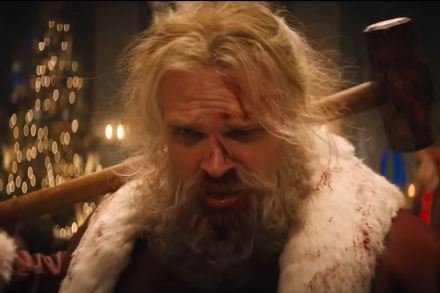
The pitch meeting for Violent Night must have been fun: why not make a big-budget film where Santa Claus himself (David Harbour) must protect a spoiled rich family from a home invasion? It might even settle the age-old debate about whether Die Hard is a Christmas movie: this is what a Die Hard-style Christmas really looks like! Violent Night largely delivers on that premise, serving up high-octane holiday mayhem for the grownup set. Here, we get a disenchanted (and borderline alcoholic) Kris Kringle, who’s grown tired of modern kids requesting only cash and video games and is contemplating hanging up his hat. We’re a long way from the jovial protagonist of The Santa Clause or even the crankier iteration of Elf. Years of munching Christmas cookies haven’t made this Santa soft.

Don’t Worry Darling was almost interesting

Olivia Wilde’s Don’t Worry Darling is a film more likely to be remembered for its offscreen drama than its substance. If only the final product that made it onscreen was as spicy: here, a promising premise and intriguing themes are let down by languid pacing, scattershot performances, and a willingness to lapse into preachiness that borders on misandry. Don’t Worry Darling is set in the planned community of “Victory” somewhere in the American West, a town led by self-help guru Frank (Chris Pine, playing a mixture of Joe Rogan, Jordan Peterson, and a televangelist — really, he wouldn’t be out of place on The Righteous Gemstones).

The Woman King is satisfying but it sanitizes African slavery

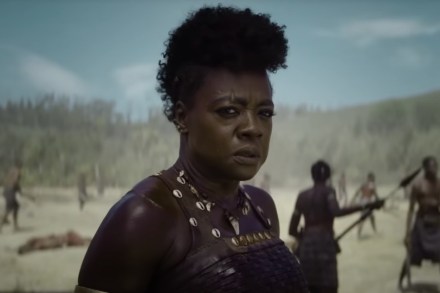
Every large-scale historical drama is a product of its time. The introduction to Cecil B. DeMille’s beloved The Ten Commandments explicitly outlines the film’s anti-communist agenda: “Are men the property of the state or are they free souls under God? This same battle continues throughout the world today.” Similarly, Gladiator, released in 2000 at the height of neoliberal dominance, anachronistically portrays the arc of Roman history as bending away from despotism towards democracy. 2022’s The Woman King is no exception to this rule. It centers on a fearless female leader who defends a pan-African, antislavery vision while reckoning with her own private traumas. Historically questionable? Yes. A satisfying movie? Also yes.