Moma

Is Hilma af Klint overrated?

At the corner of Manhattan’s Tenth Avenue and 22nd Street, there is a mural by the Brazilian artist Eduardo Kobra. Situated over the landmark Empire Diner, Kobra's painting reimagines Mount Rushmore as a paean to art stardom or, depending on how one looks at these things, the tragically hip and perpetually overrated.  Kobra supplants George Washington, Thomas Jefferson, Abraham Lincoln and Theodore Roosevelt with the graffiti artists Keith Haring and Jean-Michel Basquiat, the Mexican fabulist Frida Kahlo and the melanin-deprived panjandrum of Pop, Andy Warhol. These cultural icons loom over the crowds supping on blistered shishitos and tuna tartare inside the diner.
A cultural summer in the city

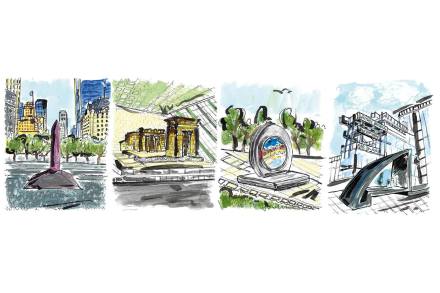
New York is gilded in beguiling art. It has an excess of riches and though summer is one of the best times to visit, quenching your cultural thirst can be difficult, as the arts patrons decamp to the Hamptons and watering holes ending in -an. From museums to galleries to street art at subway stations or parks, each borough is a canvas, so much so that it is often an afterthought against a landscape of pavement and honking cars. Will you be uptown for the first Monday in May? While the performances on the Met Gala’s red carpet are an art form in themselves, the exhibit the gala underwrites offers plenty to check out uptown as the tulips bloom on Park Avenue.

New York

Georgia O’Keeffe wants you to take your time

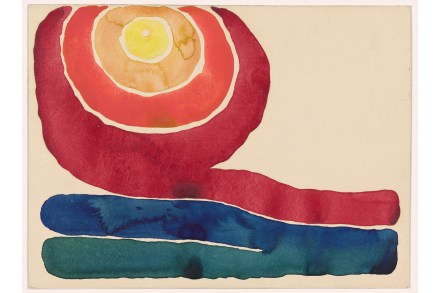
Georgia O’Keeffe is beloved for her oil paintings on canvas showing flowers and animal skulls: the first all soft, sensual openings; the second, spiky points and hardness.  Her works on paper are less well known. Yet, as MoMA’s exhibition, Georgia O’Keeffe: To See Takes Time, argues, paper played a key role in her early experimentation and art. As she told Alfred Stieglitz, the influential art gallerist and photographer who became her husband, “Why — it’s just like scrap paper. I throw it in the scrap heap and go on to something else.”  Paper is the beating heart of this retrospective, which shows 120 of O’Keeffe’s works from fifty-eight separate lenders, and which range from charcoal sketches to candy-colored pastels, rich watercolors to grainy graphite.

‘Evening Star No. III,’ 1917, by Georgia O’Keeffe (MoMa)

Make art free, not digital

If you won the lottery tomorrow and suddenly had the money to invest in art, what would you prefer: a work from Picasso’s Cubist period (Guitar on a Table, 1919), or an NFT made from AI-based images and shapes? On the one hand, Picasso’s Guitar on a Table isn’t his most famous or even most interesting work — by 1919, the radicalism of Cubism had begun to wane. But on the other, NFTs are a relatively unproven market with dubious artistic merit, and have been linked to art crime, money laundering, and even allegations of human trafficking. If Picasso couldn’t persuade you to ditch the digital art, what about a painting by Renoir, a sculpture by Rodin, or a triptych of paintings by Francis Bacon?

Culture and anarchy

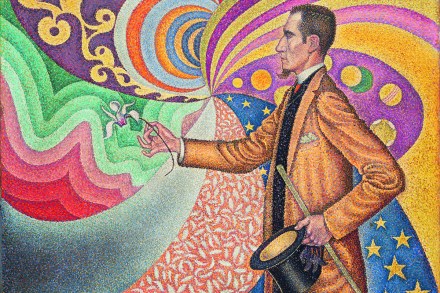
Paul Signac’s portrait of Félix Fénéon is a striking and historically important painting. But is it a good one? Its subject didn’t think so. Signac profiles Fénéon against a swirl of complementary colors and kaleidoscopic shapes, as if anticipating an acid-trip scene from a Roger Corman movie. This radioactively abstract background was bold stuff for Paris in 1890, when the picture was made, but contemporary critics disapproved, one finding the work ‘cold and dry’, another calling it ‘neither decorative nor comprehensible in terms of feeling’. Fénéon himself was similarly vexed by the final result, though he held onto the portrait throughout his life out of loyalty to his painter friend.

Féneon anarchy