Milton avery

The dynamic genius of Milton Avery

It’s hard not to feel slightly odd when standing in front of a Milton Avery painting. Take his 1943 work Hors d’Oeuvres as an example. The painting — currently on show at London’s Royal Academy’s exhibition, Milton Avery: American Colorist — is large, at nearly a meter across, and the background is what appears to be a coastal landscape, with a greenish sea and the curve of a bay appearing in the upper right-hand corner. In the foreground of the painting is a cream table and on it, a blue platter of food: the “hors d’oeuvres” of the work’s title. So far, it might be hard to understand what is so disconcerting about this painting.
Precarious and thrilling

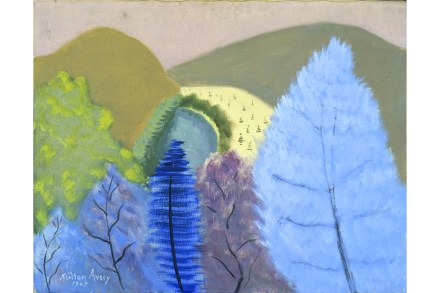
"Those trees are blue — I never saw a blue tree in Vermont,” a collector once argued to Milton Avery when looking at one of his New England forest scenes from 1945. The reticent artist parried: “That one was done in New Hampshire.” “Blue Trees,” the painting in question, is classic Avery (1885-1965): logically nonsensical but improbably believable, forcing us to re-question language’s tenuous hold on the slippery wonders of color. It’s also one of the standout examples included in a new retrospective of the American painter, set to open at the Wadsworth Atheneum Museum of Art (Hartford, Connecticut) on March 5, the middle leg of a three-venue tour.

Avery