Military

Saudi and Iran at each others’ throats

From our UK edition

Yesterday — as Pete pointed out earlier — the Obama administration filed criminal charges against two individuals, Manssor Arbabsiar and Gholam Shakuri, claiming that they worked with Mexican criminals and for the Iranian government on orders to assassinate the Saudi ambassador to the United States. The plot has met with denials from Tehran, which “categorically and in the strongest terms condemn this shameful allegation.”     But, if true, the plot would only be the latest in a long-standing feud between Iran and Saudi Arabia. The struggle between Riyadh and Tehran has become the Middle East’s central conflict, overshadowing even the Israeli-Palestinian conflict.

Fox on a knife edge

From our UK edition

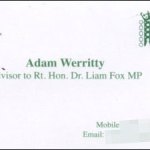
Another deluge of awkward news stories for Liam Fox this morning, with almost every paper providing new details for our consideration. The Observer has video footage and emails which suggest that Adam Werritty was indeed a close participant in the Defence Secretary's meetings with foreign dignitaries and businessmen. The Sunday Telegraph quotes Fox as saying that "I have absolutely no fear of complete transparency in these matters," but adds a warning from Whitehall sources that he "could be gone within days". And, perhaps most concerning of all, a senior MoD type tells the Independent on Sunday that "[Werritty] appears to have been involved in arms contracts all over the place". The story is now taking on a dangerous, two-tone complexion for Fox.

How safe is Fox?

From our UK edition

This weekend's gossip is all about Liam Fox and his ministerial future. Ministers and journalists are calling each other, weighing the evidence, trying to find out the latest gossip. Nobody should underestimate the Defence Secretary's fight — he is an alumni of the school of hard knocks. But two things go against him. First, having annoyed many colleagues — not least in No 10 — not everyone is rushing to his defence, as they did during the suspicions that dogged William Hague. No.10 has now given him its "full backing," but, as history shows, that can mean anything from support to sayonara. David Cameron would prefer not to reshuffle his Cabinet, that's clear.

The problem with using soldiers to advance women’s rights

From our UK edition

Mariella Frostrup, fresh from interviewing Nick Clegg in Cheltenham, writes about women's rights in Afghanistan in The Times (£). Her pithily-titled piece — "Women's rights in, before troops out" — makes the case that British forces cannot withdraw from, and the government should give no development assistance to, a country where the plight of women is so terrible and declining. It is hard not to sympathise with Frostrup's point. During my own time in Kabul I witnessed plenty of examples of female subjugation, and was glad the West was present to help address some of these problems. Western policymakers were, at the time, eager to portray the entire mission as a morally good, progress-guaranteeing task.

Fox hunt

From our UK edition

This is one Fox who doesn't have the benefit of a hole to bolt into. He is on open ground, and exposed even more this morning by fresh revelations surrounding his relationship with Andrew Werritty. A business card and a self-aggradising title, that certainly smelt of impropriety. But now we're talking about sensitive business meetings arranged by Werritty, and attended by both him and Fox. It's a whole different level of concern. And it leaves Fox in a most difficult position. The FT has the full story, but basically Werritty arranged for Fox to meet a group of businessmen in Dubai looking to transfer "communications technology" to the Libyan rebels. One of the suits present at the meeting tells the paper that, "His business card looks very official.

Labour and the forces

From our UK edition

The main event at the Labour conference this morning has been a long debate on Britain's place in the world, featuring Douglas Alexander, Harriet Harman and Jim Murphy - shadow foreign secretary, shadow DfID secretary and shadow defence secretary respectively. The debate touched on liberal intervention, soft power and human rights; there was even a video message from Aung San Suu Kyi. But Murphy's extended homily on the military covenant was the centre piece of the discussion. Murphy revealed a plan to allow servicemen to join the Labour party for just £1 and he also pledged to defend the pensions of retired servicemen and their widows from cuts, saying that reducing payments was "simply wrong".

From the archives: On liberal wars

From our UK edition

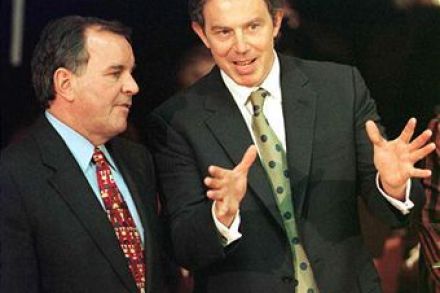
David Cameron’s speech to the United Nations yesterday was, among other things, a defence of liberal intervention. It reminded numerous observers of Tony Blair’s famous speech in Chicago in, the setting for the so-called Chicago Doctrine that guided his foreign policy thereafter. The Spectator said surprisingly little about Blair’s speech, perhaps because it wrote the following 5 days before the speech was made on 22 April 1999. End this liberal war, The Spectator, 17 April 1999 We can now see how liberals start wars, and wage them. First, they notice on television that people are being ill-treated or murdered.

Mullen adds to the tension between the US and Pakistan

From our UK edition

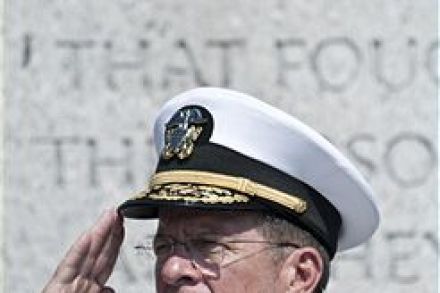
US-Pakistani relations will deteriorate even further following today’s claims by Admiral Mike Mullen, the outgoing chairman of the Joint Chiefs of Staff, that the Pakistani ISI aided and abetted the attack on the US embassy in Kabul. Mullen told a Senate panel that, "With ISI support, Haqqani operatives planned and conducted a truck bomb attack, as well as the assault on our embassy." This charge was part of broader criticism of what Washington sees as Pakistan’s strategy of exporting its internal problems.

Cameron’s Libyan gamble

From our UK edition

It is conventional wisdom that David Cameron won't get much of an electoral bounce from the Libya intervention, despite emerging as a bold and competent interventionist. People, the argument goes, are tired of warfare. A senior figure in Tony Blair’s No 10 told me yesterday that he did not think the PM would earn a lot of kudos, because with all the problems at home there is less tolerance for overseas adventurism. But this narrative overlooks a number of key points. First, the success of the operation has dealt with the charge that the government is less competent than it pretended to be. This was a serious charge, as the Prime Minister (and by extension the Conservative party) cannot withstand being called incompetent.

The enemy within | 3 September 2011

From our UK edition

The most telling figure in Carey Schofield’s book on the Pakistan army is Faisal Alavi, a major general who was murdered in November 2008. The most telling figure in Carey Schofield’s book on the Pakistan army is Faisal Alavi, a major general who was murdered in November 2008. As head of Pakistan’s special forces, Alavi found himself in a bitter struggle against influential military opponents in the Pakistan army. They favoured secret deals, paying large sums to the Taleban leader Baitullah Mehsud so that his supporters should not target the army. Alavi was by contrast desperate to attack the Taleban, and made no secret of this when on a visit to SAS headquarters at Hereford in 2005.

Cameron winning over the Libya doubters

From our UK edition

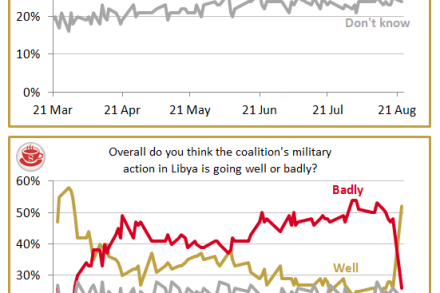
"They'll like us when we win," the West Wing's Toby Ziegler said of the Arab world. David Cameron might have said the same when public opinion was turning against the intervention in Libya. And, judging by today's YouGov poll, he'd have been right. Public support for military intervention has mirrored the public’s view of how well the action is going. In the first two weeks, when optimism prevailed, the public were largely in favour. However, as that optimism wore off and people increasingly doubted that the rebels could succeed, more and more began to oppose our involvement. Before the weekend, just 26 per cent thought the intervention was going well, and only 31 per cent were in favour of it.

Winning the peace

From our UK edition

The sight of rebel troops kicking a statue of Gaddafi round the colonel’s compound is another sign that the rebels are taking control of the capital. But the whereabouts of Gaddafi remain unknown. I understand that the British government is doing what it can to help the rebels locate him. But, until Gaddafi and his sons are detained there’ll be uncertainty about the situation. There’ll be much discussion of where Gaddafi should be tried if he is captured. Personally, I think it is entirely understandable if the Libyans want to try their old oppressor themselves. But the crucial thing is that the Transitional National Council prevents a wave of revenge killings.

The end of Gaddafi?

From our UK edition

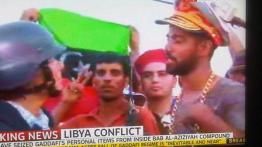
Pictures across the world's news channels currently show hundreds of Libyan rebels standing in the first perimeter of Gaddafi’s compound at Bab al Aziziya. A statute of the colonel has been pulled down, its head decapitated, and rebels are taking pot-shots at the other icons of his tyranny, including a clenched bronze fist clutching a US fighter jet. Gaddafi himself remains hidden from view, lurking perhaps in the tunnels beneath his compound or in another part of the city. He may, of course, be dead or fled, but the CIA says they suspect he is still pinned down in the country.

Gaddafi in Tripoli as the <em>entente cordiale </em>flourishes

From our UK edition

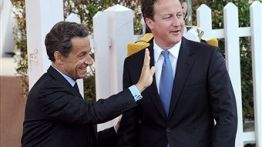
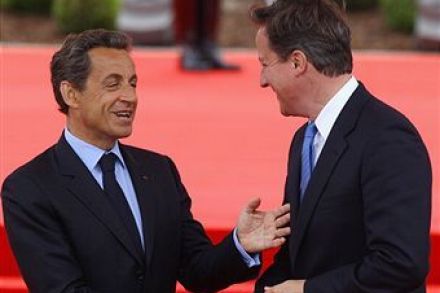
The imminent success of the Libya intervention was, to a remarkable degree, down to Anglo-French cooperation. Though the media has been keen to play up, and even conjure up, rifts and disagreements between Paris and London — and the hyper-active Nicolas Sarkozy can't help but act first and coordinate later — the fact is that the two states worked closer and better together than they have done for years. Probably not since the Suez operation have the British and French militaries cooperated so closely. But the intervention, even if it is coming to a (deadly and protracted) end did show up a number of deficiencies in materiel and command and control arrangements, as well as problems of political coordination.

Saif al-Islam Gaddafi: We’re winning

From our UK edition

Despite the claims of rebels and the International Criminal Court yesterday, Saif al-Islam is not in captivity, not any longer at any rate. He drove to the Rixos hotel, where western journalists and a handful of US Congressmen are incarcerated, in the early hours to give a press conference. “We’re winning,” he said in that insouciant, cultured manner of his — the effect ruined only by his unkempt beard. NATO spokesmen have been across the airwaves this morning, saying that the military situation in Tripoli is confused but the outcome of this battle is not in doubt. NATO commanders insist that they are not pursuing regime change, a claim that causes an involuntary snort of irony.

A victory for the Libyan rebellion, and for NATO

From our UK edition

The regime of Colonel Gaddafi appears to be over. In a matter of hours, we hope, the Libyan dictator will be located and captured, assuming he does not flee Libya. Finally, after 42 of evil rule, the Libyans can build a free nation. The tumultuous events of recent days are, first of all, a victory for the brave Libyan rebels who took arms against Gaddafi. They defied the odds, underwent setbacks but carried on. But, secondly, today's events are a vindication for David Cameron and Nicolas Sarkozy. Keen to learn the lessons of Bosnia, Kosovo and Rwanda, they saved Benghazi from a massacre and helped to build up the Transitional National Council. In the process, they suffered the opprobrium of realists, armchair generals and so-called "experts".

Through the gates of Tripoli

From our UK edition

After a summer of discontent, David Cameron must be counting his blessings this morning. He has broken his holiday because Colonel Gaddafi is about to fall. Rebel forces swept into Tripoli's Green Square overnight and members of the regime were captured as Gaddafi’s militia vanished into the night. Gaddafi’s son Saif al-Islam, who was being groomed as his successor, fell into rebel hands; the International Criminal Court is in touch with his captors. Another Gaddafi family is also understood to have been detained. Of the Colonel himself, though, there is no sign. Rebel forces are moving to encircle Tripoli, cutting off his line of retreat. Rebel spokesmen told the Today programme that they want to take Gaddafi alive in order to try him.

Reversal of fortune in Libya, but the old questions remain

From our UK edition

There has been a dramatic turnaround in the military situation in Libya. The rebels are now within 30 miles of Tripoli and the consensus is that Colonel Gaddafi’s days are numbered. The rebels have taken the strategically vital town of Zawiyah, which lies on the road between Tunisia and Tripoli, upon which Gaddafi relies for supplies. The town’s oil refineries are also of crucial importance in this conflict. With his communications shorn, the noose appears to be tightening around the Colonel’s isolated throat. This turn of events has taken observers by surprise. Just two weeks ago, Westminster types were blithe in their assertions that the end was still far off.

An American context for UK defence cuts

From our UK edition

Yesterday’s defence select committee report provoked stern critiques of the government’s defence policy from Alex Massie and Matt Cavanagh. It is hard to dissent from Matt’s view that Cameron, Fox and Osborne will be defined to some extent by how they handle the defence brief, which, as Alex points out, also proved to be Gordon Brown's undoing.  It is also clear, as both Matt and Alex say, that the SDSR suggests that Britain is entering a period of ‘strategic shrinkage’, in terms of the size of the defence establishment at any rate. A political squall has erupted over this, but it’s worth pointing out that western countries are narrowing their military horizons.