Media

Labour’s disintegrating campaign

From our UK edition

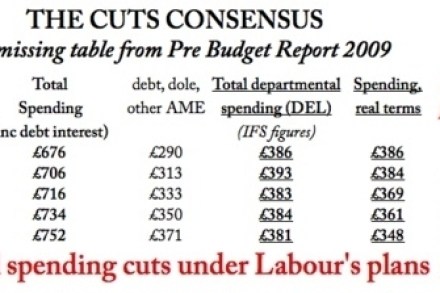
Fireworks at Labour's press conference this morning, thanks to some brilliant questioning of Mandelson and Balls about the cuts which Labour is concealing from the public. A while ago, the FT did its own version of a table that Coffee House ran in February: the implied cuts that departments will make under HM Treasury forecasts. I reprint it below. The IFS has sought to quantify these cuts. So Sky's Adam Boulton read out this list and confronted Mandelson: which of these would Labour not do? Freezing benefits? Cutting public sector pay? Halving the spend on teaching assistants? Cutting funding to Wales and Scotland? Nick Robinson from the BBC piled in too: Labour has asked broadcasters to focus on the issues, so why can't it discuss this issue?

The spotlight turns on Labour

From our UK edition

It's the story which has been simmering throughout the election campaign, and now it has has boiled over onto the front pages: fear and loathing in the Labour ranks.  After rumblings in the Sunday Times yesterday, its sister paper splashes with the headline "Labour in turmoil as pressure on Brown grows".  And, inside, Francis Elliot and Suzy Jagger report on the "jockeying to replace Gordon Brown".  Meanwhile, the front of the Independent speaks of "growing recriminations in senior Labour ranks over a lacklustre campaign that has seen the party relegated to third place in opinion polls."  The spotlight is finally turning, white-hot, on to Labour - after ten days of near exclusive illumination on the Lib Dems.

Cameron’s low reward interview with Paxo

From our UK edition

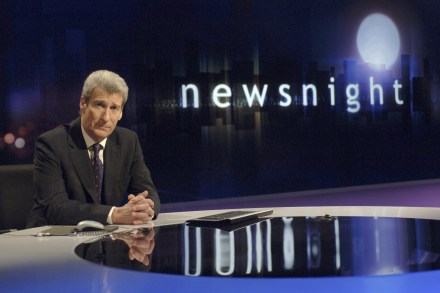
David Cameron is recording his interview with Jeremy Paxman at 5.15 today, it’ll air at 8.30. Cameron didn’t want to do this interview. Originally, Clegg was the only leader to agree to be interviewed by Paxman. But after the first debate, Brown said yes and the Tories decided that Cameron couldn’t be the only party leader not to do it. There is, of course, history between Paxman and Cameron. When Paxo interviewed Cameron during the 2005 leadership contest, Cameron turned the tables on Paxman spectacularly, attacking the whole Paxman school of interviewing. Cameron’s approach in 2005 was previewed by a very funny piece by Michael Gove in The Times which imagined Paxman interviewing Jesus.

People loathe politicians – but do they loathe the political media too?

From our UK edition

One thing's for certain: the Lib Dems are coming in for greater scrutiny and attention from the media.  The covers of the Telegraph, Sun, Mail, Express and, yes, The Spectator are testament to that - even if some are less substantial than others.  But the question is: will this derail the Clegg bandwagon?  And, like Iain Dale, I'm not so sure. Iain's point is that some of the coverage is so spiteful that it will "serve to increase his popularity and position in the polls".  He adds that this would be a "sure sign that the power of the press to influence an election is on the wane".  He's right, and the theme he identifies is one of the major currents that's swirling about underneath the surface of this election campaign.

Not so squeaky clean

From our UK edition

“All my life, I’ve opposed the old politics,” says Nick Clegg ad nauseam. Not so it seems. Peter Oborne’s Mail column reports that one youthful indiscretion has been omitted from Clegg’s CV: ‘In fact, he has a background as a Westminster lobbyist with the firm GJW, where he worked as an account executive for 18 months. (Something he has omitted from his curriculum vitae on the Lib Dem website).’ So, Clegg glosses over his stint of political kerb-crawling. Hypocrisy always makes a good story but the Tories should, and probably will, shun this story. They have lost the media narrative and the last thing Cameron needs is for the campaign to focus on the leaders’ backgrounds.

How Whelan & Co. exploit Britain’s libel laws

From our UK edition

The Charlie Whelan problem is intensifying for Labour, with more revelations in the Mail on Sunday today taking on from our cover story in this week’s magazine. Whelan’s behaviour may be no worse than that of Ed Balls and Gordon Brown – but he is more careless. Like McBride, he was actually caught: and his tactics documented in a formal seven-page report. Not the sort of document you want surfacing during a campaign. So it's little wonder why Whelan used Carter-Ruck to try and deter The Spectator from any further investigation in the bullying case: it threatens to expose Gordon Brown’s entire modus operandi and the methods which he uses to control the party. And, for that matter, run the country.

Take your seats

From our UK edition

Right – the pizza has been ordered, my glass is overflowing with raspberry Ribena (New! And delicious!), and I've fired up the old cathode ray tubes. But, somehow, I'm still feeling quite ambivalent about tonight's TV debate. Maybe it's because I still suspect it will be a cautious affair – with neither side wanting to risk the kind of mistake which could define their evening. Maybe it's because of the wall-to-wall coverage of the past few days. Or maybe it's because the New York Times has a (deliciously arch) point when it writes that UK politics is finally "moving into the television age".

Adam Boulton’s damning verdict

From our UK edition

We've already collected some of the general blogosphere response to Labour's manifesto launch, but this addendum is worth making separately.  In a post describing the hostility of the Labour crowd towards the gathered media, Adam Boulton writes (with my highlights): "The crowd, including some cabinet ministers, booed and shouted at questions they didn’t like. Nick Robinson, the BBC’s political editor, had his question interrupted by jeering and Graham Wilson of the Sun was booed just for identifying his newspaper. Labour did not behave like that in the last three elections when the Sun backed them. Gordon Brown was happy to join in this confrontational mood. It was the most substantive aspect of the manifesto event.

Around the Web: Labour’s manifesto

From our UK edition

We have some video footage of Brown’s speech at Spectator Live, and you can read Pete’s analysis here. Elsewhere on the Web: Hopi Sen likes the promise on early diagnosis on Cancer care, and the fact that no incredible spending pledges have been included. The Guardian’s Julian Glover attacks a 'meaningless manifesto': 'Ed Miliband, who we are told wrote Labour's manifesto, is fond of saying that the Tories are on the wrong side of the battle of ideas. It's a neat phrase, but an empty one unless you have ideas of your own. On the basis of today's manifesto performance, Labour doesn't.

The Times is wrong about the Tories’ marriage tax break

From our UK edition

Since The Times moved its leaders on to page two, they've also taken on a new vitality. For years, they were the voice of solid good sense. It was pretty difficult to disagree with them. Now, they are more polemical, more risk-taking - and more wrong. But I'm not complaining: I far prefer reading a fiesty opinion with which I disagree, than boring opinion that I nod quietly along with. And I could not disagree more with the leader today denouncing Cameron's marriage tax break. Let's kick off: "This is surely no time to be giving money away so that people can just carry on doing what they are already doing, namely being married. In a long philosophical journey in Opposition, the Tories appear to have alighted on moral authoritarianism advanced by economic interventionism.

Brown comes under heavy fire on Today

From our UK edition

Woah. I doubt Brown will endure many tougher twenty-minute spells during this election campaign than his interview with on the Today Programme this morning. You could practically hear the crunching of his teeth, as John Humphrys took him on over Labour's economic record; practically smell the sweat and fear dripping down his brow. It was compulsive, and compelling, stuff. Humphrys started by putting a grim story to Brown: that his "handling of the economy was not prudent ... your record suggests that the economy is not safe in your hands."  The PM's mission was to deny all this, and he did so with his usual stubborness and disingenuity.  His pitch here was all about inflation: about how we'd avoided the high inflation of recessions past, and how we should be grateful for that.

Where the Mail’s cover story came from

From our UK edition

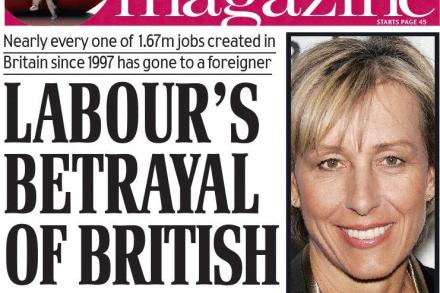
It's always gratifying to see Coffee House posts followed up in the newspapers, and I almost admire the way the Daily Mail has just splashed the newspaper on one of our posts without mentioning the source. CoffeeHousers will recognise the story on the Mail's front page (left) - some 99 percent of jobs created since 1997 are accounted for by immigration. But the reader is left wondering where this figure came from. Was it released by the ONS? Erm, no. The only source for these figures is an email I was kindly sent by the ONS after specifically requesting the data. I used it in a line from The Spectator's editorial endorsement of the Conservatives, which we flagged up in a CoffeeHouse post at 11am yesterday. The Tories spotted it, and Damian Green raised it in PMQs at 12.28pm.

Cameron defends his spending cuts – and suggests there won’t be more before the election

From our UK edition

Want some more David Cameron?  Well, the Tories are happy to oblige.  After their party leader's speech yesterday, he is interviewed in the FT and appeared on the Today programme earlier.  The FT interview was certainly the more comfortable of the two.  In it, Cameron stikes a confident note – saying that his party have "come a long way," and that "people are gagging for change".  And he stresses that he thinks – and, apparently, Ken Clarke thinks – that George Osborne is "the right person" to be Chancellor. But Cameron had a tougher time in his Today Programme interview.  It started well, with Today highlighting the supportive letter that business leaders have written about the Tories' national insurance cut.

A smart move by Osborne – but he needs to ready himself for his opponents’ attacks

From our UK edition

There's little doubting it: the Tory plan to (at least partially) reverse Labour's national insurance hike has handed George Osborne a high-calibre weapon for tonight's TV debate.  It is, I suspect, an attractive and attention-grapping policy in itself.  But it also helps the shadow Chancellor paint the Tories as the party of aspiration.  Or, as Tim Montgomerie has put it: "Seven out of ten working people will be better off if Cameron becomes Prime Minister." But announcing the policy this morning has also given Alistair Darling and Vince Cable a chance to very publicly denounce it later today.  We've already had a preview of what's likely to form the central thrust of Darling's counterattack, courtesy of Patrick McFadden on GMTV earlier.

Osborne must ask: why trust the party which ran up the credit card bill in the first place?

From our UK edition

Public sector net borrowing, public sector net debt, total managed expenditure, departmental expenditure limits ... zzzzz.  One of the main reasons why Labour has been able to fashion an economic narrative, against all odds, is because they can rely on some pretty esoteric language.  Thus debt becomes interchangeable with deficit, and cuts can be hidden under layers and layers of different spending metrics.  Perhaps more than anything, this almost-casual deception is Brown's greatest skill. Which is why it's encouraging that the Tories have tried to demystify some of the fiscal debate, putting it into language that everyone can follow.  They've set out their "more for less" argument by referring to the practices of supermarkets.

Explaining the NotW endorsement

From our UK edition

The News of the World's endorsement of the Conservatives today is worth reading. It has taken some time and much soul-searching for the paper to make this decision. Papers, even under the same proprietor, have different readerships with different outlooks on life. The Sun came out for the Tories on the last day of the Labour conference last September, but its stablemate has taken far longer. It has been firm in its denunciation of Brown's failings but – like many voters – it has looked long and hard at just how a Tory government would correct them. The reason for its endorsement now is laid out in the leading article. It started with the reasons for why it backed New Labour in 1997 – what would it change?

Darling and Brown get away with it

From our UK edition

Strange days, indeed.  While most of the frontpages today are unflattering for Labour – particularly, and unsurprisingly, those of the Telegraph and the Sun – I imagine that Brown & Co. will be quite pleased with the general tone of the Budget coverage.  Much of it mirrors the Independent's view that Darling "played a weak hand well".  Or, elsewhere, there's a kind of detached indifference about what is described as a "boring" Budget. Yes, if you like, you can take that as proof that the Darling-and-Mandelson approach to the public finances is less politically toxic, and a good degree more sensible, than the Balls-and-Brown approach.

The Budget is a bigger opportunity for the Tories than for Labour

From our UK edition

Last night's Dispatches programme was a concentrated double blow for Labour.  Not only did the limelight burn more unflatteringly on their party, but it has also undermined their careful Budget operation.  For the next few days, at least, it's possible that broken politics may trump the broken economy in the public mind.  And Alistair Darling is going to have a difficult, if not impossible, task in bridging that chasm of "distrust and disbelief" with his prescriptions tomorrow.

Memo to the Tories: stop talking about being authentic, and just do it

From our UK edition

Paul Goodman wrote a thought-provoking article for ConHome last week, in which he suggested that "authenticity vs artificiality" will be one of the key battles of the forthcoming election.  Not only do voters crave authenticity after years of spin, deception and malice on the part of politicians, wrote Goodman.  But, also, this election is specifically wired to expose inauthentic behaviour.  Blogs, YouTube, mobile phone cameras, poster spoofs – all will work to undermine the cold and the stage-managed methods of elections past. Which is why the Tories are getting all excited about David Cameron's more or less spotaneous performance in Lewisham last week.