Marriage

A question of identity: Passage, by Colin Thubron, reviewed

From our UK edition

Colin Thubron’s compact, elegant and beautifully written new novel opens with a woman undergoing surgery to remove a brain tumour. Kathleen has had a successful career as an actor and is married to Robert, a pompous neurologist with whom she is planning to go on holiday to Egypt. The operation stalls and so is postponed until their return from the Valley of the Kings. This passage to Egypt, where Robert, in an ironic echo of E.M. Forster’s Adela Quested, hopes to see the ‘real’ country, is complicated by the inclusion of Robert’s younger brother, Alan.

Love lessons from my grandfather, Alexander Chancellor

After a lovely 25th birthday trip to Vienna, I returned home to face the reality of my quarter-life circumstances. I had been happy with my milestones to date – a degree, a stint of modelling on the European and New York runways, a couple of relationships and some encouraging writing contracts – but was then told by my mother what my grandfather Alexander Chancellor had pulled off by the time he was my age. Having moved to Italy to work for Reuters news agency, he spoke Italian fluently and had married my grandmother, Susanna Debenham; he had two children, he had bought a house and even had someone iron his shirts from time to time, which Susie was definitely not going to do. By the time he reached 35, he was editing this magazine.

Make weddings short again 

From our UK edition

As every single one of my friends – and their spouses – is a tasteful soul, it goes without saying that every wedding I have ever attended has been the last word in elegance. You do hear things, though. Of Balham-based chartered accountants behaving like Victorian land magnates by renting stately homes for their nuptials. Of multi-venue events in five-star resorts by the lapping shores of the Mediterranean Sea. Of women having to buy, rent and borrow ten dresses for the summer that makes up wedding season. I could go on. So I am not surprised to read that one in three people is now turning down wedding invitations because they’ve become so expensive.

Looking back in anguish: Good Good Loving, by Yvvette Edwards, reviewed

From our UK edition

Ellen is at the end of her life and is frankly waiting to die while her extended family surrounds her, discussing her shortcomings: It felt very unfair to be so completely mentally alert while she was lying there on her hospital bed trying to await a peaceful passing. Her hearing was perfectly intact, and as a consequence she was forced to endure the never-ending discussions about the mass of her failings. This is the first novel from Yvvette Edwards for a decade. Her debut, A Cupboard Full of Coats (2011), longlisted for the Booker, was inspired by a friend showing her a newspaper cutting about her former partner being convicted of the murder of his next girlfriend. The Mother (2016) was about a woman whose son is murdered.

A nasty little tale about a marriage: Look What You Made Me Do, by John Lanchester, reviewed

From our UK edition

Adultery and betrayal have always been richly rewarding subjects in fiction, as John Lanchester’s Look What You Made Me Do confirms. Set in contemporary London and featuring architect-designed homes, book groups and the Oxbridge-educated middle-class, it comes perilously close to being that dread thing, a Hampstead novel – only to subvert it. For after one chapter, Kate’s husband Jack is dead. Her long marriage and comfortable life are cast into turmoil, first by bereavement and then by a hit TV series which suggests that Jack had been having an affair with its scriptwriter, Phoebe. Interleaved with Kate’s account of agonised grieving is the TV script of Cheating.

Long live the joint bank account!

From our UK edition

My husband and I share a bank account, and I don’t care who knows it. This detail lumps us in with many Boomer couples who have typically shacked up together financially – for better or worse, richer or poorer – for the duration of their married life. As (geriatric) millennials, our joint bank account therefore renders us something of an anachronism, but we’re used to this by now. We are outdated and unfashionable in our approach to many things, including (but not limited to) childcare, housework and car management.

Christmas with my soon-to-be-ex-wife

From our UK edition

I didn’t force any hyacinths this Christmas. Most years I plant a dozen bulbs at the end of September and hide them in a dark corner so they’re ready for Christmas Day – they never are, of course, but they usually arrive shortly after the Wise Men on Epiphany. But last September I took out the wooden planters – oak boxes stamped with the date of our wedding, a gift for our fourth wedding anniversary (wood) – and they fell apart in my hands, the wood split and rotten. I always thought the Christmases Yet to Come after my wife and I separated would be sad and un-Christmassy. I saw a vacant seat in the chimney-corner and all that.

Lara Brown, James Heale, Sam Olsen & Toby Young

From our UK edition

19 min listen

On this week’s Spectator Out Loud: Lara Brown reports on how young women are saying ’no’ to marriage; James Heale takes us through the history of the Budgets via drink; Sam Olsen reviews Ruthless by Edmond Smith and looks at Britain’s history of innovation and exploitation; and, Toby Young questions the burdensome regulation over Politically Exposed Persons (PEPs).  Produced and presented by Patrick Gibbons.

The scientific case for marriage

‘Those whom God hath joined together, let no man put asunder.’ With this stern admonition, the Church has long been a fervent defender of marriage. But as religion has faded as a social force, so too has marriage. The annual number of marriages in the UK has halved since 1970, with a similar decline in the rate in the US. Does it much matter if people choose to shack up together instead of tying the knot? What is lost if some men are incels or if women decide a husband is a bothersome surplus to their needs? The problem is that all lifestyles alternative to marriage serve to undermine it. And like other major social institutions, marriage is not some arbitrary cultural construct like a bank holiday.

Marriage is the real rebellion

From our UK edition

Jonathan Swift had a suitably unromantic attitude to holy matrimony. Once, when sheltering under a tree during a storm near Lichfield, he was asked to marry a heavily pregnant bride to a rather guilty-looking groom. Asked to provide evidence that he had performed the shotgun wedding, Swift found a piece of paper and wrote: Under an oak, in stormy weather,I joined this rogue and whore together;And none but he who rules the thunderCan put this rogue and whore asunder. Despite his cynicism, even Dean Swift would lament the marginalisation of one of our foundational institutions. Marriage is undergoing a seemingly inexorable decline. In the 1970s, almost three quarters of the adult population were married.

Are you too cool for marriage?

From our UK edition

The term ‘spinster’ doesn’t seem to scare young women like it once might have. In fact, it is rarely heard nowadays. Instead, women are declaring themselves ‘alpha singles’ and eschewing dating altogether. Influencers are keeping their relationships quiet, for fear that simply posting photos of a new amour can lead to an exodus of followers. Vogue has declared boyfriends to be unfashionable. Women, it seems, are swapping engagement rings for solo travel, matcha lattes and nights spent at home with an LED face mask. Is marriage suddenly uncool? There are certainly plenty of women pushing this idea. Elle McNamara, a beauty influencer who goes by the name ‘Bambi Does Beauty’, posts advice videos on Instagram and TikTok aimed at other women.

The Church of England’s muddle over sex and marriage

From our UK edition

Whatever you think of the new Archbishop of Canterbury, Sarah Mullally, there can be no doubt about this: she firmly backs the Church of England’s current official teaching on sex and marriage. Indeed, as the bishop who was recently in charge of updating that teaching, it might be the case that she upholds it more completely and sincerely than anyone else. Perhaps some readers would like to be reminded what the Church’s current official teaching on sex and marriage actually is. It is this: marriage remains the preserve of heterosexuals. Homosexuals may have their unions blessed in church. Um… that’s it. That’s all that can be said for sure. What about this obvious question: does the Church condemn sex outside of marriage? There is no clear answer.

Honeymoon from hell: Venetian Vespers, by John Banville, reviewed

From our UK edition

‘I am by trade a man of letters,’ Evelyn Dolman tells us as the curtain rises on Venetian Vespers. ‘I had a middling reputation in the period coming to be known, in our increasingly Frenchified age, as the fin de siècle, that is, the 1890s.’ If his writing mostly appears in the review sections, his marriage to Laura Rensselaer, the daughter of an American oil baron, is front-page stuff. But Laura has proved to be a distant, phantasmal partner. Even during the Dolmans’ sole night of physical intimacy, ‘it was as if, clasping me to her breast, she were at the same time looking aside and past my shoulder’. It moreover transpires that T. Willard Rensselaer, dead in mysterious circumstances, has cut his daughter out of his will.

Taylor Swift is saving America

From our UK edition

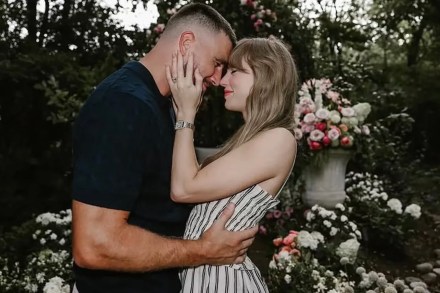
Elon Musk and Taylor Swift fans rejoice! America’s birthrate is saved! News of the engagement between America’s reigning sweetheart, Taylor Swift, and jock, Travis Kelce, can mean only one thing: a millennial marriage boom is upon us. And with it, natalists will hope, an impending baby boom. I’m no Swiftie. Nor am I one of those men who’s organised his entire political identity around hating the singer. Still, I can’t deny that I feel uplifted by the jubilation erupting across the US and beyond this week. Why? Because Taylor and Travis are taking a stand against pessimism. America’s permanently heartbroken oldest daughter has escaped her fate (for now). These are people taking the leap! Committing to something! How exciting is that?

Campus antics: Seduction Theory, by Emily Adrian, reviewed

From our UK edition

There is a fine tradition of campus novels that stretches from Evelyn Waugh’s Brideshead Revisited (1945) and Kingsley Amis’s Lucky Jim (1954) through Donna Tartt’s The Secret History (1992) and J.M. Coetzee’s Disgrace (1999) to Chad Harbach’s The Art of Fielding (2011) and Kiley Reid’s Come and Get It (2024). Emily Adrian’s Seduction Theory, her fourth novel for adults, shows the author’s awareness of her predecessors in the genre. One of its main characters even regards Pnin (1957), a campus novel by Vladimir Nabokov, as his comfort book. Ethan, the character in question, feels he needs comfort because he has cheated on his wife with their secretary.

The tragedy of a life not lived: Slanting Towards the Sea, by Lidija Hilje reviewed

From our UK edition

‘He leaned in to kiss me. And when he did, something inside me reoriented itself, my world softly tipping into his direction, as if he himself were the sea.’ This is the story of Ivona and Vlaho, one that aches from the offset. The two fall in love as students against the backdrop of postwar Croatia, with the promise of their lives ahead of them. Ten years later, divorced yet longing for one another, they’ve kept up a delicate connection, despite Vlaho’s new partner. But when a fourth person enters their orbit, buried feelings resurface, threatening to unravel everything. Lidija Hilje’s Slanting Towards the Sea is ostensibly a love story. It is poignant and evocative, exploring first love with an intensity so raw that reading feels like pressing on a bruise.

My son took drugs – and they were mine

From our UK edition

The weekend before last, I came home from walking the dog at about noon to find Caroline asleep in bed. This was surprising for three reasons. She’d been up and about when I left the house. She’s not one for taking naps. And her mother was coming to lunch. ‘Are you all right?’ I asked, prodding her awake. ‘No,’ she said. ‘I felt a headache coming on, took some Nurofen and suddenly started feeling incredibly dizzy. So I decided to lie down for a few minutes and then fell asleep.’ I wasn’t too worried because she does occasionally suffer from dizziness, usually accompanied by a migraine. So I made lunch while her mother went to a chemist and bought Caroline some travel sickness pills that she thought would help.

Marriage, motherhood and money: Show Don’t Tell, by Curtis Sittenfeld, reviewed

From our UK edition

Show Don’t Tell, a collection of 12 short stories by the American writer Curtis Sittenfeld, explores marriage, sex, money, racism, literature and friendship from the 1990s to the present. There is a fine line here between memoir and fiction, with many of the female protagonists being Midwestern, bookish Democrats – quite like Sittenfeld herself. In the eponymous story, Ruthie, a writer, dismisses the notion that ‘women’s fiction’ is perceived as giving off ‘the vibe of ten-year-old girls at a slumber party’. She reflects on internalised misogyny: ‘It took a long time, but eventually I stopped seeing women as inherently ridiculous.

Gavin Mortimer, Colin Freeman, Lawrence Osborne, Lionel Shriver and Anthony Cummins

From our UK edition

34 min listen

On this week’s Spectator Out Loud: Gavin Mortimer looks at how the French right can still win (1:48); Colin Freeman interviews Americans who have fought in Ukraine and feel betrayed by Trump (11:01); Lawrence Osborne details his experience of last week’s earthquake, as he reads his diary from Bangkok (18:38); Lionel Shriver defends traditional, monogamous marriage (24:07); and, Anthony Cummins examines media satire and settled scores as he reviews Natasha Brown’s Universality (31:13).  Produced and presented by Patrick Gibbons.

How to find your perfect man

From our UK edition

My late parents perpetually promoted their marriage as the best in the history of the universe. Because this cult of two was hardly subtle, others readily detected what they wanted to hear, so fawning social admiration of what lovebirds they were made them even worse. For us kids, this Trumpesque superlative (how they’d hate that adjective) wasn’t remotely as traumatising as divorce, but still – the romantic hagiography was a bit much. In our adulthoods, our own sad little relationships could never compare, and our parents seemed to feel sorry for us. While big proponents of marriage as an institution, they seemed to regard their children’s marriages as pale imitations – you know, nice try, kids.