Mark carney

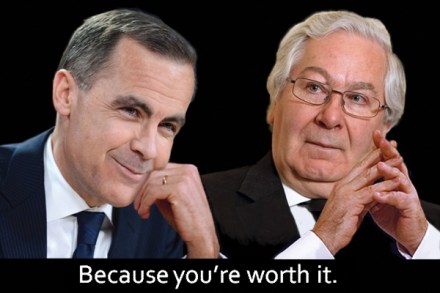
Sir Mervyn King to Mark Carney: You’re Worth It!

From our UK edition

Sir Mervyn King held an emotional farewell with the Treasury Select Committee this morning ahead of his move from the Bank of England to the House of Lords. Committee chair Andrew Tyrie was as keen to recruit him as a supporter of banking reforms going through Parliament in the future as he was to grill the outgoing Governor: in fact, all the of the MPs on this often incisive committee were reasonably gentle with the man known as Merv the Swerv. As part of his farewell, he gave some advice to his successor which sounded a little bit like a L'Oréal advert: 'Well, I have no intention of giving public advice, but if you really insist, really insist… it's very simple: he should be himself.

Norman Lamont’s diary: Green shoots, George Osborne and Mark Carney

From our UK edition

I was surprised to be told, by the editor of this magazine, that next week will mark the 20th anniversary of my standing down as Chancellor. The anniversary had entirely passed me by. I was asked this week why, if the economy was turning, George Osborne didn’t announce that he had spotted ‘green shoots’, as I observed in 1991. Although my remark, much rubbished at the time, turned out to be surprisingly prescient, I think Osborne is right to be cautious. Economic statistics are revised so often, trying to steer the economy as Chancellor is, as Harold Macmillan observed, like trying to catch a train using last year’s timetable. The best comment on green shoots was that of my then wife: ‘You don’t get green shoots in the autumn.

Why Mark Carney’s Canadian success story may be about to fall apart

From our UK edition

No Bank of England governor has ever been installed in office with quite so much advance hype as Mark Carney. When he moves from running to the Bank of Canada to his new office in Threadneedle Street, expectations will be running high. Carney arrives with a reputation as a master of economic strategy, a man who can single-handedly steer an economy through the most treacherous of waters, and get a country growing again with a few deft strokes of monetary magic. Certainly, George Osborne has invested his hopes in him. During Carney’s time as governor in Canada, the country was ‘acknowledged to have weathered the economic storm better than any other major western economy’, he said on announcing the appointment.

What’s keeping the banks buoyant?

From our UK edition

‘The central bankers have won,’ a senior City stockbroker said to me this week with an air of resignation. ‘There’s no point fighting them. Investors are doing as they’re told.’ And, wow, how they’re doing as they’re told. Thanks to central bank money-printing, cash is sloshing around the global financial system in desperate search of a decent return. There may still be little sign of a real economic recovery: China has slowed, to add to the misery in the eurozone. Yet the Standard & Poor’s 500 index of US stocks is at an all-time high and the FTSE 100 is within a whisker of breaking above its 14-year peak.

Forget beer and petrol: will MPs debate monetary policy today?

From our UK edition

MPs are debating the detail of the Budget today, and will doubtless pick over some of the lines from George Osborne's round of interviews this morning, particularly the confusion over whether Help to Buy is available for those buying second homes. There are plenty of queries about whether the government's new mortgage plans are actually very wise at all. The debate will inevitably focus on the doorstep issues on taxes and cuts. But will MPs talk about one of the most important elements of yesterday's announcement? It wasn't on petrol, and it wasn't beer duty. It actually concerned monetary policy.

The problem with Mark Carney

From our UK edition

In Washington last week, I encountered amazement that the Bank of England is about to be run by a foreigner. This was not because of any contempt for Mark Carney, the Governor of the Bank of Canada, who will soon succeed Sir Mervyn King, but because Americans could not imagine how a job so pivotal in the national psyche could be bestowed on someone with a different allegiance. The Fed, though far from popular in a country constitutionally suspicious of central power, does have a mythic, incorruptible status. As a result, the chairman, Ben Bernanke, has a tiny (by banking standards) salary. Last year, he was paid $199,700.

Mark Carney: I want a debate on inflation target

From our UK edition

If Mark Carney had any reservations about his move to Threadneedle Street later this year, he might now add to his list regular sessions with the Treasury Select Committee. His three-and-a-half hour hearing included a quiz from Committee member David Ruffley on his ability to explain capital ratios and other terms, questions on how many mistakes he'd be happy for staff to make, whether he wanted to rename the Bank's Court, and whether he'd judge his success on the return of growth to the economy during his tenure.

Like the Mounties, Osborne gets his man

From our UK edition

George Osborne pulled off one of those bits of political theatre that he so enjoys today. Watching his statement in the Commons, one sensed something was up as Osborne delighted in delaying naming the new bank governor. It was an indication that, like the Mounties, the Chancellor had got his man. Moments later, a clearly delighted Osborne announced that Mark Carney, the Canadian Central Bank Governor, would be the new governor of the Bank of England. This is quite a coup for Osborne as Carney is widely regarded as the best central bank governor in the world. It also marks a clear break with all that has gone wrong in the City in the last dozen years or so. It was an open secret in Westminster that Carney was the preferred candidate of the Chancellor and his circle.

Osborne’s coup: Mark Carney is the new Bank of England Governor

From our UK edition

Hiring Mark Carney may just be George Osborne’s best move since becoming Chancellor. Britain badly needed a break from the failed economic consensus which still hangs around the Bank of England like a bad smell. In August, The Spectator implored the Chancellor to mount a global search. When Carney ruled himself out, I gave up hope and resigned myself to Paul Tucker, who would be likely to keep Britain on its current Faustian monetary path paved with freshly-minted banknotes. Instead, Osborne has succeeded in hiring one of the best-qualified of all the Queen’s 137 million subjects — from a country that knows a thing or two about economic crises and how to handle them.