Margaret thatcher

The ex-factor

From our UK edition

One of the interesting features of this election campaign is the near-absence of ex-leaders in national election roles. Tony Blair has been stuck in the Middle East because of the eruption of the Eyjafjallajökull volcano and has, at any rate, been “Gored” by Gordon Brown, who is as keen to have his predecessor canvassing for Labour as Al Gore was to see ex-president Bill Clinton in the 2000 election. The former Deputy Prime Minister John Prescott has been more active. For the Tories, Michael Howard is standing down and has not been particularly visible. When I saw him recently in Portcullis House, he looked chipper and relaxed – not like a man about to electioneer for all he is worth.
A New Tory Policy: Back to the Eighties

From our UK edition

I cornered Ken Clarke after the press conference on employment and welfare today and asked him a direct question about my pet subject - Margaret Thatcher's Enterprise Allowance Scheme. I couldn't get in a question during the press conference itself, which was dominated by journalists from Channel 4 (three questions, come on chaps, fair's fair!) and some bloke called Forsyth from the Spectator. I asked Clarke about his post on the Linked In social networking site asking for people's experiences of the 1980s scheme for people wanting to come off the dole and set up their own small businesses. I have been lobbying for this for some time, as has the Federation of Small Businesses.

What did Darling mean by his “deeper and tougher” cuts claim?

From our UK edition

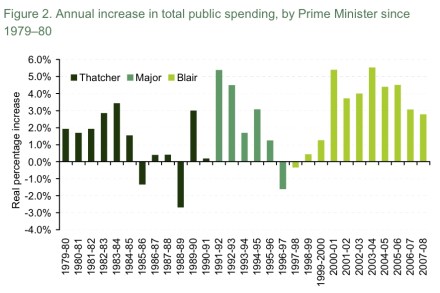
There's been some hubbub on the good ol' blogosphere about Darling's claim that Labour spending cuts would be "deeper and tougher" than Thatcher's.  Did Thatcher actually cut spending?  What would that indicatate about Labour's plans?  And so on. Part of the confusion is caused by the different metrics that are referred to as "spending".  So here's a quick guide to what Darling might have had in mind: OPTION 1: Real-terms total spending.  As the below graph from the IFS shows (taken from this excellent blogpost by the FT's Alex Barker), real-terms total public spending only fell in two years of the Thatcher premiership.  In all the other years it rose.  Indeed, spending increased by an average of 1.

The two sides of Alistair Darling

From our UK edition

After delivering an insipid, insufficient Budget yesterday, Alistair Darling has now smuggled a little bit of honesty into the fiscal debate.  In interview with Nick Robinson, he has claimed that if Labour is re-elected its spending cuts "will be deeper and tougher" than Thatcher's.  Needless to say, that's a message which will not sit well with his Cabinet colleagues like Ed "investment vs cuts" Balls. And this is precisely why Darling is such a confusing figure.  Yes, he deserves some praise for being more upfront about the public finances than his predecessor ever could be, and for restricting the wilder excesses of Brown and Balls.  But it's hard to forget that he, as Chancellor, hasn't delivered a spending review when we need one most.

Tony Judt’s Manifesto for the Left

From our UK edition

Anyone who cares about political debate should read the essay by the historian Tony Judt in today's Guardian. It is an astonishing piece of work which argues for a renewal of social democracy in response to the failure of the New Labour experiment (which Judt considers as evidence of the redundancy of the philosophy of Thatcherism so willingly embraced by Blair and Brown). You may quibble with the detail -- Judt remains over-sentimental about the public sector -- but it is a challenge to received wisdom in all strands of dominant contemporary political discourse.  He captures what many of the liberal left feel here: "It's difficult to feel optimistic about the upcoming election.

Clegg: Heir to Thatcher?

From our UK edition

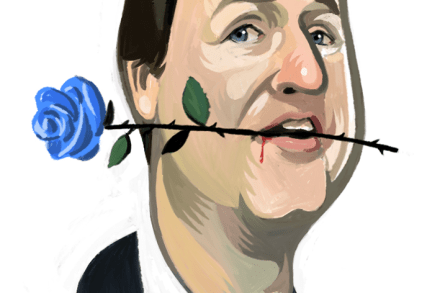
Nick Clegg has a blue rose in his mouth in tomorrow's Spectator, serenading readers - and showing his hidden Tory side. I have to say, he puts his heart into it. Not only does the Lib Dem leader say he'll end the structural deficit with 100 percent spending cuts (not the 20 percent tax rises, 80 percent cuts combo that the Tories advocate), but he even heaps praise in Lady Thatcher. More, he describes her as something of an inspiration: just as she took on vested interests in the 1980s, so he will take on the banks now.   Personally, I can't quite see the equivalence - and Clegg as the Heir to Thatcher is an image that I just can't conjure in my mind. But you can't blame him for trying.

Revive the Enterprise Allowance Scheme

From our UK edition

Some will see it as final proof that I have made the journey from left to right, but I have to say I don't see it that way. In tomorrow's Telegraph I have written a column calling for the revival of the Thatcher-era Enterprise Allowance Scheme. This initiative gave a £40 per week payment to people who wanted to get off the dole and set themselves up in business. Alumni include Alan McGee, who set up Creation Records on the EAS, Julian Dunkerton of the Superdry fashion label and visual artists Jane and Louise Wilson. New Deal of the Mind was commissioned by the Arts Council to examine the government's response to the recesssion.

The Ultimate New Labour Insult

From our UK edition

Mental illness has always taken up a lot of space in the lexicon of New Labour,  I have always thought Alistair Campbell's own brush with the black dog had something to do with this. From Ron Davies's "moment of madness" to Gordon Brown's "psychological flaws", the terror of incipient madeness has always been a New Labour nightmare. I wrote about this tendency a few years ago but recent events have brought me back the subject. It was telling that Damian McBride's emails contained references to Frances Osborne's state of mind - as if it would be a bad thing that she was upset by her husband's political misfortunes.

Some Thoughts on Political History

From our UK edition

The brutal truth about politics is that a whole career can often be telescoped into a single defining event. The judgement of history can be particularly cruel on  unlucky Prime Ministers. Ted Heath’s reputation is dominated by the 1972 miners’ strike, Jim Callaghan is synonymous with the “winter of discontent” and Anthony Eden, perhaps the most ill-starred of all post-war PMs, will be forever associated with a single word: “Suez”. All those years of vaulting ambition, grinding thankless work and genuine public service reduced, in the end, to those two damning syllables. And how thin sometimes is that line between success and failure. Who remembers John Major for his remarkable 1992 election victory rather that the crushing 1997 defeat?