London

Push off now, Press TV, and take your conspiracy theories with you

From our UK edition

A week that began with an insane decision from the European Court of Human Rights has come to an end with a sensible decision from Ofcom. The Iranian government’s propaganda channel in London, Press TV, has just had its license to broadcast revoked. Insomniac Islamists will no longer be able to enjoy their weekly dose of programmes presented by the likes of Lauren Booth, Tariq Ramadan or Derek Conway. And of course they will now forever miss The Real Deal with George Galloway. On that show you could see such treats as Galloway interviewing ‘President’ Ahmadinejad.

Boris’ poll lead evaporates

From our UK edition

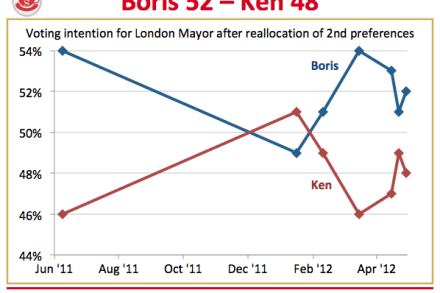
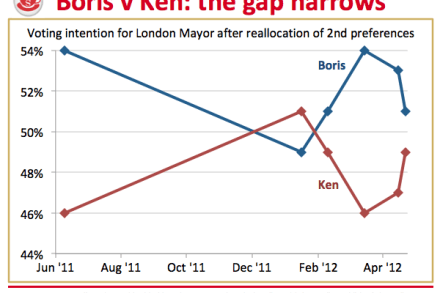
It looks like the May's election for Mayor of London will be a close run thing. A new poll today from YouGov has Ken Livingstone two points ahead of Boris Johnson – a big turnaround from the eight point lead Boris had in June: Ken shouldn't be popping any champagne corks yet, of course. His lead is well within the poll's margin of error, and there's three and a half months to go before election day. But he's certainly looking more likely to topple Boris than he did seven months ago. So why the change? YouGov's Peter Kellner has a good article on the poll's details here, but two key points jump out from the numbers: 1. Labour voters are getting behind Ken.

Boris puts on a performance for the 1922 Committee

From our UK edition

Boris Johnson was very well behaved this evening when he appeared before the 1922 Committee of Tory MPs. He stayed off the topics of Europe and tax and instead confined his remarks to London, saying that he wanted the capital to be an example of ‘cost-cutting, one nation Conservatism’. Those MPs inside the room say the performance was classic Boris, as one put it ‘he left no erogenous zone unstroked’.   Afterwards, Mark Reckless, a north Kent MP, asked the Mayor a sceptical question about his plan for a new airport in Kent. In the questions, I understand that Boris also took the chance to express his support for Rebecca Harris’s daylight saving times bill.   Interestingly, the turn-out for Boris was decent but not massive.

What Boris Island tells us about Cameron

From our UK edition

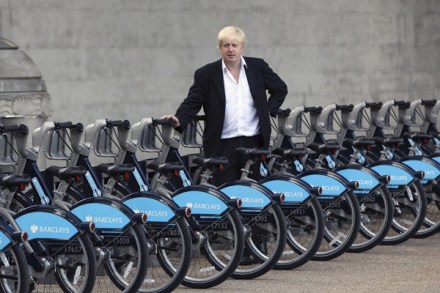
He already has his bikes and his buses, but might Boris get his island too? Today's Telegraph reports that David Cameron is going to announce a consultation into building a new airport in the Thames estuary, as was first proposed by the London Mayor. The PM will wait until that consultation is over before making a final decision, but he's said to be 'provisionally supportive' of the plan at the moment. Nick Clegg, by the sounds of it, is more provisionally negative. Even the very prospect of Boris Island is a triumph for the Mayor, and not least because Cameron and George Osborne were previously opposed to it. It also says much about the more general shift in attitude of those Tories in government.

The past is another city

From our UK edition

This absorbing book is — in both format and content — a much expanded follow-up to the same author’s very successful pictorial anthology Lost London of 2010. It replicates some of the photographs that appeared there and contains many new ones, all in captivating detail. The photographs are ones of record. There is little sense of artful composition or a striving for special effects. Many are of great beauty in their direct simplicity, as though the images were breathed onto the page with no human intervention.

A green-light for HS2 — but the coalition’s political instincts should tell it to stop

From our UK edition

Earlier today, the Government announced that it is still planning to go ahead with a new high-speed rail line that will reach Birmingham by 2026, and then be connected to Manchester and Leeds. And it's doing so in the face of widespread scepticism among the public and business leaders. When we at the TPA commissioned YouGov to test public support for different cuts in public spending, 48 per cent of the public supported cutting the project against just 34 per cent opposed. While organisations like the CBI back high-speed rail, the Institute of Directors (IoD) actually asked their members and found that 38 per cent thought HS2 would represent poor value for money, against 30 per cent who thought it would represent good value.

Ed Miliband is No Teddy Roosevelt

From our UK edition

This is, I know, a statement of the obvious but Ed Miliband is no Teddy Roosevelt. There are two reasons to be thankful for this. First, TR was really a ghastly man; secondly, if Ed Miliband were able to muster a quarter of Roosevelt's brio he'd be faring rather better than he is. In the present circumstances, the opposition should be thumping the government every day. Granted, this requires more credibility than either Mr Miliband or Mr Balls can boast but the fact remains that a) George Osborne's economic hopes have been vanquished by events and b) there is little substantive difference between his proposals and those made by Alistair Darling before the general election last year. Events have pushed the government towards accepting a timetable they once thought impossibly timid.

Newt Gingrich is Not John Kerry. That’s His Problem.

From our UK edition

In the end your view of the battle for the Republican party's presidential nomination comes down to the degree of confidence you have that Republican voters, especially but not exclusively in the early primary states, remain capable of remembering that the election that matters takes place in November, not the spring. If you doubt they can manage this then you probably think Newt Gingrich is the bona fide front-runner; if you think they can then you're liable to think Newt's resurgence is just another teenage crush that will fade as swiftly as it developed. I'm in the latter camp, for what it's worth. There have been improbable Presidents before (some, including the man himself, might consider the present President such) but few so unlikely as Newt.

The Only Thing You Actually Need to Read About the Riots

From our UK edition

Three cheers for Bagehot for this superb post on the Guardian/LSE's abject justification for inquiry into this summer's riots. Mr Rennie puts it exceedingly well: Now, put me in many contexts, and I am quite the hand-wringing bourgeois liberal. Watching Newsnight yesterday evening, I fear I came over all Judge Dredd. The researcher’s contention, in a nutshell, is that the rioters were not criminals who ran amok for a few days in August, losing their moral compass when they realised their actions would probably be without legal consequences. Instead, we are asked to believe, they are angry young people who hate the police and believe that they were taking revenge on a heartless world.

The Ritz in the Blitz

From our UK edition

‘It was like a drug, a disease,’ said the legendary Ritz employee Victor Legg of the institution he served for half a century. There’s something magical about London’s grand hotels. Even those of us who usually experience them only when we nip in for a five-star pee know that. Matthew Sweet has tapped this glamour to tell tales of the human dramas the hotels hosted during the second world war. It’s surely the variety of people gathered together in one place that explains the fascination held by the Ritz, the Savoy, Claridge’s et al. The good, the bad and the clinically barking all share the same address for a night, then tomorrow the cast-list changes.

From the archives: A nation ablaze

From our UK edition

A more recent gem from the archives than we would normally mine, but with the forthcoming government report into the riots — and with Fraser's and David's recent posts — we reckoned you might care to (re-)read Harriet Sergeant's piece from this summer. It formed the centrepiece of an issue largely dedicated to those fiery disturbances, and which also included thought-provoking articles by Theodore Dalrymple and Ravi Somaiya. Here it is: These rioters are Tony Blair's children, Harriet Sergeant, The Spectator, 13 August 2011 On the third day of the London riots I received a telephone call from Mash, a member of a Brixton gang who I befriended three years ago. He was standing outside an electronics shop in Clapham, watching the looting.

Chagrin d’amour

From our UK edition

The horror of love: Nancy Mitford’s first fiancé was gay; her husband, Peter Rodd, was feckless, spendthrift and unsympathetic, and her great amour, Gaston Palewski, was endlessly unfaithful. She met him during the war in London and was in love with him for the rest of her life. Palewski was Charles de Gaulle’s right-hand man. He organised the French Resistance in London and commanded the Free French forces in East Africa. After the war, he was appointed De Gaulle’s chief of staff and he became known as the sinister éminence grise behind De Gaulle’s presidency. He and Nancy shared a love of France, beauty and jokes.

George Osborne Slays the Tobin Tax

From our UK edition

George Osborne was filmed laying into the idea of a Tobin Tax on financial transactions at today's Ecofin meeting in Brussels. As he says: if you want to tax bankers, tax them but don't create a tax that will only be paid for by their customers. Here's Osborne: All this is well said (transcript here) and is, incidentally, a revealing glimpse into parts of euroworld that are rarely broadcast. Also, calling this a "Robin Hood Tax" is perverse: in fact it's a Sheriff of Nottingham ploy that appears to target the rich while actually being paid by the poor.

The building of our history

From our UK edition

Athens, for all its current woes, still has the Parthenon. Rome has the Colosseum, Paris the Louvre, Berlin the Reichstag, Beijing the forbidden city, Moscow the Kremlin and Washington the White House. But where in London is there a structure that sums up and encapsulates the sweep of  English History from 1066 and all that, to the Second World War and beyond? The answer is certainly obvious to the 2-3 million mainly overseas visitors who flock to the Tower of London every year, making it easily Britain's top tourist attraction.

The paucity of the “99 per cent”

From our UK edition

A week may be a long time in politics, but it is no time at all in protest. As the inhabitants of Parliament Square have demonstrated, even a decade is as nothing so long as you have a constantly morphing cause, a council with no balls, and a small but steady stream of acolytes. Last weekend I watched a bridal party sneak in through the side entrance of St Paul's Cathedral. This weekend I went back, curious to see whether the protest that had kept them from entering through the main door had located a point yet. Walking up from Fleet Street the first sight that greets the visitor is a large banner saying 'root out usury.' A surge of Presbyterian nostalgia powered through me. Perhaps I could identify with this protest after all?

Health & Safety: What Would Jesus Do? Weep, Obviously.

From our UK edition

I hold no particular brief for the people "occupying" the London Stock Exchange but whatever one may think of their aims it's evident that in closing the cathedral this week the Dean of St Paul's Cathedral and his colleagues have behaved like total ninnies. Then again, this is the Church of England so a certain measure of hand-wringing may be part of the job description at St Paul's. Who knows? What we do know, thanks in large part to this splendid, exhaustive, post by David Allen Green is that the so-called "health and safety" concerns are so feeble they could almost be a parody of CoE hopelessness. Among the "possible" threats to "life and limb": Smoking/drinking within the tented areas. Slips, trips and falls exacerbated at night with cover of darkness.

Overreacting to Werritty

From our UK edition

The Werritty case has made everyone who believes that government is controlled by lobbyists and tycoons slaver. The Guardian screams that Ministers held more than 1,500 meetings with corporate representatives in the first 10 months of the coalition, which presumably the newspapers’ readers know to disapprove of. But how many unionists did Labour meet after a year in office — and how many corporations? The party that declared itself "relaxed" about profit-making presumably met one or two profit-makers. Or did Ed Balls, when he was City minister, stay away from the Square Mile?

This will Occupy Boris

From our UK edition

A few months ago I hosted a debate at my think tank with one of the key Tahrir Square leaders. After his talk about Egypt, he warned the audience: the protests that toppled Hosni Mubarak were not just an Egyptian or Middle Eastern phenomena; it could – and, he said, would – spread to the West. For the youth of today, he argued, feel disempowered, empoverished and betrayed. As protests spread from New York to London and other European capitals, it seems that Egyptian protester may have been right. Today's efforts to occupy the London stock exchange failed but protesters remain on the grounds of St Paul's Cathedral. Whatever happens in the next days, protests like these are likely to appear, disappear and appear again.

How will Greening deal with the airports issue?

From our UK edition

One Cabinet minister fretted to me yesterday about the implications of Justine Greening’s appointment as Secretary of State for Transport. Their worry was not Greening’s position on the Tory ideological spectrum but her views on aviation. This minister worried that Greening, who helped lead the opposition to a third runway at Heathrow, would be against any expansion in airport capacity. In recent months, opinion has been shifting at the top of the Tory party on the airports issue. People were increasingly coming round to the view that there was need for an extra airport or at least an extra runway somewhere close to the capital.

A preview of just how personal the Boris Ken struggle will be

From our UK edition

If anyone had any doubts about just how personal the 2012 London mayoral campaign is going to be, they should have been dispelled by Ken Livingstone’s speech to Labour conference today. Ken claimed that the Mayor had ‘got what he wished for’ in above average unemployment and accused him of standing for a ‘privileged minority’. He then went on to draw an equivalence between Boris’s student antics and those of the rioters: “What is the difference between the rioters, and a gang of over-privileged arrogant students vandalising restaurants and throwing chairs through windows in Oxford? Come on Boris – what’s the moral difference between your Bullingdon vandalism as a student and the criminality of the rioters?