Language

Do ‘picky bits’ give you the ick?

From our UK edition

Marks & Spencer’s (as we still call it) has designated 27 June National Picky Bits Day. It entails eating things like olives and dips straight from their packaging. An evening meal of this kind is called a picky tea. It is, of course, a class minefield. ‘So what’s going on here, are we having a children’s party?’ asked Mary Berry when she was presented with a picky tea on Radio 1 three years ago. ‘I think I’m right in saying you have cooked none of this,’ she continued as she inspected the goods. On St George’s Day this year, the Scottish edition of the Times had a strap across the front page declaring that readers would find inside details of ‘The best supermarket “picky bits”.
Where do passion-killers come from?

‘Rearing homing pigeons was always a passion for the Queen,’ said a feature in the Daily Mail about Elizabeth II on the centenary of her birth. Yet perhaps that passion didn’t rage, hot as lava, through her veins, decade after decade. With Sir Keir, it has been football – ‘his only real passion and his one release from the tensions of office’, according to another source of the Daily Mail’s. Every young person tries to convince their chosen ‘uni’ that they are passionate about law or sport science. ‘When you can turn your hobby and passion into your profession, then that is the best thing there is,’ observed Marie-Louise Eta, the football coach, as though it were a truth universally acknowledged.

invalid

Why do we loiter?

From our UK edition

When my husband wants to do something I won’t like, such as getting tickets for Henley, he hangs about, plucking up courage, while I’m busy in the kitchen. Normally he sits idly by. It’s the loitering that is unsettling. He might get a job, if he could fly, as a loitering munition. These drones hover or circle until they detect a target. In 1988 an article in the American Air Force Magazine mentioned unmanned aircraft being developed to ‘loiter on high and then swoop down’. In 2022, Britain declared it would send ‘hundreds of loitering aerial munitions’ to Ukraine. Loitering, in use since Chaucer’s day, comes from a Dutch word meaning ‘to wag about (like a loose tooth)’.

Is a ‘link-up’ a modern ‘flash mob’?

The public disturbances in Clapham, achieved by social media link-ups, have their precedents. ‘You can imagine what an exhilarating week this has been,’ wrote Harold Nicolson in 1945, ‘The surrounding of Berlin; the link-up with the Russian armies.’  Link-up, first recorded from 1945 by the Oxford English Dictionary, has since been applied chiefly to military connection and that of spacecraft. On the same day as the first Clapham disturbance, three ‘flash mobs’, as they called themselves, were honestly busy in Slough High Street, doing little dances and holding up placards calling for the place to be named UK Town of Culture 2028.

The creep of AI ‘slop’

From our UK edition

‘The creep of “AI slop” in writing on the arts is everywhere,’ complained the Telegraph’s music writer Ivan Hewett the other week, and it’s up to us readers, he says, to stop it. For others, it means weirdly disjointed videos of anthropomorphic cats. But where did the forceful term AI slop come from? For prisoners, slopping out meant emptying chamber pots in the morning. For two centuries slop has been swill or food for pigs. At the same time it could be dirty household water. Long before that, it meant unappetising, semi-liquid food. Sloppy Joes were, from the 1940s, a kind of mushy hamburger (and also a loose-fitting sweater). I remember from the 1960s a probably ironic use of slop in the lyrics of a song by Arthur Lee on Love’s Forever Changes (1967).

A guide to Strait talking

I little thought in 2023, when writing about dire straits, that we’d so soon be pushed into them by trouble in the Straits of Hormuz. In discussions of these on the wireless, I find that even the best-informed commentators begin by referring to this geographical feature as the Strait of Hormuz but before long fall into calling them the straits. Insisting on the singular strait seems sterile pedantry. The Oxford English Dictionary has got the usage pretty straight: ‘When used as a geographical proper name, the word is usually plural with singular sense, e.g. the Straits of Dover, the Straits of Gibraltar.’ A pleasant piece of naval slang 100 years ago was up the Straits, meaning ‘in the Mediterranean’.

Why does a burglar burgle?

From our UK edition

When I hear surveil on the wireless I often imagine it is spelt surveille, since it is a back-formation from surveillance. But the spelling has settled down as surveil. The Telegraph had a report the other day about someone who found his iPhone had been infected with spyware ‘in order to surveil him’. The word sounds unhappy to my ear, as new back-formations often do, though it has been in use for 60 years. Back-formation appeared in the OED before it had an entry there. Its entry came in the Supplement of 1933, but it was coined by Sir James Murray in 1888 and used by him in the dictionary’s entry for burgle. This was marked as originally colloquial or humorous (as burgling probably was in The Pirates of Penzance in 1879: ‘When the enterprising burglar’s not a-burgling.

A meta-analysis of meta

‘That’s really meta,’ said my husband, attempting to imitate a stoned hippie at a festival, but only achieving his usual character role of a tipsy retired major in a Hampstead saloon bar. I had been trying to pin down what people think they mean by meta. The dominant element is the self-referential, as in a review in the Guardian of James Acaster playing a tribute act to James Acaster and ‘making meta-merry in a carnival of self-satire’. Before we get there, I think we must clear the ground with a brief visit to metaphysic. This was first found in a translation made in 1387 by the estimable John Trevisa, the Cornish-born vicar of Berkeley, Gloucestershire, and Fellow of Queen’s College, Oxford.

What makes a politician a ‘grandee’?

From our UK edition

To me, grandee goes together with Tory. So it was a surprise to find Lord Mandelson called a Labour grandee in recent reports. The Sun even called Andrew Mountbatten-Windsor ‘Grandee Andy’, though that spoils the original joke of calling party bigwigs grandees as though they were the truly grand grandees of Spain. At the last count, all but one of the 153 dukes in Spain were grandees, as were 264 other nobles. Grandees were exempt from paying tax, but so were hidalgos, whose numbers were reckoned by 1683 to have reached half a million. I got my daughter Veronica to search a database for references in the national press to Tory grandee in the past year. She found it applied to 31 men and one woman, Dame Priti Patel.

‘Both things can be true’: The creep of an annoying cliché

‘It’s lunchtime and it’s raining. Both things can be true at the same time,’ said my husband, putting on the face that makes him look like John Betjeman on a windy day. The use of this gnomic formula has grown so popular that not many minutes go by without encountering it. Danny Fortson, in the Sunday Times, wrote: ‘If the question is “is AI ‘real’ or a bubble?”, the answer is “yes”. Both can be true.’ A leading article in the Times observed that ‘violent crime has dropped to historic lows, yet a rise in antisocial behaviour has made many Londoners feel less safe. Both phenomena can be true at the same time.

How should Misha Glenny have pronounced ‘stela’?

From our UK edition

‘Can you tell us what a stela [pronounced stealer] is and describe it for us?’ Misha Glenny asked the learned guest Fran Reynolds on In Our Time, blessedly continuing after Lord Bragg’s long innings as presenter. The episode was on Hammurabi, King of Babylon. Professor Reynolds managed to get quite far before saying: ‘There’s the most beautifully carved cuneiform inscription on the stele [pronounced steely].’ Misha Glenny then mentioned that in Paris, the week before, he had gone to ‘see the stele, as I gather it’s pronounced’, on which Hammurabi’s laws are carved. Later he picked up the courage to return to stela.

Me, myself and the i

Misuse of myself ‘should be a capital offence’, suggests Oliver Duff, the editor of the i Paper. ‘As reflexive pronouns, myself and yourself require a prior subject (I, you),’ he says. I applaud the prospect of a general massacre of abusers of the English language, but by Mr Duff’s criterion, Shakespeare and Richardson, Ruskin and the great lexicographer Samuel Johnson himself should have been slaughtered. Historically, myself began not as a reflexive pronoun but as an emphatic, and as an emphatic it is often still used. Other constructions allow it too. In a letter in 1782, Johnson wrote that ‘both Williams, and Desmoulins and myself are very sickly’. There it is used as part of a compound subject.

Do only bitches bitch?

‘How many letters?’ asked my husband, as though it were a crossword we were doing together. ‘Five,’ I replied. ‘Begins in b, ends in h.’ The clue, according to the Daily Telegraph, was that the head of Norfolk county council had told opponents not to ‘b---h and moan’. ‘Belch?’ asked my husband optimistically, adding at intervals, in exactly the same hopeful tone: ‘Blush? Birch? Bunch? Bleach?’ ‘Too many letters,’ I replied to the last suggestion. Obviously the intended word was bitch. But I wondered why it had to be blanked out. Is bitch taboo in every sense? Would it be blanked out in the Crufts sense of a female dog? The doublet ‘bitch and moan’ is quite common.

The doctor will patronise you now

How a profession speaks to its subjects is always of interest to a writer, sometimes perversely so. Over the past few weeks a persistent problem with my foot worsened and appeared to take charge of things. (This isn’t going to be a piece moaning about ill health, I should reassure you.) The hospital took soundings of the ulcer, now turned into infection: first with a probe, then an X-ray, then an MRI scan, and finally the consultant manifested himself. The infection was in the bone and showed no sign of retreating under the antibiotics. It looked as if an operation was unavoidable, to remove – the consultant paused in his explanation – ‘We’re just going to take a kind of little nibble at the toe,’ he said. I regarded him levelly.

Woke language obviously doesn’t change the way we think

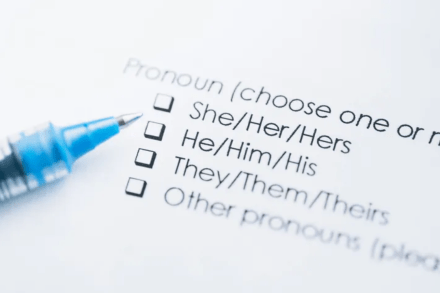
It’s been a cherished belief of progressives over the decades that you change the way we think, and in turn transform society, by changing the kind of language we use. This stretches back to a 1980s strand of feminism determined to jettison default masculine terms such as "chairman" and "headmaster" and replace them with gender-neutral equivalents. Then there are today’s hyper-liberals, who believe they can erase binary thinking on sex by introducing expressions such as "pregnant people" or forgo "he" and "she" altogether and substitute everywhere with "they." Many radicals have imagined that linguistic revolution is essential to actual revolution. Unfortunately for these idealists, new research suggests that their faith has been misplaced.

language

Have we reached peak ‘curation’?

From our UK edition

Are we all curators now? From the hotel chef offering an artfully curated cheeseboard to the fashion world’s curated capsule collections, the sound curators (DJs) and the luxury tour operators flogging seamlessly curated travel experiences – and don’t forget the curated (actually, algorithm-generated) lists from Substack – nowhere is safe from the scourge of the contemporary curator. The actor Idris Elba sees himself less as a conventional musician, ‘more of a curator of music’. In 2023, he curated the Nigerian musician Fela Kuti’s Box Set 6, in case you’re not up to speed on your Afrobeat vibes. The American rapper and songwriter Kanye West identifies as an ‘inventor or maybe curator’, possibly not clocking they’re quite different things.

Nicolas Sarkozy and the problem with ‘sweet treat’

From our UK edition

In October, Nicolas Sarkozy took with him to prison a copy of The Count of Monte Cristo. Its hero, Edmond Dantès, was imprisoned in the Château d’If for 14 years. Mr Sarkozy was in for 20 days. In his instant memoir, Journal d’un prisonnier, he says the food was horrible. Yet, ‘neither wishing nor knowing how to cook’, he left the hotplate in the cell untouched, even though a former chief of staff had taken the trouble to provide written instructions on how to boil an egg. He relied on yoghurt, cereal bars, apple juice and ‘quelques douceurs sucrées’. These are translated into English as ‘sweet treats’. I have an aversion to the jangling phrase sweet treat.

Are you ‘marred’ or ‘mired’ in scandal?

From our UK edition

My husband made a noise which he thinks is like a klaxon but sounds as if he is choking on his whisky. Even though I was in the middle of making a roux, I had to hurry from the kitchen to make sure he wasn’t. The klaxon was to signal that he had found in the paper a cliché that had led to complete nonsense. ‘Sir Tony’s position on the board was marred in uncertainty because of his role in the 2003 invasion of Iraq,’ someone said in the Telegraph. The cliché he was aiming at was mired. But, as clichés are empty of meaning, he hadn’t noticed that marred made no sense. It is a common error. In an article on electrical charging, someone on the Times had written that ‘the process of getting approval is marred in red tape’.

invalid

‘Invalid’ has become invalid

‘They should ask me. I’m a complete cripple,’ said my husband, heaving himself from his chair with great determination to reach the whisky. The Department for Transport is asking disabled people whether the term invalid carriage in legislation should be changed and what term they might prefer. ‘Language has moved on and changed,’ the government says, since 1970, when legislation was drafted. One problem is having to keep changing terminology. No one, even my husband, should be called a cripple. No one should be called handicapped. Now no one should be called disabled, but rather a person with a disability. These changes are paralleled in the languages of our neighbours. The Paris Métro had seats reserved for mutilés de guerre. The term was replaced by personnes handicapées.

invalid

If you’re ‘reaching out’, you sound deranged

“Why doesn’t anyone ever do what you ask them to?” inquired my husband, who is something of an expert on the question, I should have thought. He was referring specifically to a plea I made three years ago to people I’ve never met to stop sending emails that begin: “I am reaching out to you.” But it has grown worse. Using the expression makes it sound as though the emailer is deranged. Reach out has for more than a century meant “to offer sympathy, support or assistance” to people. Correlatively it can mean to seek those things. British Prime Minister Keir Starmer has acquired the habit of issuing a Christmas message. For 2025 he said: “At this time of the year, which celebrates love and abundance, loss or hardship can feel even more acute. Reach out.

invalid