Labour party

Defending his own premiership

From our UK edition

The Times's story of how Bob Ainsworth came to be Defence Secretary is equal parts extraordinary and disheartening.  Here are the key passages: "Mr Ainsworth’s predecessor, John Hutton, had indicated to Mr Brown in mid-May that he was thinking of leaving the Government. Mr Hutton, recently remarried, had a compelling family reason for wanting to step down. But Mr Brown, preoccupied with the elections and the possibility of a leadership challenge, appears to have spent little time thinking about the vacancy. It wasn’t until around noon the day after the polls that he began to focus on who should oversee Britain’s military and its engagement in Afghanistan.

What Labour women think of Gordon

From our UK edition

For those of you who missed it, Radio Four has just broadcast a piece about what the women who worked with think Gordon Brown think of him. Not a lot, it seems. Here are some of the quotes: Jane Kennedy "Well I think that the Labour Party is expecting us to do better. The Parliamentary Labour Party were told in the first meeting after the election in June we were promised that there was going to be a change.  We haven't seen that change yet, we haven't even really seen the kind of clarity and willingness to listen to what the voters are telling us about policy.

So who’s really “playing politics” over troop numbers?

From our UK edition

Just when you thought Brown's government couldn't sink any lower, you go and read the Sunday Times's lead story today and the comments it contains from "senior Labour figures", including a minister.  Here are the first few paragraphs: "Senior Labour figures accused the head of the army last night of playing politics as he said that there were too few troops and helicopters in the Afghan war zone. One minister expressed fury that General Sir Richard Dannatt, the chief of the general staff, had attended a private dinner with Tory MPs and suggested an extra 2,000 troops were needed in Helmand province. The general’s remarks put him at odds with the official government line, that the 9,000 British troops already in Afghanistan are sufficient to cope with the offensive.

Smith’s claims call Brown’s political judgement into question

From our UK edition

Ok, let's get the hard, grim facts out of the way first: Jacqui Smith was an ineffective Home Secretary whose expense claims were dubious, to say the least, and who rightly lost her job in government.  But - having said that - it's hard not to feel slightly sorry for her as she discusses the embarrassment caused by her husband's porn rentals in an interview with the Guardian today.  The whole piece is a remarkably candid exchange: she also discusses how she "did wrong" with her expenses, and how she'd "definitely" be voted out "if the general election was tomorrow".  But this passage struck me more than any other:      "[Smith] insists she wasn't forced out - that Brown asked her to stay when she first said she wanted out.

Darling speaks his mind

From our UK edition

You've got to hand it to Alistair Darling: he really does seem to be making the most of his post-reshuffle security.  His interview with the Telegraph's Ben Brogan today is a case in point.  Once again, he goes against the Brown/Mandelson claim that there won't be a spending review before the next election.  But it's this passage which jumped out at me: "In another departure from Mr Brown, he even talks about reversing tax increases, including the planned rise in the top rate to 50p on those earning more than £150,000. 'Looking into the future I would like to be able to reduce tax. Raising the top rate is something I didn’t want to do.'" Brown will be livid.  Just imagine: a Chancellor who speaks against the authority of Number 10.

Brown’s legacy of inequality, poverty and joblessness

From our UK edition

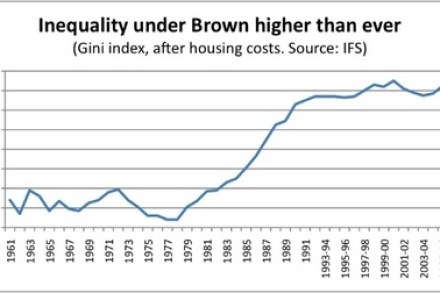
We all know Labour has failed to run an efficient economy or public services, but what’s little discussed is its failure to achieve even its own goals. Had Brown bankrupted the country but, say, made the poorest much better off, then Labour members might not be facing such an existential crisis. As it stands they won three victories, trebled health spending, redistributed some £1.5 trillion – and will end up with a society even more ‘unequal’ than it ever was under Thatcher. I look at this in my column today, and thought I’d share a few of the points with CoffeeHousers. First, equality. This (rather than making the poor better off) is the great leftist goal – and it can be nominally achieved by hurting the rich.

Whom do you trust more?

From our UK edition

So, a ComRes poll for the Daily Politics has Cameron leading Brown on the issue of which party leader would be more honest about spending cuts. It echoes a poll that we conducted a few days ago; the results of which we figured we’d share with CoffeeHousers, before our work experience at the Speccie comes to an end. Basically, we hit the streets of London (avoiding Westminster and all the party hacks), and asked around 350 people: “Who do you trust more, Gordon Brown or David Cameron?” Sure, it may not be as scientific as a YouGov or ComRes poll, but the results are still striking. Cameron polled a comfortable 62.5 percent, while Brown only managed a lacklustre 37.5 percent. A massive victory for Dave, then? Well, yes – in one respect.

The extent of Johnson’s loyalty?

From our UK edition

Kevin Maguire's Commons Confidential column in the latest New Statesman contains this intriguing little snippet: "Home Secretary Alan Johnson was a picture of innocence during the plot to oust Brown and replace him with a former postie with the initials A J. Not so his entourage. It has come to the attention of No 10 that one of his team offered a job in Downing Street to a hackette." After his article for the Indy earlier this week - and his fizzy performance in Manchester yesterday (covered by John Rentoul as part of his AJ4PM series) - you suspect Johnson is being a little more active than the Dear Leader would like.

Labour prime their anti-Coulson strategy

From our UK edition

Some useful insights from PR Week's David Singleton, who reveals that Labour are planning a concerted effort to paint Andy Coulson as a "sleazeball" ahead of - and perhaps during - the next election campaign.  Here's a snippet: "One senior Labour source in regular contact with Gordon Brown's inner circle told PRWeek: ‘Cameron wants to present himself as the man who's going to clean up politics. That's going to be difficult if the public think his right-hand man is a complete sleazeball.'   Another Labour insider said that senior party figures had been thrashing out a strategy to target Coulson since the news emerged yesterday. The source said the aim was have Coulson ‘wounded, but still there'.

There could be a pay freeze, after all

From our UK edition

Over at the FT's Westminster blog, Jim Pickard picks up on an important comment from Stephen Timms, the Treasury minister, speaking at a committee meeting this morning.  Timms suggests that Treasury hasn't ruled out a public sector pay freeze, as recommended by the Audit Commission's Steve Bundred.  Here are the minister's words:   “It’s certain the case that our pay policy needs to reflect the wider economic circumstances ... we will be deciding on pay policy over the next few weeks, the policy has got to be fair to people who work in the public sector just as we have to be fair to everybody else. The suggestion by Steve Bundred has made is certainly one we will reflect on but the details on that will be made over the next few weeks.

The consequences of Johnson’s cowardice

From our UK edition

There was great excitement here in Old Queen Street when Lord Carlile, the Government’s own adviser on anti-terror law, announced that Alan Johnson can and should help poor Gary McKinnon. McKinnon is the computer nerd who hacked into the Pentagon looking for evidence of UFOs, but who is soon to be extradited and tried as a terrorist in America. Lord Carlile – not usually a dovish man – thinks a great injustice is being done (Mckinnon might get 70 years in a ‘supermax’ prison) and has said that the Home Secretary should prevent it. So we called the Home Office to find out when Alan Johnson was planning to act. “The Home Secretary can do nothing. This is a matter for the judicial review,” said his spokesman. So why does Lord Carlile think he can?

Harman’s debt calculator is broken

From our UK edition

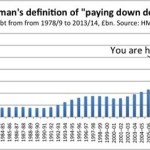
I know Harriet Harman is not supposed to be taken seriously, so I’m prepared to believe that she just struggles with numbers and didn’t knowingly mislead MPs today. But it’s worth correcting the record on one crucial point. “We have paid down debt,” she says. Actually, if you take the last Budget into account – it ranges to 2013/14 – decisions taken by her government will have increased national debt by more than every government since the Norman Conquest. Put together. If this is her definition of paying down debt, I’d hate to see her overdraft. Don’t they teach them anything in St Paul’s?

Could you stick with Gordon for 3 more years?

From our UK edition

Brace yourselves.  According to some great research by David Herdson at Political Betting, Gordon Brown could refrain from holding a general election until 2013.  The loopholes by which he could manage it are a bit arcane and convoluted – so I’d suggest you read Herdson’s post in full – but this snippet gives the idea: “The only statutory requirement to move writs for a general election is under the Meeting of Parliament Act 1694, which allows no less than three years between the dissolution and the writs being issued. In other words, technically, the election doesn’t have to be held until June 2013.

When the cat’s away…

From our UK edition

Hm.  Seems like Alan Johnson has chosen the day that Gordon's away in Italy to write another comment piece on voting reform.  Like his article for the Times a few months ago, it pushes the AV+ version of proportional representation.  And, like his Times article, it goes out of its way to mention Brown ("I work for a leader who accepts the need for ... renewal"), but it still comes across as an attempt to grab the leadership limelight.  After all, why should the Home Secretary be reiterating points he's made before about voing reform?  Why isn't he leaving this attention-grabbing stuff for his leader who "accepts the need for renewal"?  And why now?

Government wins 10p tax vote

From our UK edition

The government's dire warnings that if the amendment passed all income taxes collected this tax year would have to be repaid, seems to have deterred many of the rebels.

To freeze or not to freeze?

From our UK edition

The question of whether or not to freeze public sector pay has had a fair bit of airtime over the past few days.  In his interview at the weekend, Alistair Darling seemed to take a hard-line on the issue - and most outlets wrote it up as him not ruling out a freeze.  But, via today's Times, "sources close to [Darling]" say that he won't re-open wage deals to introduce a freeze.  While, for his part, David Cameron is also claiming that a Tory government wouldn't order a freeze of public sector pay.  The politics of the situation is plain: neither side wants to seem especially tough on public sector pay ahead of the "nice cuts vs nasty cuts" battle which lies ahead.

How to Cut Spending and Frame the Argument

From our UK edition

A characteristically interesting column from Rachel Sylvester in The Times today, in which she describes how the Tories are looking to how the Liberal Party in Canada managed to slash public spending a decade ago. As Sylvester describes it, our Canadian friends lopped 20% of their public spending bill and dismissed as many as a fifth of all state employees. In other words, cutting spending can be done, even if it's never easy and always controversial. But unless you tackle welfare and the NHS then - absent a fundamental rethink of government needs and priorities - it's unlikely that many of the other measures - charging for museum entry! - will make much of a difference. Of course, the Tories say they are committed to that sort of Big Thinking. Momentum is on their side.

A rebellion stirs

From our UK edition

So, what does today hold in store for Gordon Brown?  Howabout another 10p tax rebellion marshalled, as always, by Frank Field?  A bunch of around 30 Labour rebels have prepared an amendment to the Finance Bill, by which the last Budget couldn't pass into law until everyone who lost out from the 10p tax fiasco has been fully compensated.  It should be debated today, and the rebels have the support of both the Tories and the Lib Dems.  In response, Labour whips have cancelled all foreign trips by ministers and MPs, and are feverishly trying to rally the troops.   If the rebellion succeeds, then it will be hugely embarrassing for Brown - his beleagured premiership could well do without another Commons defeat.

How important were all those initiatives the government kept announcing?

From our UK edition

There was a time when the government seemed to be announcing new measures to get the economy and the banking sector in particular moving again on an almost daily basis. Today, the Wall Street Journal has done a rather good audit of these measures. For instance, in January “the British government created a guarantee program meant to revive the dormant market for asset-backed securities. The program aims to spur purchases of banks' asset-back securities, or bundled consumer loans, by guaranteeing them for buyers. The guarantees were made available in April, but since then, none of the major U.K. banks has issued a security with such a guarantee.” Also, only 13 firms have joined in the government’s £5 billion trade insurance programme.