Labour party

Brown’s double hit

From our UK edition

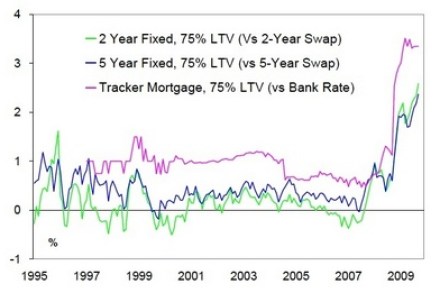
What is the true price of Gordon Brown’s economic incompetence and inept bank regulation? The soaring national debt is one. And if you own a mortgage, you’ll find that you’re paying another. The gulf between the Bank of England base rate and the average mortgage rate is now at a huge high – as banks rip off their customers, trying to fill the hole in their balance sheets. This is an under-discussed topic. The “action we have taken” (a phrase Brown uses to try to lay claim to the Bank of England’s base rate reduction) would have a far greater effect on the economy if the UK banking system was not (still) so badly broken. The below graph, from Citi, shows spreads (ie, gap between base rate and retail rate) on key UK mortgages from 1995.

A shaming episode

From our UK edition

The Culture Secretary would be advised to keep his fingers to himself. Following Wednesday’s Twitter gaffe, he let fly on Twitter once again. His target was David Cameron’s demolition of the state. All Bradshaw hit was Cameron’s dead son Ivan. He tweeted: ‘the camerons got good nhs care thanks to Labour’s investment and reform. Is this the ‘big government’ the derides.’ (sic) Bradshaw then issued a clarification, not an apology, on Twitter: ‘it wasn’t meant to be offensive. Point is they will the ends but not the means. Need positive government to deliver these things.

The Tories’ post-conference bounce

From our UK edition

Breaking news on Politics Home: the Tories have a 17 point lead in the polls following their party conference and Cameron's speech. The Conservatives stand at 44%, Labour at 27% and the Liberal Democrats at 17%. That would suggest a job well done by Cameron and Tories in Manchester, and that Cameron's speech resonated with the public, because this is a sharp bounce from polls at the beginning of the week, which had the Tories placed between 37% and 40%. Obviously, these bounces don't last: consider that Labour is dropping back after its 5-point conference climb last week. But this bodes well for the Tories' momentum as the election draws near.

How are the Tories responding to Labour’s pay freeze?

From our UK edition

So what do the Tories make of Alistair Darling's limelight-grabbing decision to freeze public sector pay? The ones I've spoken to seem perfectly relaxed with it. A little bit annoyed perhaps: wouldn't you be, if your opponents appeared to cynically delay an announcement that they could have made during their own party conference last week?  But they're confident that the public will see through the stunt, and that it will actually reflect badly on Brown & Co.  On top of that, the Tories are sure that Labour will make little headway in a news agenda that will be dominated by Tory announcements for the next few days. It's hard to disagree with them.

Gordon Brown & The Thick of It

From our UK edition

A lovely catch and telling observation from Iain Martin* on how the Prime Minister's speech to the Labour party conference was put together and how this exhausted government is, essentially, a real-life satire: My favourite [part of The Thick of It] is the episode in which, after a Prime Ministerial resignation, increasingly frantic meetings go on all night around Whitehall as various spin-doctors try to find a suitable replacement leader. Well, over to that exasperated Labour aide: “Do you know when the decision was finally taken by Gordon to drop the commitment to debate Cameron from the speech? At 1:30 in the morning on the day of his speech, that’s when he decided. At that point there’s panic. Quick, who has some substance we can use to fill the hole in the speech?

Cameron’s radicalism is best for Britain

From our UK edition

The Observer’s leading article asks the question: will David Cameron’s modernism serve Britain’s interests? The article’s conclusion is a firm ‘no’; its key is that the ‘Conservatives' apparent relish in tackling the budget deficit is not entirely economic in motivation. It expresses a broader ideological commitment to a smaller state.’ A smaller state is better for Britain. The consistent growth of the state over more than a decade has demolished Britain’s financial strength. In changed economic circumstances, its continued growth is unsustainable. July is a month that should produce a revenue surplus, as tax receipts outweigh borrowing. This year saw a £8.1bn deficit.

Signs of the changing political landscape

From our UK edition

So how radical is David Cameron? I  was on a Radio Four panel yesterday for “Beyond Westminster” (now online) where, for once, I was not the only token right-winger. It was presented by Iain Martin and had Bruce Anderson, who wrote this week’s cover piece about Cameron, and Jackie Ashley. I was begging Iain to introduce her as being from “the left-wing Guardian” to repeat the intro that the BBC so often gives the “right-wing” Spectator (“Warning: the views you are about to hear are not from the consensus”). Iain asked me if I thought Cameron had the courage and the character needed to transform Britain. I concluded with words of endorsement that had TGF UKIP choking (on another thread). In spades, I said.

Time to start banging on about Europe

From our UK edition

It’s not yet official, but everyone is couning on a big “yes” from Ireland – to the tune of about 64% says The Guardian. I say in my News of the World column tomorrow that this is far from a disaster for the Conservatives. It works well for them, in fact: it isn't nerds who want a UK referendum but any fair-minded person who has just witnessed the way Brussels bullies, bribes and cajoles to get its way. Tony Blair was the one who reneged on his promise of a rederendum – something which, in my opinion, should be a criminal act (but, as Stuart Wheeler tested, is not technically breach of contract). And who is to be EU President? Blair himself. It will be dawning on Cameron, fairly soon, why Europe is important.

The politics of hope are dead. Cameron has everything to gain by being realistic

From our UK edition

Publicly at least, Labour MPs are jubilant that Gordon Brown has agreed to appear, in principle, in a televised election debate. They give the responses to the creed first spun by Blair: that Brown is an arch-realist and heavyweight who will undo the vacuous Tories in debate. Certainly, Mr Brown is blessed with talents. As proud wives like to do, Brown’s listed his the other day – intelligence, hard work, dutifulness, diligence and patriotism. All laudable attributes, but even from environs of the cosy Labour conference, Mrs Brown did not dare suggest that her husband was in any way a realist. Brown’s, and Labour’s, messy divorce from political reality was finalised this week when they launched a limp counter-attack based solely on crass anti-Tory slurs.

The Hague Miliband Euro-feud hots up

From our UK edition

Much has been made of David Miliband’s vitriol against the Tories and their EU parliament grouping, and the intimation that Eric Pickles is Anti-Semitic. William Hague complained yesterday, and has now formalised that complaint by writing to the Foreign Secretary, highlighting the factual errors and misconceptions that dominated Miliband’s speech. Hague ends the letter by writing: ‘Democratic politics is at its best when it is a civilised and constructive debate between different points of view. It is deeply regrettable that you have listened to those who prefer the politics of slur and smear. Your duty as the country’s Foreign Secretary is to support our nation’s good relations with our allies.

Council tax freeze is a cracking wheeze for Labour

From our UK edition

Paul Waugh has the scoop that all eight Labour councils in London will freeze council tax from next April. The councils worked with Communities Secretary John Denham, who emphasised that 2010-2011’s increase in the central grant means that tax rises are unacceptable. As Waugh puts it, the “low-tax era seems finally to have begun”. This is very early to announce rate levels and represents a pre-election skirmish, suggesting that Labour will campaign on the issue of maintaining low council taxes nationwide. Labour face annihilation in the capital, so freezing unpopular rises whilst not embracing equally unpopular cuts is politically smart.

Memo to Brown: compromise can be a good thing sometimes

From our UK edition

Iain Martin writes a typically insightful post on Labour's conference capitulation.  His central point is that Brown & Co. are following a misguided "no compromise" strategy: "These difficulties with the media are part of a wider problem with the so-called 'fight-back' strategy being used by Gordon Brown. It is based on an analysis which is highly unlikely to convince any voter to change his or her mind. In short, it runs like this: 'We have looked at the many opinion polls which tell us the vast majority of you think we’re untrustworthy and have messed up monumentally. But we think you’re wrong. We’re actually brilliant, and we’re going to keep telling you so, in a very aggressive fashion.' Who is going to be wooed by that?

Labour’s Next Leader, Darling?

From our UK edition

Photo: Max Nash/AFP/Getty Images Brother Liddle says that Jon Cruddas is the only one of Gordon Brown's potential successors that gives him any great hope for the future of the Labour party. And given the competition that may not be so very surprising. But if the party conference this week has proved anything, it's that one of the reasons Brown remains leader is that he is by far and away and for all his faults the most substantial figure in the party.  Still, Labour will, as things stand now, need a new leader next summer. That, actually, is the lesser of the party's two major problems. Before it decides what sort of leader it wants, Labour needs to decide what sort of party it wants to be. That, however, is a discussion that takes time and demands a period of quiet reflection.

Memo to Labour: the Press is Always Revolting

From our UK edition

The press really is beastly, isn't it? According to Jonathan Freedland, The media's conviction that Labour, and Gordon Brown in particular, are doomed has grown so intense that it has turned into a kind of sneering disdain for the government, casting aside all conventions of respect for those holding elected office... You don't have to yearn for a return to the days of dinner-jacketed deference on the BBC, or want an end to robust questioning, to feel uncomfortable at all this playground bullying of a man deemed weak. Like it or not, Brown does lead the democratically-elected government of this country. True, he does not have a personal mandate. But the office of prime minister deserves a modicum of basic respect.

Is Miliband the elder up to the job afterall?

From our UK edition

If there was an award for most improved conference speaker it would go to David Miliband. Last year his lacklustre effort helped put an end to his putative leadership challenge. This year he showed delegates why he might be up to the job of being Labour leader after the next election. He has dropped his voice making him sound more serious and cut out the gurning. His comments about military force which sounded so absurd last year carried more weight this time round. However, he’s far from presentationally perfect. He still managed to get ahead of his autocue and hit the microphone with his hand when trying to emphasise a point. But in the leadership stakes the bar was doing better than Ed Balls did yesterday and Miliband sailed over it.

Brown claims it’s 1945 all over again

From our UK edition

So we've heard before that Brown is "obsessed" with Winston Churchill and, in his mind, wants to avoid the wartime leader's fate as a Prime Minister who guided Britian through a crisis only to be answered with a thumping in the polls. In which case, it's rather odd that Brown should write this in the campaign document that he's releasing today:   "This is the stark choice facing the British people at the next election. The choice will be as stark as 1945." So who's Brown meant to be?  Churchill or Attlee?  Or some alternate universe Churchill who won the 1945 election?

Burnham blocks reform

From our UK edition

More evidence today that the TUC is dictating government policy on public services. Nick Timmins in the FT notes that Andy Burnham’s new guidance to health authorities requires them to treat NHS organisations as the “preferred providers” of care, reversing the Blair/Milburn reforms which opened up health care to private suppliers. By insisting that NHS providers have ‘at least two chances to improve’ before failing services are put out to tender, and that NHS staff should have the opportunity to bid not just once but twice for any new service contracts, Burnham is effectively excluding private providers from the process. It’s no surprise that Unison welcomes the move as a ‘significant policy shift.’ No word yet from Andrew Lansley.

A Strategic Blunder by a Prime Minister Living in a Fantasy World

From our UK edition

Gordon Brown is an intelligent man but I've always thought him a better tactician than strategist. His speech to the Labour party conference yesterday confirmed that view and, indeed, strengthened it. Consider this passage from Jonathan Freedland's column today: The Brownites always loathed Blair's "respect agenda", regarding anti-social behaviour orders as dismal and sacking Blair's respect tsar. But Brown devoted a full page and a half of today's text to the topic, more than on foreign policy, defence and climate change combined. So there were crowd-pleasing promises to crack down on Britain's "50,000 most chaotic families" and to set up "supervised homes" for teenage mothers.

Will Labour go to war with The Sun?

From our UK edition

Tony Woodley of the Unite union just received a huge cheer for coming to the podium and ripping up a copy of The Sun while laying into ‘Australian Americans’ who come to this country and try and tell us how to do politics here. There’s no doubt that the feeling here in Brighton is that Labour should hit back at The Sun. Harriet Harman laid into the paper this morning and Peter Mandelson called The Sun ‘losers’ at a fringe event. (However, Labour is denying that its responsible for the Google ads that appeared today saying, "You can't trust The Sun. Wrong on Hillsborough, Wrong on Labour".) But the more Labour pick a fight with The Sun, the more hostile the paper is going to be to it.