Labour party

Seeing it through

David Cameron’s address to the House contained no surprises. NATO and its allies are 6 months into a strategy to stabilise Afghanistan. All sides of the House were agreed that Britain should fulfil its commitments, but remain in Afghanistan not a day longer than necessary. That date is unknown. Like Blair and Brown before him, Cameron aspires to ‘improve Afghan security’. ‘Stability’ surely means the expulsion of al Qaeda from Afghanistan. How likely is that without the complete co-operation of the Taliban? (At what cost would that be secured?) And, as Julian Lewis MP pointed out, is al Qaeda more dangerous in Afghanistan than it is The Yemen, Somalia or

Waiting on the OBR

The Office for Budget Responsibility is expected to downgrade the previous government’s growth forecasts. Alistair Darling’s rosy prediction that the economy would grow by 3-3.5 percent in 2011 will be replaced by a conservative estimate of 2-2.5 percent, in line with other independent forecasters. Also, according to the Guardian, the OBR will ‘trim’ the Treasury’s breezy estimates of growth until 2014-15.   There is no guarantee that the OBR’s forecast will be flawless – and the Treasury Select Committee’s scrutiny will have to be exhaustive. But George Osborne is bound to the OBR’s figures, rather than the Treasury being bound to a political agenda. Balance and responsibility will be restored

Darling has a point

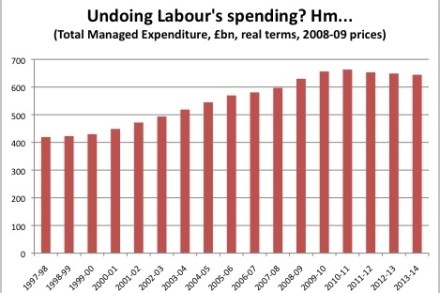
I had expected Alistair Darling to have slumped off to spend more time with his memoirs after the election, but here he is, fists aloft, fighting the government. About the only member of the Labour front bench effectively doing so. He has a point. The economy is looking better than expected, not worse – as David Cameron has been pretending. Each new forecast for the deficit seems to give a less ghastly picture. British house prices are on the rebound. And when the Office of Budget Responsibility announces its forecasts on Monday, it is likely to give a better picture than that in Darling’s budget. Already Darling is telling the

Ed Balls and the art of campaigning

I thought that Ed Balls would be a natural for opposition politics. But I’ve been struck by the naivety of some of his recent interventions – notably the Duffy-wooing immigration proposal. As James has argued, Balls’ plan to limit freedom of movement within the EU ia classic opposition politics. They are eye-catching, populist and but completely unworkable in practice. But Balls isn’t really in opposition yet: the Labour party is caught in a kind of limbo whilst it determines its future, a future that Balls wants to control. Advocating the unimplementable looks conniving rather than statesmanlike, naïve rather than astute. It provided an opportunity for his opponents, and Peter Hain,

Coulson on £140,000

The list of Special Advisors pay is out. The headline grabbing figures are that Andy Coulson is on £2,500 less than the PM, and that the overall bill is allegedly £1.9m less than Labour’s. Also, George Osborne appointed Rupert Harrison and Eleanor Shawcross to the Council of Economic Affairs, but they will claim no extra salary. And, for those interested, there are 5 SpAd vacancies in government. Still, £4.9m is a lot of money for unaccountable, party officials. Some time ago, I asked if Cameron would govern any differently. Transparency and cost-cutting are welcome, but wearing fewer garments doesn’t change the innards of a government.   

Ed Miliband pitches at change

Obviously, the Labour party must change and make a clean break with the era of Blair and Brown. I have my doubts if any of these candidates, other than incredible Diane Abbott, can escape the politics that moulded them. None have said anything substantively new. They are not wedded to the past; they pine for it. Today, however, Ed Miliband has suggested that he would break from New Labour. He has written an article for the Mirror, arguing that he would keep the 50 percent tax rate. His analysis is: ‘There is something wrong with a society where nurses earn less in a year than bankers – whose botched deals

BREAKING: Abbott has made it onto the ballot

David Miliband’s patronising ruse has worked. The rumours that have circulated for half an hour or so have now been confirmed by the BBC. I wonder what damage Abbott will now cause the other candidates? Also, what does it say for the case for diversity and Labour’s internal policy debate if Abbott’s election was a stitch-up?  

The Labour leadership race descends into farce

Perhaps it’s just me but this morning’s Labour leadership machinations are a farce of political correctness. Everyone is falling over themselves to be as nice as possible and essentially rig the ballot so that Diane Abbott receives a nomination. As James notes, it’s a peculiar tactic as Abbott will cause no end of trouble for the ‘serious’ contenders for the ultimate prize. Needless to say, David Miliband, that auteur of absurdity, planted the banana skin. Attempting to be magnanimous but excelling in pomposity, he has voted for Abbot and urges all to do the same. My hunch is that there are many on the right of the party who will

John McDonnell pulls out of Labour leadership race in an effort to get Diane Abbott on the ballot

John McDonnell’s decision to pull out of the Labour leadership contest should help Diane Abbott get the number of nominations required. But it is worth pointing out why so many Labour people at Westminster are not thrilled about this prospect despite the fact she would stop the contest from being between four embarrassingly similar figures. Their fear is that Abbott—with her TV skills and fondness for one-liners—will spend the contest making jokes at the expense of the four white male Oxbridge special advisers turned politicians she is running against. She won’t win but the tags she applies to her opponents could stick, making it even more difficult for the new

A day of elections at Westminster

By the end of the day, we will know the identity of the Liberal Democrat Deputy Leader and the chairmen of Select Committees as well as a sense of the shape of the Labour leadership contest. The races for the Select Committees are a mix of near certainties and unknown quantities. Keith Vaz is expected to return to the chair of the Home Affairs Committee. Michael Fallon is understood to have the backing of the members of the Treasury Select Committee, whilst his rival Andrew Tyrie is in with a shout of winning the cross party vote. The leadership races are clear cut. Simon Hughes’ team have briefed that their

Ed Balls and the art of opposition

There’s been a lot said about Ed Balls’ Observer piece on immigration. But the most striking thing about it to my mind is that it shows that Balls has made the transition to an opposition mindset.   Take his proposal that ‘Europe’s leaders need to revisit the Free Movement Directive’. This is classic opposition politics; suggest something that sounds good but it practically impossible. The other EU member states are unlikely to agree to agree to renegotiating this directive. But the Tories can hardly point this out; emphasising the UK government’s impotence when it comes to changing the rules of the game would hardly go down well with the Tory

The Prince of Darkness passes into night

If Ed Miliband wins, it’s curtains for Peter Mandelson. Michael Crick reports this exchange between GMB president Mary Turner and Ed Miliband. ‘”As Labour leader, would you invite Peter Mandelson to join your shadow cabinet?” “All of us believe in dignity in retirement,” replied Ed Miliband.’ Is Mordor mobilising? You bet your sweet life it is. No. In reality, I think that Mandelson, the uncompromising diarist, is finished with frontline Labour politics, and it with him.

The previous government’s economic failure laid bare

As Ben Brogan notes, there was a clean symmetry to David Cameron’s speech this morning: the crisis was Labour’s fault; therefore, Labour is to blame for the painful measures needed to restore stability. As Cameron put it: ‘I think people understand by now that the debt crisis is the legacy of the last government. But exactly the same applies to the action we will take to deal with it.’ Cameron made constant reference to the actions of the ‘previous government’. As a foretaste of what the Independent Office for Budget Responsibility will expose, Cameron alleged that Alistair Darling withheld estimates that Britain will be repaying £70bn per annum in debt

How the coalition makes room for Labour

Whoever wins Labour’s leadership, whether it’s a breed of Miliband or Balls, its future will be dominated by its understanding of how it found itself on opposition benches. Philip Gould, Tony Blair, Gordon Brown and the other progenitors of the New Labour project – were wrong. Their fatal assumption was that their core vote, the working classes, had no-where else to go. Labour, therefore, could reach out the middle classes, broadening their support and thus New Labour was born. At first their calculations were correct. Two slogans, “Education, Education, Education” and “Tough on Crime, Tough on the Causes of Crime” brought together the two separate demographics to create a powerful

Balls: we have to be more bigoted

Meet Ed Balls, the candidate for Mrs Duffy. As the race for nominations closes, the Labour leadership candidates are beginning to focus on party members. With varying degrees of conviction, the contenders have identified immigration as the issue the party must address if it is to reconnect with those voters who spurned it. Ed Balls is that analysis’s most fervent advocate. He devoted an article in the Observer to the subject.  Balls argued that there has been too much migration from Eastern Europe, and it has caused economic and social ills in communities such as the one he represents. In hindsight, Britain should have accepted the transitional controls during the eastern bloc’s accession in 2004. Labour rejected

Labour leadership contenders eyeing the past, not the future

I wonder if the Labour leadership contenders worry that the previous generation’s forthcoming memoirs have created more excitement than them? I would be. The insipid campaign has laid bare the paucity of talent on Labour’s benches, and the party’s ideological exhaustion. No serving Cabinet minister lost their seat at the election; Tony Blair aside, the Milibands and Ed Balls are the best Labour has. That’s a grim prospect if your colour’s red. Ed Balls has the panache of a Vauxhall Zafira; and the two Milibands are trapped in a Beckettian whirl of meaningless jargon, convinced that using abstract nouns is a mark of vital intelligence. It isn’t; it’s irritating, and

Harman’s schtick

Harriet Harman is irresistibly attracted to the absurd. This morning, she has decreed that the shadow cabinet be split 50:50 between men and women. Naturally, she would pervert Labour party rules to ensure the quota was a statutory requirement. To be honest, I’ve lost track of Harman’s myriad ruses to increase the female presence in high politics; and to be equally honest I’m no longer interested. It’s Harman’s schtick, leave her to it. Speaking to the national Unite conference, Harman made some sensible points about Labour’s electoral failure. She said: ‘We must listen and learn… Our biggest loss of support was from hard-working families who, worried about housing and jobs,

The Third Man for the third way

Peter Mandelson’s Machiavellian streak runs deep. Like the wily Florentine, Mandelson wants to retire to the country to farm and be close to the earth; but first, there is the small matter of a book for political princes. In this morning’s Times, Mandelson has written an exhaustive plug for his forthcoming book, The Third Man: Life at the heart of New Labour.   In the course of writing his publisher’s press release, Mandelson makes two important points: one historical and one current.   He admits his greatest mistake was to broker Blair and Brown’s deal in 1994; the soap opera that followed, Mandelson argues, would never had occurred had they fought it

Labour’s gruelling task

There was a great sense of pathos after the election, when Jack Straw was the only Labour politician who could recall the shadow cabinet room’s location. It must have been surreal for those who knew only government. The loneliness of opposition would have struck at last week’s Queen’s Speech. The party must renew whilst avoiding the internecine struggle that condemned the Tories to 13 years in opposition. Fantasy politics won’t be sufficient. Introspection must yield a coherent and credible agenda, free from the undeliverable abstractions and the oscillation between arrogance and desperation that characterised the Brown government. The leadership campaign will define Labour in opposition; Hopi Sen offers the contenders