Ireland

The Irish Ask Another Brussels Question

From our UK edition

And, as we know, Brussels has a habit of changing the answer any time anyone offers the wrong inconvenient answer. Nevertheless, the Irish government's decision - made on the advice of the Attorney General - to hold a referendum on the latest EU "Stability Pact" is not, I hazard, likely to please everyone: "I am very confident that when the importance and merit are communicated to the Irish people that they will endorse it emphatically by voting yes to continuing economic stability and recovery,” the Taoiseach [Enda Kenny] said. The compact, agreed at special EU summit earlier this month, proposes tough new budgetary discipline on each euro zone state, including near-zero public deficits. It has already been approved by 25 of the EU’s 27 members.

The forgotten victims of the Troubles

From our UK edition

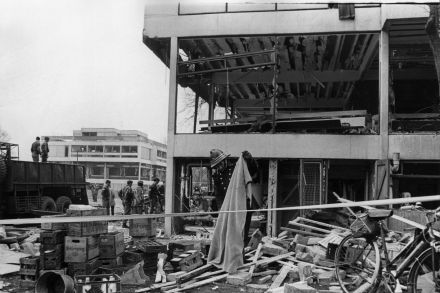
This post, marking the 40th anniversary of the Aldershot bombing, was published earlier on the Biteback website. But as its author, Douglas Murray, is a regular here on Coffee House, and as its subject matter is so important, we thought we'd re-post it here: The 30th January this year was the 40th anniversary of Bloody Sunday, the day when members of the British Parachute regiment shot dead fourteen civilians on the streets of a British city. The constant commemoration of that day by families of the dead and injured was one of the things that kept its memory alive and eventually led to the British government setting up the Saville Inquiry.

Can Home Rule Solve Scotland’s Problems?

From our UK edition

This is not a Question To Which the Answer Must Be No. I too saw the headline Now 51% Back Independence and thought, "Well, that's interesting but implausible". Then I noticed it was a Sunday Express splash and revised my appraisal to "That's obviously cobblers". And so it is, making it mildly foolish for SNP types to boast of a breakthrough on the back of a sample of 200 Scots that's harldy more dispositive than polling, say, my Facebook pals. Nevertheless, Fraser's post yesterday won't quite do either. For instance, the boss writes: My hunch is that Cameron’s intervention will not have helped Salmond.

26 versus 1 — really?

From our UK edition

Judging from much of the coverage in UK media, you would be forgiven for thinking that Britain is on the fast track to becoming the North Korea of Europe — eccentric and completely isolated from the rest of the world. Indeed, the media narrative over the past couple of days has largely treated the agreement reached at the summit as concrete, supported in full by everyone apart from Britain. Or ‘27-minus’, as Commission President Jose Manuel Barroso put it. The reality, of course, is quite different. Leaving aside whether Cameron could have played his cards better (he could have), as Gideon Rachman pointed out in yesterday’s FT, ‘the picture of an isolated Britain’ will become blurred as the rest of Europe grapples with the Merkozy deal.

Sarkozy’s Victory

From our UK edition

This is, according to the Spitfire & Bullshit brigade, a great triumph for David Cameron and, more generally, for euroscepticism. If so, I'd hate to see what defeat looks like. What, precisely, has the Prime Minister vetoed? It seems to me that the Franco-German european mission remains alive and well and, if viewed in these terms, Britain has been defeated. That is, the price of a short-term tactical success may be a longer-term strategic defeat. Of course, the Prime Minister had to avoid a treaty that would, sure as eggs be eggs, be vetoed by the British people via a referendum. In that sense, he prevailed. But this is a pretty narrow victory, especially when set beside the prizes claimed by other governments. The biggest winner of all, it seems to me, is France.

Difficult Choices Are Never Easy

From our UK edition

So spake the Taioseach, a Mr Enda Kenny of County Mayo, on Sunday night. Difficult choices are never easy. There is something near-fabulous about the phrase. It has certainly prokoked Fintan O'Toole most severely. He's in rasping form this week Savour the phrase. Hold it to the light. Swirl it round the glass. Stick your nose in deep and inhale the rich aromas of full-bodied absurdity. Get the pungent whiff of carmelised cliche and curdled smugness. Imagine the work that went into crafting it, the bleary-eyed, caffeine-soaked speechwriters in their lonely eyrie, in the early hours of Sunday morning, running through the variations: hard choices are seldom soft; nasty things are never pleasant; difficult options tend to be difficult.

How To Lose An Argument: Jim Murphy Edition

From our UK edition

Meanwhile, in more examples of sloppy Labour arguments here's a tweet Jim Murphy sent this afternoon: Oh dear. Murphy is usually better than this. I know and everyone else who pays any attention to Scottish politics (this includes Jim Murphy) knows that Alex Salmond has long admired the Republic of Ireland's low corporation taxes; he has almost never bothered talking about personal or consumption taxes. Furthermore, few sensible people think Ireland's boom and bust was fuelled by or made significantly worse by its low rates of corporation tax. To hint otherwise, as Murphy seems to here, is either foolish or dishonest. It is possible to think low business taxes a good thing while also supposing it might be a good idea to avoid the mistakes and excesses that led Ireland to bankruptcy.

A Republic, If You Can Keep It

From our UK edition

The symbolism of this is pretty dire. These are still times for bitter melancholy in Ireland and many a Dubliner has rarely felt as republican as he does now that the state's sovereignty* is, shall we say, not what once it was. This, a friend says, is just another tale of life "under the occupation": Taoiseach Enda Kenny has rejected reports that details of next month's Budget, including a planned hike in the VAT rate, were shown to German officials yesterday. Mr Kenny met chancellor Angela Merkel in Berlin yesterday after which reports emerged that the Irish Government was planning raise the top rate of VAT by 2 per cent to 23 per cent. According to documents presented to a Bundestag budget committee, the measure would generate an additional €670 million for the Government.

Some context for the ongoing growth debate

From our UK edition

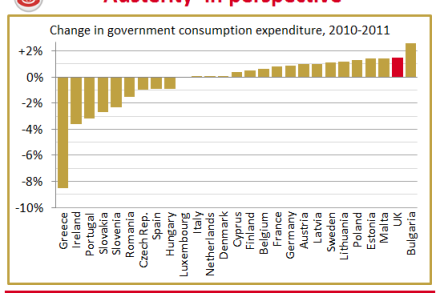
Listening to Ed Miliband's speech today, you'd be left with the impression that the UK is suffering a huge decline in government spending this year, and that this is to blame for most of our economic ills. The facts are a little different, as the below chart shows. The European Commission estimates that the UK is likely to have the second largest growth in government spending of any of the EU’s 27 members this year, clocking in at a robust 1.5 per cent increase for the year. Yet this has done nothing to help the UK’s relative growth performance. The UK is forecast to be the fifth slowest growing economy in the EU this year, ahead of only Greece, Portugal, Cyprus and Italy.

The Italian domino effect

From our UK edition

For all the debate about Theresa May and border security, the big news has not been at Westminster today. Instead, people have been watching what is happening in Italy. For it is far from certain that Europe, or the Western world for that matter, has a bucket bigger enough to bail out a country that owes more than Greece, Ireland, Portugal and Spain do combined. As the New York Times reports, the European Central Bank is reluctant to step in and start buying Italian bonds because it fears that its previous bond buying efforts have simply enabled the Italians to avoid necessary reforms. It feels that only market pressure will make the Italians actually act. But this is a dangerous game to play because if Italy falls, France will be left teetering on the brink. BNP Paribas has 12.

Ireland picks its President

From our UK edition

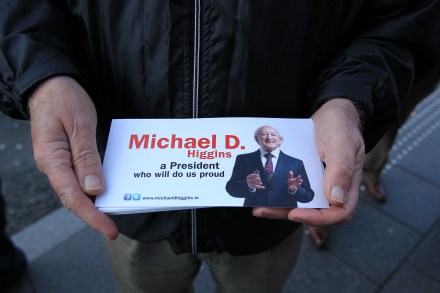
Well, the oldie got it. Michael D. Higgins — commonly known as Michael D — has all but won the Irish presidential election. The little man who resembles a bard or a leprechaun, depending on your point of view, appears to have beaten off six undistinguished competitors to succeed the formidable Mary McAleese. At 70, he was the oldest in the field and looks, in fact, rather older. You could say it’s a victory for non-partisan, non-party politics. Mr Higgins was the Labour candidate but he stood aloof from the fray during the campaign, declining to criticise his opponents.

Irish Economic Meltdown: It Wasn’t Fianna Fail’s Responsibility!

From our UK edition

Even by the lofty standards of delusional politicians, Bertie Ahern remains a man apart. The former Taoiseach who once boasted that "the boom times are getting boomier" has a novel theory to explain Ireland's economic bust: it was the fault of the newspapers. Apparently they were too interested in writing about the curious way in which Bertie's life was funded by a number of generous and wealthy pals and businessmen. If they hadn't been persecuting the cutest hoor on the northside perhaps they'd have noticed what else was going on. Really, this is what the man says: Bertie Ahern has called for an investigation into the media for what he said were failures to follow the economy because journalists were more concerned with following his dealings with the Mahon tribunal.

On the Centenary of Flann O’Brien

From our UK edition

How many times must a man be considered "overlooked" or recalled as a "forgotten genius" before it must become apparent to even the meanest inteligence that he can no longer sensibly be considered "forgotten" or "overlooked"? This is something worth observing in the case of Brian O'Nolan, better known to you perhaps as Flann O'Brien and, to the true cognoscenti, as Myles na Gopaleen too. What with an official stamp available as of this very day, the centenary of his emergence in bonny Strabane, a lengthy piece by Fintan O'Toole to say nothing of puffery in the New Yorker and the Guardian and lord knows where else, you cannot credibly say the old fella has been forgotten.

No, Martin McGuinness is Not a Fit and Proper Person.

From our UK edition

Since I've always thought Shaun Woodward a nasty little toad it's reassuring to discover the man will do nothing to earn a reassessment. Is anyone surprised he is entirely relaxed about Martin McGuinness's campaign for the Irish presidency? Of course not. why would ayone be surprised? As the dreadful Woodward made clear, speaking at a fringe event at the Labour conference, McGuinness's campaign is in some sense the next step in the "peace process". Yes, really, Martin McGuinness, mass murderer, is a "fit and proper" person to be Head of State.

An Irish Recovery?

From our UK edition

I think it's tiresome the way countries in desperate economic trouble are treated as lab rats by pundits far away whose sole interest in their travails lies in their providing an argument to buttress favoured policies back home. It's a pretty grim game, really. So when Paul Krugman spends a summer writing about Ireland's enforced austerity he's not really writing about Ireland at all. He's arguing about the United States and never mind what the hell happens to the poor, miserable Irish. The worse things go for them, the better they go for the Krugman school. Tyler Cowen documents all this rather neatly. This doesn't mean that a return to economic growth in Ireland (while Spain remains sluggish) demonstrates the wisdom of austerity's advocates.

Martin McGuinness Asks Ireland to Forget History

From our UK edition

Martin McGuinness's campaign for the Irish Presidency is, of course, a disgusting affair. How could it ever be otherwise? But even by Sinn Fein's grim standards, it's off to a loathsome, disingenuous beginning. Speaking on Irish radio this morning, McGuinness complained that a coterie of "West Brits" in the Dublin media are out to get him. Only someone whose loyalty to the Republic might be questioned by the more rancid brand of nationalist, you see, would be vulgar enough to bring up McGuinness's murderious past. Indeed, it's just "people who are hostile to my candidacy" who have the gall to mention McGuinness's IRA past. This is strange since, as Fintan O'Toole observes in today's Irish Times, the IRA and McGuinness himself has never repudiated its past.

All in a night’s work

From our UK edition

This inter-war story of an Anglo-Irish family in crisis opens with a bang. Caroline Adair, recovering from measles at Butler’s Hill, her aunt and uncle’s lovely house in the South-west, wakes in the night to find  Sinn Feiners surrounding the place. This inter-war story of an Anglo-Irish family in crisis opens with a bang. Caroline Adair, recovering from measles at Butler’s Hill, her aunt and uncle’s lovely house in the South-west, wakes in the night to find  Sinn Feiners surrounding the place. The family are given ten minutes to clear out. ‘Don’t be frightened, darling’, says kind Aunt Moira, ‘they won’t do us any harm, they only want to burn the house.’It’s a big ‘only’.

Irish Green Shoots?

From our UK edition

Could it be that Ireland has passed through the worst of the storm? Writig in the Financial Times yesterday David Vines and Max Watson argue that maybe, just maybe, it has. [T]he first and most important thing about Ireland is that it is swiftly restoring its competitive edge. Indeed it is moving rapidly towards a sizeable current account surplus – in a range of 3 to 4 per cent of gross domestic product. Of course, recession has also played a role in turning external accounts around, but a steady uptrend in exports has been underway for some time. The second element is that Ireland’s net public debt will probably peak at somewhere around 110 per cent of GDP.

The Last of Mr Norris

From our UK edition

Mary Robinson was (and is!) a woman and, just as importantly, the first President of the Republic of Ireland whose candidacy was not backed by Fianna Fail. Her successor, Mary McAleese is originally from Northern Ireland and thus, like Robinson, some kind of outsider. Both women expanded the idea of the Irish presidency and, in some small measure, helped refine the notion of what it means to be Irish in a modern european context. So you can see why some felt that David Norris, the independent Senator representing Dublin University in the upper house, would make an excellent candidate to succeed Mrs McAleese. These may be grim economic times but Ireland could make some kind of declaration about itself by electing europe's first openly gay head of state.