Iraq

The Iraq Inquiry should call Gordon Brown now

From our UK edition

Alastair Campbell is before the Iraq Inquiry. As one of Blair’s closest aides, Campbell’s role in the run-up to the Iraq war was key. But I suspect the spinner-in-chief will be doing what he was originally hired to do: namely, protect his master by attracting the incoming fire. In this case, though, he will be helping Gordon Brown, not Tony Blair.   Because it is Brown’s role in the Iraq War, not that of Blair, that is the most obscure part of Britain’s modern history. As chancellor, Brown was the second most powerful man in government. He held the purse strings. If he had opposed the Iraq War, it is hard to see Tony Blair succeeding in persuading Cabinet, the Parliamentary Labour party or the House of Commons.

Hoon may strike again

From our UK edition

David Miliband lacks the gumption to play Brutus, but does Geoff Hoon? The Sunday Times has obtained correspondence between Hoon, Brown and Blair illustrating that the then Chancellor overturned Treasury assurances that the MoD would receive additional funds for helicopters in Iraq and Afghanistan. Brown wrote: “I must disallow immediately any flexibility for the Ministry of Defence to move resources between cash and non-cash.” Once again we see the (supposedly) miserly Chancellor holding Blair to ransom at any opportunity, regardless of the consequences. Whilst Brown is a spectre of a Prime Minister, he was anything but as Chancellor.

More trouble lies in wait for the government

From our UK edition

Labour lost the first week of the long election campaign. The Hoon and Hewitt plot and the late and tepid endorsements of Brown from key members of the Cabinet have highlighted the divisions within the Labour party. Hoon and Hewitt were right that stories about these decisions will not go away. They will run and run right up to polling day. The weekend papers will also not be good for Labour. To compound Labour’s woes, it looks like the big political story of early next week will be Alastair Campbell’s testimony to the Iraq inquiry, which threatens to dredge up memories of spin and Iraq. It should be remembered, though, that Campbell is a formidable performer and could come out of this appearance far better than expected.

The “sleeper issue” of 2010: Yemen

From our UK edition

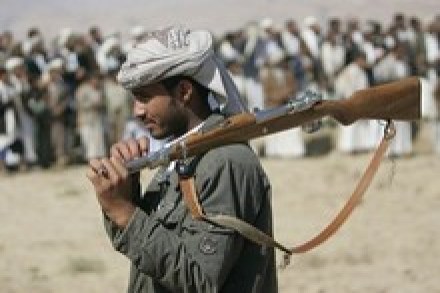
As Melanie Phillips says in her article for this week's issue of the magazine, the case of Umar Farouk Abdulmutallab highlights the role of other, less frequently discussed, countries in Islamist terror. One such country is Yemen, where Abdulmutallab is thought to have trained at an Al Qaeda camp. The US believes there may be a few hundred al Qaeda fighters in Yemen, centered on a group of key network leaders who are operating a number of camps.   Yemen has slowly been getting more international attention. A few weeks ago I was meant to go on Al Jazeera, but my appearance was cancelled at the last minute because, I was told, of other “breaking news”. Curious, I turned on BBC and searched the internet to find out what the headline-grabbing story could be.

Identifying Brown’s culpability in Iraq

From our UK edition

The Tories have missed a trick in responding to the predictable news that Gordon Brown won’t be giving evidence to the Iraq Inquiry until after the election. William Hague has just said that it stinks. He should have followed up by listing the questions Brown should be asked – highlighting the extent of his personal culpability in our defeat in Basra and treatment of the troops: 1) Did you ever ask yourself why Britain came to be fighting two wars on a peacetime budget? 2) During the 2007 Tory Patrty conference you went to Iraq and said that 500 troops would be home by Christmas. This decision stunned the Ministry of Defence, and turned out to have been – how can we put this, Prime Minister – untrue.

Pre-empting Chilcot

From our UK edition

Sir John Chilcot’s Iraq inquiry has begun honing in on failures of US and British post-conflict planning. As General Sir Frederick Viggers told the inquiry, problems arose from “not having defined the ends, ways and means of how we were going to deliver this phase of the campaign.” None of this is particularly new. As further evidence is provided to the inquiry, it will become even clearer how unprepared the British state – the Government, civil service and military - were for the task at hand, and how soldiers, diplomats and development workers were expected to deliver near-miracles with limited resources, limited backing, limited security and limited public support. I was there and it was not very pretty.

Blair admits to misleading the British public over Iraq

From our UK edition

It has taken eight years, but Tony Blair has finally leveled with the British public and admitted that the WMD thing didn’t really matter: he wanted to depose Saddam Hussein anyway. That's what he has said in a BBC interview, presumably to pre-empt his appearance before the Chilcot inquiry. His chosen confessor: Fern Britton. His medium: BBC1 on Sunday. It has been trailed to the newspapers, including tomorrow’s Times. As it says: "He said it was the 'threat' that Saddam presented to the region that was uppermost in his mind. The development of weapons of mass destruction was one aspect of that threat. Mr Blair said that there had been 12 years of the United Nations going 'to and fro' on the subject, and he noted that Saddam had used chemical weapons on his own people.

Iraq Inquiry Digest

From our UK edition

The Chilcot Inquiry is already proving a hundred times more interesting than anyone expected. My only worry is that people already view 2003 as ancient history. There is a tendency to think we already know what we only suspected. I was an agnostic on the intervention. I hoped in would work, but worried that it would be a disaster. I still think it is too early to tell whether it was.  What is certainly the case is that most British journalists failed to hold the government to account at the time. Even at the height of excitement about the Hutton Inquiry, much was missed by those being paid to cover the hearings.

The Iraq inquiry we should be having

From our UK edition

Do we still have the will to win in Afghanistan? If so, the question the Iraq inquiry should be asking is not “how did we get into this war” - we have had a number of separate inquiries into that already – but “why were the military defeated on the ground in Basra?”. If the Chilcot Inquiry were to focus on that, it might actually serve a purpose: not just in unearthing new information (which it has signally failed to do so far) but drawing lessons that just might help the troops in Afghanistan. I make this point in my News of the World column today. I am in a tiny minority of people who a) supported the war in Iraq, and b) still admits it. People like me feel every bit as angry as the anti-war people about what happened next.

Smoking guns and missing memos

From our UK edition

Sir Christopher Meyer gave evidence to the Chilcot inquiry this morning. He spoke with characteristic flamboyance, awash with elegant witticisms and indiscretions calculated to amuse. Amid this tour de force, Meyer released one potential weapon of mass destruction. Hans Blix was given too little time to conduct a satisfactory inspection. Courtesy of Andrew Sparrow, here is the relevant transcript: ‘The real problem, which I did draw several times to the attention of London, was that the contingency military timetable had been decided before the UN inspectors went in under Hans Blix. So you found yourself in a situation in the autumn of 2002 where you could not synchronise the military timetable with the inspection timetable.

Will Chilcot be any different?

From our UK edition

The Chilcot inquiry’s precedents don’t auger well. It's unfair to describe the Hutton and Butler inquiries as 'whitewashes', but their colour was certainly off-white. That said, the condemnatory characterisation of Sir John and his panel as ‘establishment figures’ is redolent of a lower-sixth common room circa 1968. Who else could conduct this inquiry? Mohammed al-Fayed? Pete Doherty? The Bishop of Bath and Wells? The Iraq controversy has not abated and a panel of angels would not be pure enough for some. But it’s absurd to suggest that anyone besides officials and foreign policy experts, with an intricate knowledge of the practices and issues concerned, should or can decide such matters.

Shaming allegations that reveal the full horror of the Iraq war

From our UK edition

The Independent's front page splash about British troops torturing and sexually abusing Iraqis in 2003 has, to put it mildly, put me right off my cornflakes. The allegations are horrific. Acts of live pornography designed to humiliate sexually conservative Muslim sensibilities, the electrocution of detainees, beatings, rapes and widespread detention without charge - the echoes of Abu Ghraib resound. Phil Shiner, the lawyer representing all the Iraqis, wrote to the MoD saying: 'Due to the wider access of information and disclosure in the US, we do know that sexual humiliation was authorised as an aid to interrogation at the highest levels of the US administration.

My BBC Radio 4 Analysis programme on Secrecy

From our UK edition

Can secrets ever be good for you? I used to describe myself as a “free speech fundamentalist” and believed that there were almost no circumstances in which official secrets should be withheld from the public (one exception was when disclosure would put the lives of individual members of the armed forces or intelligence services at risk).  But over recent years I have become worried that the cost whistleblowers pay for their disclosures is too high. I worked closely with two high-profile leakers, Katharine Gun from the government’s secret surveillance centre, GCHQ, and Derek Pasquill, a former Foreign Office civil servant. Both ended up being hauled in front of the courts and both have found it difficult to find work since.

The Generals & Their Plan of Attack

From our UK edition

Actually, the General Staff's manoeuvres on Fleet Street have, alas, been rather more successful than their efforts in Basra and Helmand province. I commend*, therefore, Paul Robinson's article in this week's edition of the magazine in which he argues that the Generals must take their share of responsibility for recent military failures. More provocatively still he suggests the Army has been saved by Labour since without Tony Blair's zeal for expeditionary warfare it's not quite clear what the army would be for these days. There's something to that in as much as I suspect that if Blair had not committed us to the wars in Afghanistan and Iraq, the MoD budget would be, once again, the first port of call for Chancellors hell-bent on cutting costs across Whitehall.

Defensive moves

From our UK edition

So, General Dannatt is to be a Tory Peer. This worries me greatly. On balance, General Dannatt did a good job as Army chief. Not a great job, but a good one. His interventions boosted the morale of frontline troops and his concern for the care of soldiers, especially the wounded, was important. Conversely, many defense analysts thought he was too cautious on military reform, blocking the Army’s transformation into an effective counter-insurgency force and opposing stop gap procurement in case it compromised future acquisition projects. But the real concerns over General Dannatt’s ennoblement are different. General Dannatt should have given his sucecssor a clear run at the job. He should have had the decency showed him by his predecessor, Mike Jackson.

What Next for the “Decent” Left?

From our UK edition

Earlier this month I was asked to address an audience about what future there might be for the “decent left”. For those unfamiliar for the term this is the tendency on the left generally associated with backing the Iraq War (though some of the key advocates of this approach did not), opposition to alliances with extreme-right Islamism and the identification of a tendency towards anti-Semitism in some left-liberal discussion of Israel and the Middle East. The Euston Manifesto, published in 2006 expressed some of the thinking of The Decents. On the key issue of  the Iraq War, I was an agnostic.

A devastating assessment

From our UK edition

This quote from a retired aide to General Petraeus about the British performance in Basra is, as Alex Massie says, devastating: "The British failure in Basra was not due to the conduct of British troops, which was exemplary. It was, rather, a failure by senior British civilian and military leaders to understand the political dynamics ... in Iraq, compounded by arrogance that led to an unwillingness to learn and adapt, along with increasing reluctance to risk blood and treasure to conduct effective counter-insurgency warfare... ...British commanders attempted to cut deals with local Shia leaders to maintain the peace in southern Iraq, an accommodation that was doomed to failure since the British negotiated from a position of weakness.

A Nice Little War for Slow Learners: Is the Army Fit for Purpose?

From our UK edition

Most arguments about Afghanistan this summer quickly became another opporturnity to bash the Prime Minister and the Ministry of Defence. No surprise there and, of course, a good deal of the criticism about the shortage of helicopters and other equipment has some merit to it. But the government's failures, manifold as they are, ought not to be the sole focus of attention. They matter, but so too does the actual performance of the armed forces. Is the Army doing enough with what it's got? And can it legitimately be expected to do better? The political leadership in London matters, but that doesn't mean the Army top brass can deftly shift all responsibility for failure onto Ministers and civil servants.

George W Bush: Terrorist Appeaser?

From our UK edition

Well, according to Dick Cheney, George W Bush was just as almost as bad as your average America-hating euro-weenie or member of the Democratic Congressional caucus. Barton Gellman - whose sourcing is pretty good - reports that: Cheney's disappointment with the former president surfaced recently in one of the informal conversations he is holding to discuss the book with authors, diplomats, policy experts and past colleagues. By habit, he listens more than he talks, but Cheney broke form when asked about his regrets. "In the second term, he felt Bush was moving away from him," said a participant in the recent gathering, describing Cheney's reply. "He said Bush was shackled by the public reaction and the criticism he took. Bush was more malleable to that.

MPs and Whistleblowers

From our UK edition

I'm delighted to see Tony Wright's Public Accounts Committee recognising what many of us knew all along: a "culture that encourages proper whistleblowing... is the best safeguard against leaking". The BBC has an outline of the findings here. The challenge is shifting that culture. Unfortunately, Britain still has an instinct for secrecy. The  introduction of whistleblower legislation and the Freedom of Information Act have made surprisingly little difference to this deeply ingrained taste for keeping the public in the dark. I sincerely hope that the PAC's proposal that civil servants are given a route of disclosure through parliament will make a difference. But I have my doubts.