Investment

Investment special: Gaining from a housing recovery

From our UK edition

The long period of dormancy for Britain’s housing market looks as if it is coming to an end — though there are huge regional differences. Central London remains exceptional, with the influx of overseas buyers into Kensington, Chelsea and adjoining neighbourhoods creating a microclimate of surging prices that has little to do with economic fundamentals — and has the political left salivating at the thought of a ‘mansion tax’ on properties worth £2 million-plus, even if that means turfing elderly widows out of family homes. Some five years on from the financial crisis that brought many lenders and house-builders to their knees, there are signs of a broadly based recovery.

The wealth transfer and where it’s going

From our UK edition

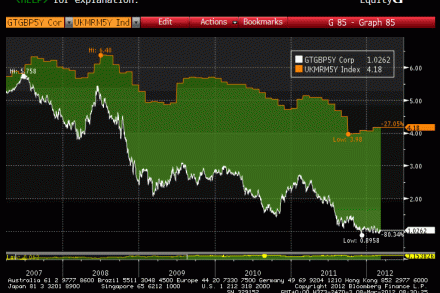
The last three years have been one big transfer of wealth from savers to borrowers. Thanks to record low interest rates, savers have gained little from tucking their money away in bank accounts, whereas borrowers have reaped the benefits. According to data from the Bank of England, mortgage holders paid interest of £1328 billion in the three years from 2008-2011, compared to £1897 billion in the preceding three years. That's a difference of £569 billion, or just over £50,000 for each of the UK's 11.2 million mortgage holders. Call it a stimulus if you like. But it's a stimulus that involves clobbering savers so that borrowers can buy a flatscreen TV at the end of the month. There are signs, though, that this transfer is slowing.

Euro-zonked

From our UK edition

Well, so much for that. The FTSE 100 fell as much as 1.7 per cent this morning, while overnight the euro and Asian stock markets tumbled, after Europe’s leaders announced their grand 2-trillion-euro plan over the weekend to drag the Eurozone out of the mire. It appears the markets are well past the point of believing that political leaders can get us out of this mess. The consensus is that the plan is not concrete enough. Of course, equities may recover a bit later, as they have been prone to do in past days. But the whipsawing itself is the worst sign of all; stock investors and retail-end funds are confused, panicky and probably still in denial.

A hotel on the Strand is a potent symbol in the great money-Monopoly game

From our UK edition

‘A jolly nice little place for lunch, handy because you can get to it on a number 11 bus.’ That was a senior partner of Cazenove the stockbrokers talking about the Savoy in the days when captains of industry and City grandees treated its Grill as their canteen — and my predecessor Christopher Fildes, who nicknamed it the Dealmakers’ Arms, was often at the captains’ tables. ‘A jolly nice little place for lunch, handy because you can get to it on a number 11 bus.

The bond supremacy

From our UK edition

The crash has led to a new boom in corporate bonds. When Tesco’s debt yields more than its shares, every little helps When the Bank of England began its £200 billion programme of quantitative easing — ‘QE’, its technical name for printing money — at the height of the credit crisis in March last year, it made two important discoveries. The initial plan of the Bank’s markets director, Paul Fisher, was to use the money to buy up bonds issued by major companies. This, it was hoped, would put cash into company balance sheets and help prevent the crisis cascading though the rest of the economy. But the Bank quickly learned that, apart from a few blue-chip companies, the market in UK corporate bonds was virtually nonexistent.

Look for the silver lining

From our UK edition

Outsourcing firms and insurers may find opportunity in the government’s fiscal crisis It’s an ill wind that blows no good and, counterintuitively, some companies could benefit from next week’s government belt-tightening. Despite fears that spending cuts may stall fragile economic recovery, firms which provide services more cheaply than the public sector may enjoy increased turnover and profits. Outsourcing companies ensure that light bulbs are replaced and loo rolls supplied, among a wide range of other ‘facilities management’ services, without the need to provide expensive final salary-based pensions and other benefits for staff.

Art is a high-risk business

From our UK edition

Never before have so many people in so many places collected works of art. In the past decade, the auction houses in particular have made heroic efforts to expand their markets, both by reaching out to emerging economies and by embracing new technologies. Thanks to instant translation by online search engines and live online auction platforms, it is now as easy to buy a work of art offered by an English provincial auction house or a Manhattan dealer while sitting in Guangzhou as it is from Guildford. The international art market has become global, and art is now seen as an asset class for investors. Given the current performance of the global financial and property markets, it is probably fair to say that more people than ever are tempted to put their money in works of art.