Immigration

Why the Tories should talk about immigration

From our UK edition

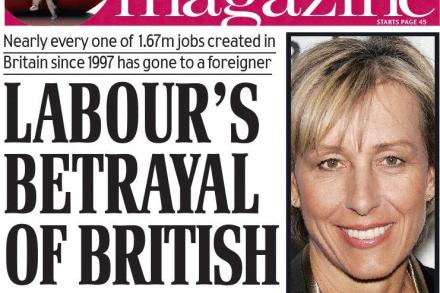
Should the Tories talk about immigration? This will bring back a lot of bad memories for the modernisers, who believe that this hurt them in 2005. But, as Tim Montgomerie says over at CiF today, the picture has transformed since then. The total number of immigrant workers has risen 25 per cent, to 3.5 million. And nationally, immigrants now make up a remarkable 15 percent of the workforce (see graph below) – which puts us up there with America. Except our immigration is handled in a haphazard way that creates plenty of bad feeling. Talk to a Tory candidate and they will say there’s only one issue that gets cut-through on the doorsteps. And, so, all parties seem to be adopting a “shout it locally, say nothing nationally” approach to immigration.

Why won’t immigrants assimilate?

From our UK edition

Some readers don't think it's fair or reasonable for people living in rural areas to talk about immigration. Fair enough, though it's not as though I've always lived in the countryside. Anyway, some country dwellers don't much like immigrants either. Here's a note from a Dordogne correspondent: I live in the countryside and have pretty strong views on some immigrants. I'd like some of them to hop back over to the other side of the channel seeing they can't be bothered to learn French or even be polite enough to say Bonjour (or even Bonn Jaw) when they go into shops etc. l think many of them think they are in Kenya c.

Immigration: The BNP are Winning and Britain is Losing

From our UK edition

One of the odder aspects of contemporary politics is the amount of attention lavished upon the goons at the BNP. Anyone would think they were about to win the election. But they're not. Nevertheless, grant Nick Griffin and his pals this: they've managed to hijack the debate - such as it is - on immigration. Despite what the media might have you think, there is no party of open borders in this country. Instead both the Tories and the Labour party effectively concede the argument to the BNP. Labour boast that they have immigration "under control" and then the Tories complain that the government isn't "cracking down" hard enough. The dreadful Phil Woollas and the likes of Damian Green may be more sophisticated than Griffin and his mob but they differ from him in degree, not in kind.

Some reasons to be cheerful about Cameron and the Tories

From our UK edition

By way of a response to the comments on my post yesterday, here are some reasons to be cheerful about Cameron and the Tories. The poll lead dropping to six points is indeed a wake-up call, and Cameron probably worked out a while ago that things were going a bit Pete Tong. Indeed (Short the UK), there are signs that he has already started to act. Look at last Monday: three strong election videos, without a politician in sight. The perfect remedy to the Tragedy of Cameron's Head poster. The policy of allowing management buy-outs of government departments is bold, radical and entirely in keeping with Cameron's general policy of empowering the many, not the few.

Helping Haiti | 1 February 2010

From our UK edition

How best to help Haiti? Plenty of people will tell you that writing off Haiti's debt would be a good start. And, in truth, there's an argument to be made for doing just that. But no-one should think that will really have much of an impact on Haiti's ability to recover. What might make a difference, then? Letting Haitians leave Haiti, that's what. Alex Tabarrok has a handy chart: The downside: What if all the best, most energetic people leave? Haiti may be a special, especially awful case but it bears saying that Haitians aren't the only people who would benefit from greater international freedom of movement. Plenty of other third world countries would too.

Stimulating social mobility will take decades

From our UK edition

Another pallid dawn brings more statistics proving that Britain is riven by inequality – ‘from the cradle to the grave’, concludes the Hills report. Unless the offspring of professionals pursue a peculiar urge to be writers or enter Holy Orders, they will bequeath ever greater advantages to their children. For those in converse circumstances, Larkin’s line about inherited misery comes to mind, albeit in a slightly different context. 50 years of unparalleled prosperity, and social mobility has stagnated. Before the wailing and navel gazing begins, it must be asserted that the continued aspirations of the privileged and the fulfilment of their opportunities are not to blame.

Cameron has the positioning right – but fiscal questions remain<br />

From our UK edition

Here, CoffeeHousers, is my take on this morning's Cameron interview: 1. General demeanor: excellent, articulate, confident. The complete opposite from Brown. It does make you think that he should wipe the floor with Brown in the TV debates. 2. “Last week we saw William Hague and George Osborne going to Afghanistan together. First shadow Chancellor, the man who is going to be in charge of the money, on the frontline seeing what is going on in Afghanistan”. Indeed, but the NHS pledge and deficit cut pledge imply deep cuts to the military. To govern is to choose, and Cameron has made his choice: NHS spending before the military.

The House of Lords at its exceptional best

From our UK edition

Archbishop George Carey has his detractors, but his article in the Times is a candid explanation of the ills that unfettered immigration is causing this country. The tone is so frank it shocks; the title reads: ‘Migration threatens the DNA of the nation’. Carey, of course, is not inciting anything as palpably evil as eugenics or as unworkable as uniformity between different ethnic and regional groups; he refers merely to the essence of Britain’s political, religious and social institutions. Society is determined by the health of its institutions, and ours have disintegrated through apathy. Society is broken, though not in the manner that is often assumed.

The NYT: The Detroit bomber was radicalised in London

From our UK edition

It is a depressing fact that the Detroit bomber appears to have been radicalised in London. Today, the New York Times takes an extensive look at the bomber’s radicalisation in London. As the paper, which is not prone to hyperbole, says: “Investigators are now, in fact, turning a sharper and retrospective eye to the passage in Mr. Abdulmutallab’s life that began immediately after his summer in Sana, Yemen, in 2005, when he enrolled as a $25,000-a-year mechanical engineering student at University College London. In recent days, officials in Washington and London have said they are focusing on the possibility that his London years, including his possible contacts with radical Muslim groups in Britain, were decisive in turning him toward Islamic extremism.

Why not just scrap ID cards, then?

From our UK edition

So the protracted, wheezing death of ID cards continues, with Alistair Darling admitting in today's Telegraph that: "Most of the expenditure is on biometric passports which you and I are going to require shortly to get into the US. Do we need to go further than that? Well, probably not." The government are letting it be known that this doesn't contradict their existing policy, but their shifting rhetoric remains striking.  Last year, we had the then Home Secretary, Jacqui Smith, proposing that British citizens should be able to choose between a card and a biometric passport.  Earlier this year, Alan Johnson said that ID cards wouldn't be compulsory for British nationals, after all.

Don’t give us your unwashed masses

From our UK edition

Downturns turn people against immigrants. That’s normal. But even according to the statistical average, Britons are particularly unhappy about the state of immigration these days. In a new survey undertaken by the German Marshall Fund, seventy-one percent of Britons polled disapproved of Labour’s immigration policy. Spaniards (64%), Americans (63%), Italians (53%) are also sceptical of government action.  In contrast, 71% of Germans, 59% of Canadians and 50% of French approved of the steps their countries had taken. In fact, Britons are the most sceptical about immigration, with 66% seeing it as more of a problem than an opportunity – a jump of seven percentage points on 2008 figures.

Johnson: the Tories aren’t the “nasty party” when it comes to immigration

From our UK edition

There are plenty of noteworthy snippets in Mehdi Hasan and James Macintyre's interview with Alan Johnson today, but it's this passage which jumped out at me: "Johnson even chooses to defend the Tories on immigration, saying they represent a 'mainstream, centre-right' party engaging in a 'decent, centre-ground debate on immigration'. This, despite the Tories having stuck to the 2005 pledge, under Michael Howard, for an immigration 'cap', which - along with campaign posters asking 'Are you thinking what we're thinking?' - led to accusations of 'dog-whistle' politics." It's a truism that in order to have a sensible debate, you've got to be willing to actually have a debate – so it's encouraging that Johnson is taking this more conciliatory approach to the question of immigration.

Lou Dobbs 2012?

From our UK edition

Apparently it's a possibility. At the very least such a run would help Dobbs sell a few more books. Whether a Perot-like third party anti-immigration, anti-globalisation, anti-Wall Street crusade will be as appealing in 2012 as it seems right now must be a matter that's open for discussion. Perot wouldn't have been nearly so effective in happier economic times and 2012, one trusts, will bring cheerier economic news than 2009. Nonetheless, there's no point denying that Dobbs represents a set of sentiments that, generally speaking and most of the time, don't get much of a hearing or great respect in Washington. Still, if one of the most important things in politics is being lucky in your politics, thn Barack Obama must be licking his lips at the thought of Candidate Dobbs.

The liberal centre’s continuing confusion on challenging the BNP

From our UK edition

My recent post about the BNP has offended liberals as well as the hard right. Liberal Conspiracy’s Sunny Hundal writes: ‘David is highly confused. This is because he says: "The Spectator has maintained that the party’s domestic policies are inspired by racial supremacist ideology and that its economic policies are like Dagenham – that is, three stops beyond Barking." Yes, I’ll agree with that. The party’s domestic policies are indeed inspired by a racial supremacist ideology. Which is why people should avoid following those policies right? Except, he does on to say centrist parties “must engage with (and I mean engage with, not shout down)” BNP policies. What a muddle.

British jobs for British workers

From our UK edition

Further to Alan Johnson’s immigration statement on Monday, Gordon Brown will give a speech on the topic. The intention is to re-engage with core voters who have defected to the BNP. In an interview with the Mail, Brown acknowledged that the public were right to be concerned, especially in times of economic uncertainty and hardship. Brown is expected to tighten migrant employment controls so that migrants are only used where there are labour shortages. He will strengthen the ‘Labour Market Test’ by extending vacancy exclusivity for UK citizens from 2 weeks to a month, and pledges to retrain British workers. The proposals are welcome and the rhetoric is tough, giving some weight to the maligned call of ‘British jobs for British workers’.

From maladroit to managed

From our UK edition

Labour has at last acknowledged the damage the BNP’s rise has caused them. Interviewed by Andrew Neil, Peter Hain admitted that government failure on housing and migration had heightened the BNP’s appeal, and, in an interview in this morning’s Independent, Alan Johnson elaborates on his claim that successive governments have been “maladroit” in handling immigration. “Part of its (the BNP’s) attraction is that it is raising things that other political parties don't raise. It would take the absence of a national debate as the green light to distort the debate. It has absolutely no inhibition about lying about these issues.

Hain’s hollow rhetoric 

From our UK edition

This week’s interviewee on the BBC’s Straight Talk with Andrew Neil is Peter Hain. One of the topics for discussion is Labour’s disengagement with its core vote and the rise of the BNP. Hain admits that this can be ascribed to Labour’s failings and Westminster’s disengagement with voters. Certainly, Labour’s failure on housing and migration has been a major factor in Griffin’s rise. But there is nothing to suggest that Labour has the political strength to re-engage. Even after the recent furore, there have been no new initiatives on housing or migration, just pitiful contrition in the place of action. Hain’s outright refusal to share a platform with the BNP and engage with its arguments is a case in point.

The Neather Brouhaha: A Correction

From our UK edition

So I was wrong. It was a mistake to suggest that the alleged Neather Plot - that is, the conspiracy to "swamp" Britain with Labour-voting imigrants - was the kind of cockamamie scheme that could only be the work of over-excited junior clever chaps at the Home Office. Not so! It turns out that it's even simpler than that: the scheme didn't exist at all. Remember, Mr Neather originally claimed that a report from Downing Street's Performance and Innovation Unit saw immigration as a massive political opportunity for the government: But the earlier drafts I saw also included a driving political purpose: that mass immigration was the way that the Government was going to make the UK truly multicultural.

The Nonsensical Neather Plot

From our UK edition

Conspiracies are all the rage these days. And since this has turned into Immigration Week here one might as well address the Neather Brouhaha. This, British readers will need no reminding, refers to the uncovering of the nefarious New Labour plan to destroy Britain and spike the Tories' guns forever by destroying this green and pleasant land and turning it into a multi-cultural hellhole. We are led to understand that this was indeed a deliberate plot, apparently borrowed from the Democrats' presumed determination to make the United States a Spanish-speaking Banana Republic. The evidence [sic] for this rests upon two paragraphs from an article written by a former government speechwriter.

One More Trip on the Immigration Merry-Go-Round

From our UK edition

This post on immigration prompted a pair of fine, Chestertonian (in the sense of we the quiet people of England stuff) responses to which I think it's only proper that I reply. First, Carroll Barry-Walsh writes: Of course, it's the type of people we let in because there is a difference between letting in people who share our values, who want to - and take positive steps to - become British and discard those elements of their culture which are inconsistent with or hostile to our culture. And then there are those who simply come from the Third World and continue to live here as if they were still there but with more money.