Immigration

Immigration is so much more than an electoral issue

From our UK edition

Further to Daniel’s piece about declining immigration in Europe, it is worth highlighting this passage from Iain Martin’s column in the Mail: ‘But once in Downing Street, Cameron was confronted by research from his personal pollster, Andrew Cooper, which confirmed the true extent of public concern about high levels of immigration. Ironically, Cooper was one of the very modernisers in the Tory Party who did not want Cameron to be tainted — as he saw it — by being seen as tough on immigration in the run-up to the election. But now he has changed his tune — and taken the Prime Minister along with him.

How many refugees are actually coming to Europe?

From our UK edition

A human wave of refugees is supposedly setting off for Europe from North Africa. But what are the real figures? The first thing to note that refugees from North Africa come at a time when there has been a sharp decrease in the number of asylum applicants in the 27 EU member-states. Eurostat says that in 1992 there were 670,000 applications in the EU-15 and in 2001 there were 424,500 applications in the expanded EU-27. But according to the UN, the 27 EU member-states registered only 247,300 asylum claims in 2009 and 235,900 in 2010, a 5 per cent annual decrease.

Texas Lessons for Glasgow and Liverpool

From our UK edition

Since Rick Perry's campaign theme - assuming he runs - will be It Worked In Texas, it's worth observing that Texas's success in recent years is partly based upon the fact that it is easy and often cheap to move there. That's because, as Matt Yglesias points out, it's easy to build houses in Texas. In fact the average family in Houston is actually better off - once housing and transportation costs have been considered - than a comparable family in New York City. Since the great eastern seaboard cities have the advantages of antiquity and immense reserves of cultural capital that will always make them popular places in which to live, sunbelt cities such as Houston, Dallas and Phoenix need to find other ways of competing.

How the coalition hopes to fix Britain’s economic dysfunction

From our UK edition

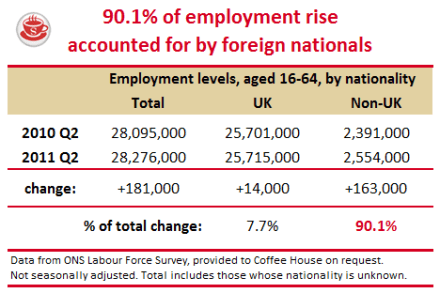
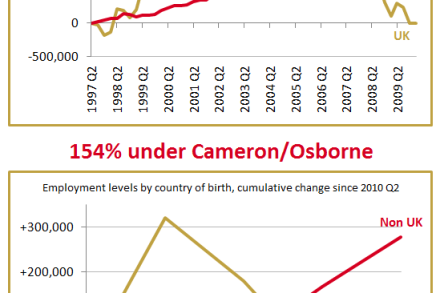
The largest welfare-to-work programme on the planet is launched today by Chris Grayling and Iain Duncan Smith. It’s not much of an exaggeration to say that the future of this country — and, perhaps, David Cameron – depends on its success. The lead article of this week’s Spectator looks at it, and we used various metrics — some of which puzzled David Smith of the Sunday Times. He understandably challenged our claim that 81 per cent of the new jobs created are accounted for by immigration. We had a Twitter "conversation" about it earlier this morning, but some things you can’t explain in 140 characters. So here is my argument: complete with data, sources and assumptions.

An Interesting Interview with John Major!

From our UK edition

Yes, really. Like his American contemporary George HW Bush, John Major has suffered from being sandwiched between two far more glamorous premiers and like Bush Sr this probably means he's under-rated these days. At the time his government often looked hopelessly weak and of course it often was, riven with feuding and driven to distraction by Europe and the Thatcherite legacy. Then there was Black Wednesday and the destruction of the party's economic credentials. Nevertheless, all these years later it seems remarkable that Major was able to hold it all together for as long as he did. As his successors' fate demonstrated leading the Tory party, not always a cakewalk at the best of times, was a double-whisky-before-breakfast kind of job in those days.

British Cities Are Not “Full”

From our UK edition

Further to this post on population increase, it's useful to remember that despite the undoubted pressures population growth causes for public services and other facilities, it is not accurate to suggest that Britain "is full". In fact there's ample room for more people as even a cursory comparison of urban population density demonstrates. Chart? Would it be disastrous if English (and Scottish!) cities were as densely populated as Boston or Chicago (12.75)? I suggest it would not. Indeed there'd be advantages to this. But that means reappraising planning and zoning regulations and permitting developers to build up as well as out. Otherwise there's little alternative to suburban sprawl. Now sprawl is not universally a bad thing but it comes with trade-offs of its own.

An Increasing Population is a Good Thing. So is Immigration.

From our UK edition

Plenty of folk seem to think otherwise. Including George Bridges who has written a very curious post for the Motherblog in which he seems most perturbed by the prospect of this happy isle's population increasing. He even suggests he's not doing his bit since Mrs Bridges is expecting their third child, presumably furthering the onrushing demographic apocalypse. Piffle. Good for Mrs Bridges and her fecund husband. Congratulations to them. May they produce this and many more little Bridges. A rising population is a feature of a healthy society, not the beginning of the end for this sceptered land. Of course an increasing population puts pressure on any number of public facilities and services, from transport to schools to housing to hospitals. But so what?

The challenge of demographic change

From our UK edition

There may be a lot of debate about what the “big society” means, but there’s one thing we should all be able to agree on: we live in a big society – and it’s getting bigger. 62 million today. 64 million in five year’s time. And then on up to 70 million by 2028, according to the government.  (No, I’m not doing my bit, as my wife is about to have our third child.) What’s odd is how little debate there’s been at Westminster about all this. Why? Partly because it means you have to talk about immigration (still seen as toxic by many in SW1); partly because it is one of those issues that is just so big that it almost saps the will to live.

Who cares about immigration? (Or education?)

From our UK edition

Who cares about immigration? In theory, everyone. It's always mentioned as the policy that exercises voters but is ignored by politicians. (Europe generally comes second in this category.) Let's see what YouGov reports. In one of their tracking polls this week they asked voters to pick the three most important issues. Chart? Fully 66% of Conservative supporters think immigration a vital issue, as do 54% of Londoners and 55% of C2DEs. Other points of interest: only 11% of Tories say Tax is one of the three most important issues, the same percentage as thinks education is in the top three. Europe is mentioned by just 9% of those polled (though by 14% of Tories). Broadly speaking, immigration is less vital and tax more important to voters under 39 than it is to those over 40.

Cameron quells the storm

From our UK edition

David Cameron turned in an emollient performance on the Today Programme this morning. He declined to stoke the coalition row over immigration, heaped praise on Vince Cable and stressed that the Liberal Democrats have been good coalition partners. Even when pressed on the question of whether Britain would block Gordon Brown from becoming director of the International Monetary Fund, Cameron spoke softly. The only line of questioning in the interview that discomforted the Prime Minister was when Evan Davis pressed him on why a localist government was placing restrictions on what local government could charge residents for recycling or rubbish collection.

Vince Cable’s Marriage May Inform His Views on Immigration

From our UK edition

Vince Cable's disagreement with David Cameron over immigration seems entirely reasonable to me and much less problematic than his attitude to Rupert Murdoch's attempt to purchase SKY. Sure, if he were a Tory he'd have been sacked. But he's not a Tory and on a subject such as immigration - and the way in which the issue should be discussed - I can't see why we have to maintain the fiction that everyone in the government must agree with one another on everything. Better, surely, to acknowledge that there's a government-sponsored policy but even within the government, it being a coalition and all, not everyone considers the policy ideal. Or is that only allowed when disgruntled Conservatives complain that the Lib Dems are "dragging" the coalition to the left?

Why Vince Cable can’t keep his peace on immigration

From our UK edition

The row sparked by Vince Cable’s attack on David Cameron’s speech on immigration is still rumbling on. The Sunday Times reports that Cable’s opposition to the coalition’s immigration policies has even extended to advising a college to take out an injunction against the government’s policies limiting non-EU student numbers. Cable’s actions are undoubtedly straining the coalition; Nick Clegg was visibly uncomfortable on the politics show as he attempted to square Cable’s actions with Cabinet collective responsibility. So, why is Cable doing this? I don’t think the reasons are particularly Machiavellian.

Cameron can make common cause to solve Europe’s immigration concerns

From our UK edition

Vince, it seems, is Vince. But Britain is not alone in struggling to arrest immigration. A mass of displaced North Africans is descending on Malta and Italy. The United Nations estimate that more than 20,000 people have already landed this year and many more expected. Neither Malta nor Italy can cope alone. On Monday, Malta called for the EU to invoke a 2001 directive that grants migrants temporary protection in cases of ‘mass influx’. Italy also petitioned Brussels to spread the physical burden. The EU did not acquiesce in either case, which especially outraged the Italian government: both Berlusconi and immigration minister Maroni said that the European Union stands and falls together, and they threatened to withdraw.

Cable lashes out at Cameron

From our UK edition

I wrote earlier that the immigration debate can bite back — and it's already done just that. Speaking this morning, Vince Cable has labeled the Prime Minister's speech as "very unwise," and at risk of "inflaming extremism." That, lest it need saying, is the same Vince Cable who's a member of Cameron's government. In theoretical terms, what this clarifies is the parameters of the Coalition Agreement. While almost every policy that Cameron highlights in his speech is part of that document, it seems that the Lib Dems don't have to agree with the way he sells them. The point is being made, this morning, that the idea of reducing net migration to its 1980s levels is very much, and very specifically, a Tory ambition.

Nothing new, but much to ponder, in Cameron’s immigration speech

From our UK edition

There is, really, little that is new in David Cameron's speech on immigration today. Besides one or two grace notes, almost all of its policy suggestions appeared in the Coalition Agreement: you know, all the stuff about a cap on immigration and a Border Police Force. Its rhetoric is strikingly similar to Cameron's last big speech on immigration in October 2007. So if he's not saying anything particularly groundbreaking, what is he saying? With the local elections only three weeks away — and on the back of the Lib Dems' newfound assertiveness — it's hard not to see this as an outreach exercise. This is one for core Tory voters, or perhaps those considering voting Ukip or worse. Which isn't to say that Cameron's speech is a Bad Thing.

Cairo Diary: Libyan transit

From our UK edition

The road from Cairo to Salloum, Egypt's Wild West town on the border with Libya, stretches out into the desert until the patched-up, grey and black cement blurs into the yellow dunes. Throughout the journey, well-kept electricity pylons line the road, while the occasional shepherd looks out from a desolate shed-like house. Otherwise there is nothing to see.  This is the road to war, or away from it. I expected to see more people fleeing the conflict; but at the last roadside café, life seems to be following its normal routine. Bedouin waiters mingle quietly with smugglers, relief workers and the occasional journalist. In the background, President Obama's speech is on TV but only one person is watching. Fava beans with fried liver is the best choice for breakfast.

David Cameron’s dreams and nightmares are written into today’s employment figures

From our UK edition

It is almost a cliche to describe jobs figures as a "mixed picture" — and yet that's exactly what today's are. Beneath the headline finding that the number of unemployed people has risen above 2.5 million, are numbers that will fuel not only David Cameron's happiest dreams, but also his most paranoid nightmares. Let's start with the nicer stuff first. The graph above shows the cumulative change in employment levels since the recession started to take hold in 2008. What it shows is something that often goes ignored: that is was the private sector, not the public sector, that took the greatest hit from the crunch.

Cameron’s call to the White House

From our UK edition

David Cameron’s statement on Libya today reflected his growing frustration at the pace at which the wheels of diplomacy are moving on this issue. In his statement, Cameron warned that ‘time is of essence’ and that Gaddafi staying in power, something Cameron had previously called ‘unthinkable’, would send a ‘dreadful signal’. Time, really, is of the essence. If we don’t see movement in the next few days, it seems almost inevitable that Gaddafi will crush the revolt. One of the things that Cameron stressed is that Gaddafi continuing in power would be more than a moral and humanitarian disaster.

British jobs for whom?

From our UK edition

Immigration isn’t a topic much discussed nowadays, because it’s one where the Tories and Lib Dems don’t agree. That’s a shame. Because there’s an urgent problem to be fixed in the British labour market: that every time the economy grows, it sucks in immigrant workers. If this dysfunction continues, it will finish Cameron. The News of the World (where yours truly is a columnist (£)) has today looked at the latest figures for this. I reprint them for CoffeeHousers below. They show that during that disastrous fourth quarter in 2010, where the economy shrank by 0.5 percent, the number of employed British-born people fell by 110,000. As grim as you’d expect. But the number of foreign-born workers actually rose – by 7,000.

Developments in the Middle East are beginning to affect Europe

From our UK edition

After yesterday’s spontaneous clean-up operation on the streets of Cairo, protestors gathered at Freedom Square today to maintain the revolution’s momentum. There have been minor developments, with the army and its interim civilian administration dissolving President Mubarak’s gerrymandered parliament, preparing the way for an election in the future. The timetable for that election remains a mystery – something about which the international community, led by President Obama and assorted European leaders, is questioning without yet expressing concern.