Hugo chavez

Venezuela’s chavista elite is clinging on – but only just

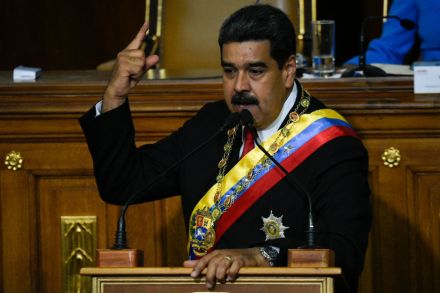
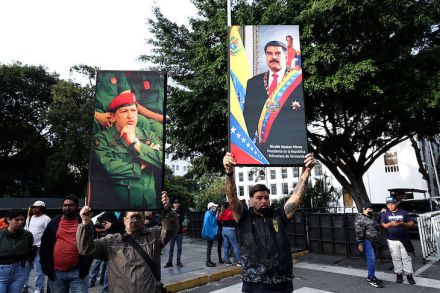
Hugo Chávez’s eyes are everywhere across parts of Caracas, Venezuela’s capital. In stark black and white, his gaze is stamped onto government buildings, public housing blocks and murals. But if the late socialist president could truly see what has become of the movement he founded, he would likely be dismayed. Most Venezuelans have abandoned chavismo. His protégé Nicolás Maduro – who had led the government since 2013 – has been captured by the US, while many Venezuelans cheered his exit. What remains is a thin but loyal chavista base – and a leadership operating firmly in survival mode.
chavismo

What Trump’s coup in Venezuela means for Iran

In a city awash with visual propaganda, one mural in Caracas is especially striking for the western visitor. In it, Jesus Christ stands alongside Imam Mahdi, a prophesied messianic figure who many Muslims believe will appear with Christ during the End Times to restore peace and justice to the world. There is only one Venezuelan – the late president Hugo Chávez – among the six smaller figures on the mural. Three are Iranian, including Qasem Soleimani, commander of the Islamic Revolutionary Guard Corps elite Quds Force, killed by a US airstrike in 2020. One is an Iraqi commander killed in the same strike, and the last is Lebanese, Imad Mughniyeh, a founder of Islamic Jihad in Lebanon and number two in Hezbollah until his assassination in 2008.

Venezuelans topple Chávez statues as they reject Maduro victory

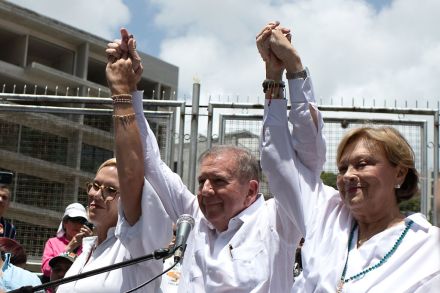
Nicolás Maduro’s rival Edmundo González and opposition leader María Corina Machado told reporters at around 6:30 p.m. Monday that with more than 70 percent of votes counted, González is more than doubling Maduro’s votes. During the press conference, both candidates emphasized peaceful protests, especially as thousands began taking to the streets the day before, when the country’s electoral council declared that Maduro had won with 51 percent of the vote. They called on voters to gather at 11 a.m. Tuesday. “I speak to you with the calmness of the truth,” González said to his cheering supporters from outside his campaign’s headquarters in Caracas. “We have in our hands the tally sheets that demonstrate our categorical and mathematically irreversible victory.

maduro

Will Venezuela invade Guyana?

Eight years ago in Guyana, an Idaho-sized country on the northern coast of South America, ExxonMobil discovered massive oil reserves. So massive, that it’s speculated that the tiny nation, which is one of the least densely populated countries on the planet, could become the richest country per capita. Estimates indicate that Guyana has around 11 billion barrels of oil equivalent, boosting the nation to the third position in terms of proven oil reserves in the region. To contextualize the enormity of these discoveries, consider that the tiny nation has almost five times more proven oil reserves than Argentina, a country thirteen times larger by land mass. Only Brazil, the fifth largest country, and Venezuela, the country with the largest proven oil reserves, surpass Guyana.

Guyana

Meet Maria Corina Machado: could she become Venezuela’s Margaret Thatcher?

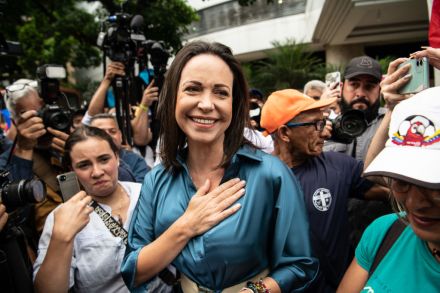
In 2006, there was Manuel Rosales. In 2012, there was Henrique Capriles. In 2018, there was Juan Guaidó. All managed to capture the hopes of Venezuela’s opposition, but as hopes slipped away, so did their popularity. Now, there is a new opposition leader in town: Maria Corina Machado, an ideologically driven fighter and a woman who was not afraid to call former president Hugo Chávez a “thief” to his face. As Venezuelans often imprudently say, she “tiene las bolas bien puestas,” meaning that, although female, she “has her testicles in the right place.” That's something that millions of Venezuelans can’t say about the charming yet gutless men who have monopolized the country’s hopes in the past. In July, Dr.

maria corina machado