Hitler

National Socialism: the clue’s in the name

From our UK edition

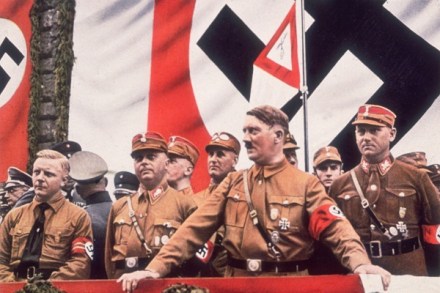
How can conservatives ensure they always lose? A good place to start is to concede every lie of the left. The Conservative Party appears to be doing what it can in this regard. Take their decision to strike Rachel Frosh from their candidates list for the great crime of... linking Nazism to socialism. Frosh committed her thought crime on Twitter. Thanks to a left-wing stink being kicked up on the same medium, her career – including twenty years in the NHS – is now apparently nullified overnight. She has had to step down from her role as a Police and Crime Commissioner and now she cannot stand for the Conservatives at an election. A party spokesman has said: ‘these comments are completely unacceptable and it is right that she has stepped down’.

The Fuhrer was not amused

From our UK edition

‘The German sense of humour,’ Mark Twain famously observed, ‘Is no laughing matter.’ Although many Greeks, stretched on the Euro's rack at Berlin's behest, may be inclined to agree, Rudolph Herzog's intriguing study of humour in and against Hitler's Germany, Dead Funny: Telling Jokes in Hitler's Germany, proves conclusively that the Teutonic funny bone, while it may be difficult to locate, definitely exists.

A great historian with fascist tendencies has died

From our UK edition

A great historian has died. He joined the Nazi party in the 1930s, spurred by a fear of the communism which was then spreading through Europe. Although he survived for many decades to see the consequences of the ideology, he nevertheless remained nostalgic for, and loyal to, fascism. He also retained an active interest in the Conservative party and acted as a guru for a time to John Major, though he subsequently expressed disappointment at the direction of his leadership. In a statement the current leader of the Conservative party, David Cameron described the historian as: ‘An extraordinary historian, a man passionate about his politics and a great friend of my family’.

Eric Hobsbawm: A man of Extremes

From our UK edition

A few years ago, I wrote a review of Eric Hobsbawm’s last collection of essays and noted  'Hobsbawm is now 94, and although I have no wish to usher the old boy from the room, I can see his obituaries now. Conservative and liberal writers will say that his loyalty to totalitarianism disfigured his writing, most notably, in his whitewashing of Soviet atrocities in The Age of Extremes, his history of the 20th century. Leftists will say he was the greatest Marxist historian of our times, whose sweeping accounts of the world from the Enlightenment to the present have shaped the way we think. Neither will acknowledge that both have a case.' I’ll have to wait for tomorrow’s papers to see if I’m right, but I can defend my argument now.

Blast from the past: The Teleportation Accident reviewed

From our UK edition

He'd probably agree with Edward Gibbon's assessment of history as 'little more than the register of the crimes, follies, and misfortunes of mankind' but Ned Beauman's instinct as to why we do what we do is a lot more basic. We're motivated by sex: whether we're having it or - as is more often the case in Beauman's world - not having it. And he might have a point. Take for example Ernst Hanfstaengl who described his former buddy, a certain Adolf Hitler, as "a man who was neither fish, flesh nor fowl, neither fully homosexual nor fully heterosexual... I had formed the firm conviction that he was impotent, the repressed, masturbating type." A committed Freudian might call that motive enough.

Bookends: A matter of opinion

From our UK edition

In an age when the merely mildly curious believe they can get all they really need to know from Wikipedia for free, A. N. Wilson’s fellow literary professionals must take heart from his expectation that there is still possibl to charge for a work of such succinctness that it is essentially an extended Wikipedia entry enlivened by some opinions. Wilson’s Hitler: A Short Biography (Harper Press, £14.99)certainly trumps Wiki for stylistic brio and brims with the author’s customary zip and zing.

What was it like at the time?

From our UK edition

At midday on Thursday, 8 June 1933 — Erik Larson is very keen on his times — the newly elected President Franklin D. Roosevelt had a call put through to the history department at the University of Chicago. At midday on Thursday, 8 June 1933 — Erik Larson is very keen on his times — the newly elected President Franklin D. Roosevelt had a call put through to the history department at the University of Chicago. Since taking office in early March Roosevelt had been trying to fill the post of ambassador to Berlin, and with none of the usual suspects prepared to take on the job and Congress on the point of adjourning for the summer recess, time was fast running out.

A conflict of loyalty

From our UK edition

What was life like in Hitler’s Germany? This question has long fascinated authors and readers alike, as books like Alone in Berlin, The Boy with the Striped Pyjamas and The Book Thief bear witness. What was life like in Hitler’s Germany? This question has long fascinated authors and readers alike, as books like Alone in Berlin, The Boy with the Striped Pyjamas and The Book Thief bear witness. Nazi Germany, it has often been argued, was a totalitarian dictatorship. Through force, indoctrination and even common consent, such an interpretation contends, Hitler wielded total power and had complete control of the German population. But were the tentacles of the Nazi state as strong as this understanding suggests?

Pastures new

From our UK edition

On 20 September 1949, five days after his election as Chancellor of the newly created German Federal Republic, Konrad Adenauer addressed the Bundestag: ‘Much unhappiness and much damage’, he told the deputies, ‘has been caused by denazification . On 20 September 1949, five days after his election as Chancellor of the newly created German Federal Republic, Konrad Adenauer addressed the Bundestag: ‘Much unhappiness and much damage’, he told the deputies, ‘has been caused by denazification . . . many have atoned for a guilt that was subjectively not heavy.

Caught between two great evils

From our UK edition

David Brooks, the great New York Times columnist, recommends the best essays of the year every Christmas. His selection this year includes a brilliant essay by Anne Applebaum, of this parish, on Hitler, Stalin and Eastern Europe. It makes you realise quite how bloody the Eastern Front was—‘On any given day in the autumn of 1941, as many Soviet POWs died as did British and American POWs during the entire war’—and think about the effect on these societies of being caught in the middle of these two extremist ideologies. There is always a tendency for us to discuss how the crimes of Hitler and Stalin compare.

Brave on occasion

From our UK edition

Hitler’s experiences in the Great War have long been shrouded in mystery and controversy, not least because there is relatively little material from that time written by himself. Hitler’s experiences in the Great War have long been shrouded in mystery and controversy, not least because there is relatively little material from that time written by himself. Although Austrian by nationality, he volunteered for the German army in 1914 and served throughout the war in its List Regiment, mostly as a dispatch runner based at regimental headquarters. After he became a celebrity, quite a few former comrades wrote about his war service. Some were enthusiastically positive about Hitler’s military record, others were more sceptical.

What we did to them . . .

From our UK edition

The perception of war changes, remarked the poet Robert Graves, when ‘your Aunt Fanny, the firewatcher, is as likely to be killed as a soldier in battle’. The perception of war changes, remarked the poet Robert Graves, when ‘your Aunt Fanny, the firewatcher, is as likely to be killed as a soldier in battle’.

When Hitler Played Cricket…

From our UK edition

Until today I had not known that Adolf Hitler played cricket. Once. Apparently. This is, actually, reassuring since it seems that cricket found him out and, as it is wont to do, smoked out the essential elements of Hitler's character. Ben Macintyre has the story: Adolf Hitler played cricket. He raised his own cricket team to play some British prisoners of war during the First World War, then declared the sport “unmanly” and tried to rewrite the laws of the game. The Führer’s First XI sounds like a Spike Milligan joke, but this small nugget of history is true. In all the millions of words written about Hitler, his telling brush with cricket seems to have escaped the attention of historians.   [...

Godwin’s Law: The Persian Variation

From our UK edition

For real: Iranian President Mahmoud Ahmadinejad on Wednesday accused his election rivals of adopting smear tactics used by Germany's dictator Adolf Hitler and said they could face jail for insulting him. Ahmadinejad was speaking at a rally in Tehran on the final day of an increasingly bitter and hard-fought election campaign, in which he faces a growing challenge from moderate former prime minister Mirhossein Mousavi. Mousavi and the two other candidates say Ahmadinejad has lied about the state of the economy which is suffering from high inflation and a fall in oil revenues from last year's record levels. Ahmadinejad said his rivals had broken laws against insulting the president. "No one has the right to insult the president, and they did it. And this is a crime.