Graham greene

The best children’s books of 2014

From our UK edition

If it’s all right with you, I’d like to launch a campaign please. Right here. You may be wanting me to cut to the chase and just recommend some children’s books, but bear with me. I’m on the case. My campaign is to have pictures in books again. Adult books too, but obviously books for children. There are some wonderful illustrators out there, contemporary ones, for all ages, and the scandalous thing is, they are usually limited to the age range, 0–7. If you want to remind yourself what we’re missing, make for the House of Illustration in London’s King’s Cross; that should do it. Or try Chris Beetles’s annual, brilliant exhibition, The Illustrators, on now at his St James’s gallery.

Ten years and an earthquake: the changing face of Haiti

From our UK edition

This summer, I returned to Haiti for the first time in ten years. I was itching to see how the Caribbean republic had changed after the terrible earthquake of 12 January 2010. This time, I would not be travelling by jitney, lorry or fishing boat, but in taxis and air-conditioned tourist coaches. Port-au-Prince, the capital, was as exhilarating and exhausting as I remembered it. The streets, thronged with pack animals and porters were a human ant heap. The smells I knew so well from earlier visits — sewage, burning rubbish — hit me forcefully and it was as though I had never been away. I made a bee-line for the Hotel Oloffson, a magnificent gingerbread mansion made famous by Graham Greene in his Haitian novel The Comedians.

Was Graham Greene right about Shirley Temple? 

From our UK edition

Shirley Temple, who died last week at the age of 85, was the most successful child film star in history. During the second half of the 1930s, a decade in which she made 23 films and earned $3 million before puberty, she was America’s most popular film star of any kind; Clark Gable came only a distant second. What was the secret of her enormous popularity? According to Temple’s own oft-repeated explanation, ‘People in the Depression wanted something to cheer them up, and they fell in love with a dog, Rin Tin Tin, and a little girl.’ This surely has truth in it, for the precocious, confident, sparkling little actress embodied an optimism for which her country yearned.

Graham Greene, Penguin and an old spelling mistake – Spectator blogs

From our UK edition

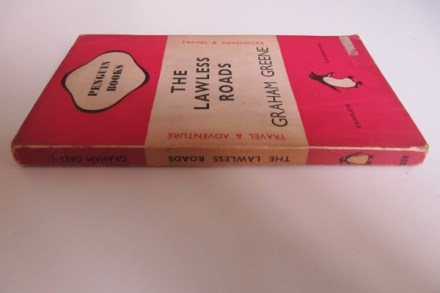
Mistakes will sometimes happen even in the best-run places. Pictured with this post, by way of proof, is a 1947 Penguin paperback of Graham Greene's The Lawless Roads, with the author's name misspelt on the spine. It's still common to talk of 'typographical errors', or typos, but back in 1947 there really was such a thing: it meant a mistake made by compositors at the printer, rather than by editors or designers. Probably this was one; certainly that is what someone will have tried to tell Allen Lane. These days any mistakes are definitely our fault - in the case of the printed Spectator, indeed, they are usually my fault, as chief sub. Which brings me to the other lesson of this book: how easily mistakes can be overlooked. I owned it for several years without ever seeing anything odd.

In a Greene shade | 26 May 2012

From our UK edition

One of the unanticipated benefits of British rule in India is the body of distinguished writing in the English language coming from the Indian diaspora — Naipaul, Seth, Rushdie, Mistry, Mishra and Pico Iyer. Iyer, however, is atypical in that he was born in Oxford, lived in California, and was educated at Eton and Oxford. Thus he is less an Indian than a global author. He is coy about having been to Eton, which he does not name: it is the ‘high school near London’, ‘somewhere between the grey towns of Slough and Windsor’, which was founded by a king, has the oldest classroom in the world, and has provided Britain with 19 prime ministers.

In a Greene shade

From our UK edition

Some travel writers, in an attempt to simulate the hardship of Victorian journeys, like to impose artificial difficulties on themselves. A glut of memorably foolish yarns with titles like Hang-Gliding to Borneo or To Bognor on a Rhinoceros discredited the genre in the 1980s. In every case it would have been quicker for the authors to take the train. Why wind-surf across the Mojave when there’s a serviceable coach service? Tim Butcher, formerly a Telegraph war correspondent, is biased towards old- fashioned travellers in the Redmond O’Hanlon mould who, with their bushy side-whiskers and squire-naturalist curiosity, continue a tradition of Victorian exploration.