Germany

In for a penny, in for a trillion

From our UK edition

The news that the EU seeks a budget of £1 trillion between 2013 and 2020 inspired disbelief rather than ire. President Barroso’s almost childlike insistence that the proposal was ‘relatively small’ was amusing, certainly not alarming. It’s a classic EU trick: pitch for 5 per cent and a string of crazy financial measures (including a ‘Tobin tax’ on financial transactions) in the hope obtaining more modest gains of say 2 per cent. Barroso will also throw the odd concession into the bargain: the announcement of a £5.4bn saving on the Commission’s staffing costs represents a concession. But, Barroso has his work cut out to secure even a 1 per cent rise on this occasion.

Can Cameronism be Europeanised?

From our UK edition

In 1997 New Labour was not just a domestic programme; it was a foreign policy too. Known as the "Neue Mitte" in Germany, Blair's Third Way soon attracted such converts as the German chancellor, the French prime minister and the Danish leader. In the end, it produced few results for Britain, failing – much as Harold Wilson did in the 1970s – to curry favour for the UK through party political links with other leaders. But for a few years, much as New Labour looked across the Atlantic to the Democratic Party, so Europe's Social Democrats looked across The Channel. International recognition for his deficit reduction plan notwithstanding, David Cameron has no such effect so far. But some have been swayed by his domestic agenda.

Greece on the precipice

From our UK edition

Europe is a doom-monger's paradise at the moment. Riots in Greece; summary Cabinet reshuffles; meetings between Merkel and Sarkozy to save the single currency — and there's still the potential for things to get worse, much worse. If the Greek government defaults on its debts, then there's no knowing where the contagion will spread, only that it it will spread wide: from Spain and Portugal to markets across the world. Share indices have already been trembling at the prospect, although many of them rallied slightly today. One consolation, however scant, is that all this crystallises just what can happen to governments who operate beyond their means.

The Lucifer Effect

From our UK edition

Today’s papers are full of comment on the brilliant Panorama exposé of care home abuse. But none have mentioned what jumped out at me: the parallels between this and the Stanford Prison Experiment. The way that the tattooed Wayne treated his mentally ill patients is sickening — but, to me, this is not just a story about human evil. It’s a story about how institutionalisation brings out the evil in people, and that this evil is far closer to the surface than we like to admit. Philip Zimbardo, a psychology professor at Stanford, randomly divided 25 volunteers to play the roles of prisoners and guards in a poorly-regulated, mock prison.

The Euro’s uncertain future

From our UK edition

Martin Wolf’s column on the eurozone today does a superb job of summing up its troubles. As Wolf says, "The Eurozone, as designed, has failed." Keeping its current arrangements is simply not an option for the eurozone. Wolf concludes that: "The eurozone confronts a choice between two intolerable options: either default and partial dissolution or open-ended official support. The existence of this choice proves that an enduring union will at the very least need deeper financial integration and greater fiscal support than was originally envisaged." The question now is essentially whether Germany and other prosperous eurozone countries are prepared to embark on further integration and a programme of fiscal transfers to save the project.

Goodbye to Berlin

From our UK edition

Peter Parker is beguiled by a novel approach to the lives of Europe’s intellectual elite in flight from Nazi Germany In his time, Heinrich Mann was considered one of Germany’s leading writers and intellectuals. Unlike his rivalrous younger brother Thomas, who always put his literary career before any other consideration, Heinrich was an early and outspoken critic of the Nazis, and so forced to leave Germany in February 1933. He was based for several years in the south of France, while travelling around the world to denounce the regime he had left behind, and he eventually emigrated to America in 1940, settling in Los Angeles. Unlike many European emigrants who thrived in the Californian sun, Mann did not adapt well to transplantation.

A conflict of loyalty

From our UK edition

What was life like in Hitler’s Germany? This question has long fascinated authors and readers alike, as books like Alone in Berlin, The Boy with the Striped Pyjamas and The Book Thief bear witness. What was life like in Hitler’s Germany? This question has long fascinated authors and readers alike, as books like Alone in Berlin, The Boy with the Striped Pyjamas and The Book Thief bear witness. Nazi Germany, it has often been argued, was a totalitarian dictatorship. Through force, indoctrination and even common consent, such an interpretation contends, Hitler wielded total power and had complete control of the German population. But were the tentacles of the Nazi state as strong as this understanding suggests?

Mixed news from the Eurozone

From our UK edition

France and Germany’s better than expected growth numbers are making news today. But the divergence within the Eurozone — Estonia grew at 2.1 percent in the first quarter, Portugal shrank by 0.7 per cent — highlights one of the single currency’s biggest problems: how can one interest rate fit all? Economists expect Germany, whose GDP is now larger than before the financial crisis, to continue to outperform the rest of the Eurozone. Given that Germany and France together make up half of the Eurozone economy, interest rates will have to be set with this in mind. But, on the other hand, the Iberian countries and Greece are struggling with austerity and need a continued monetary stimulus.

Is Chris Huhne proving coalitions don’t work?

From our UK edition

This country's not used to coalitions. So when we got one we were sceptical. When it worked, we remained sceptical. When it worked really well, taking decisions that a majority Labour government dared not take, we began to come around to the idea. Most people seemed to accept that they could live with a coalition; that it had a certain utility. Now, we don't know what to think following the spat between George Osborne and Chris Huhne. Is this proof that the coalition cannot work or merely an example of the way coalitions work? There are certainly worse examples of inter-coalition war in countries that often have coalition governments.

Much ado about Brussels, bailouts and budgets

From our UK edition

The news that the European Union has decreed that its Budget be increased by 4.9 percent in 2012 ties a knot in the stomach, as I ponder an Easter weekend spent in Margate rather than Majorca due to austerity. As Tim Montgomerie notes, the government is taking this opportunity to assert its euroscepticism. Stern communiqués are being worded; stark warnings are being issued. Behind the scenes, the government has joined with the Dutch, its closest ally on the Continent, to confront the avaricious Commission. Patrick Wintour reports that the French will also oppose the proposed Budget, and the Austrians, Danes, Swedes, Finns and Belgians are expected to lend their weight to the cause.

Merkel is running out of patience with the eurozone

From our UK edition

Like an unseasonal Atlantic gale, the Portuguese sovereign debt crisis has blown in to ruin the latest EU summit. This meeting was intended to mark the beginning of the end of the eurozone crisis. Instead, the ponderous European Union has been overtaken by events, with grave consequences. Already speculation about contagion is rife: Spain, Malta* and Italy are now being spoken of in hushed and exasperated tones. The Economist’s Charlemagne correspondent reports that several countries are now wary of the monetary pact that Germany is demanding for delving deeper into its pockets, because they do not want to be accused of surrendering sovereignty.

Nuclear hysteria

From our UK edition

The above Japanese video - explaining the nuclear accident to children — makes a lot more sense than many of the hysterical reports we have been reading in the last few days. The figures are not out yet, but it's likely that tens of thousands were killed by the tsunami. Yet the newspapers were all focused on the nuclear meltdown — which injured 15 people. The irony is that, when a tsunami strikes, the local nuclear power station is pretty much the safest place to be. This is the argument advanced in the leading article for the current issue of The Spectator (subscribers, click here; non-subscribers please join us for £1 a week).

In Defence of Germany

From our UK edition

Among the many odd things about the Libyan "debate" is the argument that Germany's decision to abstain during the Security Council vote is somehow disgraceful and proof that Germany still isn't ready to play its part on the international stage. (Obviously some of these objections come from the kind of rightists who fear or dislike German influence in other, more peaceful, areas of international politics and business. But never mind.) But Germany's vote seems qualitatively different from the BRIC-blog of abstentions. Brazil, India, China and Russia each have reasons to be wary of this kind of resolution and, indeed, this kind of precedent. Deep down, I suspect some of them would have liked to vote against the resolution.

Meltdown danger

From our UK edition

The situation in Japan is deteriorating further. In the early hours of this morning, the last workers are said to have left the Fukushima Daiichi Nuclear Power Plant as the danger of a nuclear meltdown grew. There have been explosions in three of the plant's reactors and a fourth one is on fire. Everyone within a 30 kilometre radius has been told to stay indoors, and the U.S. Navy's 7th Fleet, stationed more than 100 miles away to help earthquake victims, sailed farther away from the stricken plant after detecting unusual levels of radioactivity in the air. The Japanese Prime Minister, Naoto Kan, has confirmed that, "substantial amounts of radiation are leaking in the area".

Pastures new

From our UK edition

On 20 September 1949, five days after his election as Chancellor of the newly created German Federal Republic, Konrad Adenauer addressed the Bundestag: ‘Much unhappiness and much damage’, he told the deputies, ‘has been caused by denazification . On 20 September 1949, five days after his election as Chancellor of the newly created German Federal Republic, Konrad Adenauer addressed the Bundestag: ‘Much unhappiness and much damage’, he told the deputies, ‘has been caused by denazification . . . many have atoned for a guilt that was subjectively not heavy.

Cameron signs up to muscular liberalism

From our UK edition

"State multiculturalism has failed." Angela Merkel put voice to that sentiment last October. Now it David Cameron's turn to do the same. In a speech in Munich today, the Prime Minister has taken a rhetorical torch to Islamic extremism. "Frankly," he says, "we need a lot less of the passive tolerance of recent years and much more active, muscular liberalism." It is, at the very least, a significant political moment. What Cameron is doing here – as explained by Charles Moore and Paul Goodman – is publicly signing up to a philosophy of the world. It is a philosophy that rejects the idea that extremism should simply be contained. Instead, it says that extremism must be fought – and that means engaging in a battle of ideas.

Grim parallels with Germany for Nick Clegg?

From our UK edition

Germany is one of the few countries that Nick Clegg has been able to look to for tips on how to be a successful Liberal party in coalition with a larger Conservative party. In 2006, Guido Westerwelle even took a delegation of Free Democrats to a Lib Dem frontbench meeting. Coffee House once predicted that, if the AV referendum was won, Clegg could one day become Britain's Hans-Dietrich Genscher, a permanent powerbroker. The parties are of course different in many ways. The Free Democrats are decidedly more pro-market and pro-business than the Liberal Democrats. They also have a lot more experience of government. Before the last election, the Free Democrats were part of Helmut Kohl's governments until 1998.

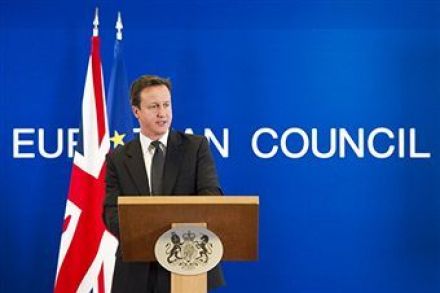
What Cameron should push for in Brussels

From our UK edition

As David Cameron stays in Brussels for his third European summit as PM, it’s becoming increasingly clear that the EU's approach to the eurozone crisis – put up short-term cash and pray – isn’t convincing anyone.   On Wednesday, Moody’s threatened to downgrade Spanish government bonds another notch, citing the fact that, between them, the country’s government and banks have to raise €290bn next year to keep the party going. And, across the eurozone, banks and governments face daunting refinancing targets in 2011, which begs the questions: at what cost? And what happens if they fail to meet them?

A “two stone” solution to the Euro crisis will unbalance the coalition

From our UK edition

Whatever the British government wants, moves are now afoot on the Continent to address some of the structural problem with the Euro. They may in the end lead to some form of fiscal federalism. So far they are not supported by Angela Merkel, the key decision-maker, who worries constantly about the court in Karlsruhe, which has set clear limits on further European integration. But they are said to be supported, at least in part, by Finance Minister Wolfgang Shauble. Writing in the Financial Times, Frank-Walter Steinmeier and Peer Steinbrück argue that the EU needs "a more radical, targeted effort to end the current uncertainty, and provide stronger support for the future of Europe’s common institutions.

What Germany gets out of the euro

From our UK edition

The Guardian has an intriguing story tonight. It reports that the German Chancellor Angela Merkel told a recent EU Summit meeting that Germany might leave the euro if it didn’t get its way on a bail-out mechanism. The threat is academic as Merkel largely got what she wanted. But there’s one other thing worth remembering: however galling bailing out other euro-zone members is, Germany benefits from the euro. If Germany had its own currency, it would be worth far more than the euro is which is kept down by the problems of the PIGS. A Germany that was still using the Deutschmark would not be able to export anywhere near as much as its exports would be far more expensive on the international market. German economic growth would, in these circumstances, be badly hit.