George bernard shaw

The art of the transatlantic liner

From our UK edition

Some time in the next few weeks, a great ocean liner will be lost at sea. One of the greatest, in fact. When the SS United States made its maiden voyage in July 1952, it was the last word in transatlantic liner design. In an age of ocean-going elegance, the ‘Big U’ was the newest, the sleekest and the swiftest. To this day, it holds the Blue Riband – the all-time record for the fastest transatlantic crossing by a passenger ship. Now, after five decades rusting in dock, and a series of unsuccessful preservation attempts, the United States is about to make its final voyage. Stripped of masts, fittings and its massive red, white and blue funnels, it will be towed out and sunk as a diving reef off the Florida coast. It’s heartbreaking to admit that this might be for the best.

How to save the King’s English

From our UK edition

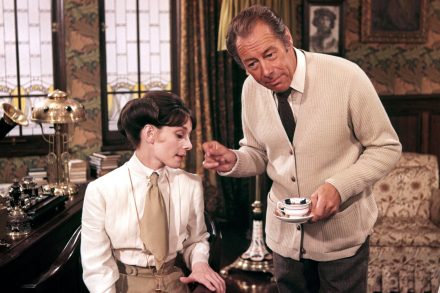
When a survey of 10,000 teachers revealed this month that Britain’s primary school pupils are increasingly relying on Americanisms (the Times front page declared ‘Trash-talking children are sounding like Americans’) I realised immediately what we needed. Rex Harrison. And if not Rex Harrison himself, then a dose of arguably his greatest role – that of Henry Higgins, the cantankerous professor of phonetics who first burst into the national consciousness in 1914 with the London premiere of Pygmalion.

Provocative, verbose and humourless: Mrs Warren’s Profession reviewed

From our UK edition

George Bernard Shaw’s provocative play Mrs Warren’s Profession examines the moral hypocrisy of the moneyed classes. It opens with a brilliant young graduate, Vivie Warren, boasting about her dazzling achievements as a mathematician at Newnham College, Cambridge. She explains her future plans to a pair of mild-mannered chaps who clearly adore her. Like most of Shaw’s characters, Vivie is hard-nosed, emotionally cold, incapable of speaking concisely and boundlessly self-confident. Quite irritating, in other words. She plans to start a firm with another hyper-brainy female and to make a killing in the London insurance market. This occurs in 1902. Was it normal for two unmarried Edwardian women to enter the world of high finance straight out of university? Hard to say.

As gripping as an Agatha Christie thriller: Shooting Hedda Gabler, at the Rose Theatre, reviewed

From our UK edition

The unlovely Rose Theatre in Kingston is a modest three-storey eyesore. The concrete foyer looks like an exercise area on a North Sea oil platform, and the auditorium itself is a whitewashed rotunda that resembles the chapel in a newly built prison. Yet this cheerless, functional space is perfect for a mischievous new satire, Shooting Hedda Gabler, about recent developments in the acting trade. The central character, Hedda (Antonia Thomas), is a washed-up American starlet who wants to gain artistic credibility by taking the lead in a pretentious film version of Hedda directed by Henrik, a tyrannical Norwegian auteur. ‘There is no script,’ he announces on the opening day. But he’s lying.

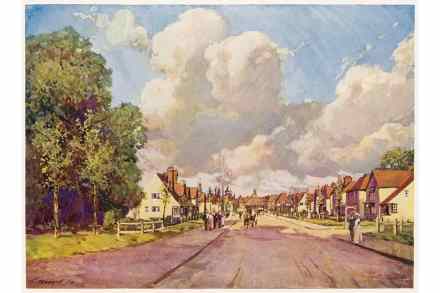
The folly of garden cities

From our UK edition

In his 1981 autobiography A Better Class of Person, the playwright John Osborne described an encounter he’d recently had with an actor who’d bought a house in Finlay Street, Fulham for £15,000. Osborne, having lived on the same street in the 1930s when properties there changed hands for £300, was astonished by the sum. Yet, as Simon Matthews notes in House in the Country, £15,000 was then only 3.5-3.75 times the average national earnings, while to buy a house on Finlay Street today you’d need £2,136,667 – which works out at 69 times the current average annual salary.

Mass appeal: Stanford in Stamford

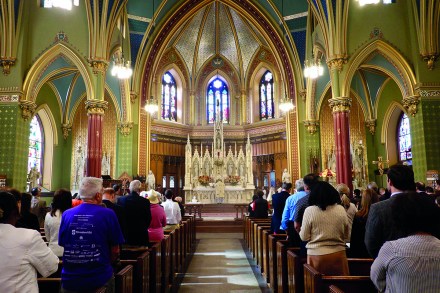
This article is in The Spectator’s March 2020 US edition. Subscribe here. The exterior of the basilica of St John the Evangelist in Stamford, Connecticut, looms large and gray. Built in 1875 by Irish immigrants who mined and hauled rocks from a nearby quarry, its interior bursts with greens, reds and golds. The saintly lives in its stained-glass windows are said to comprise one of the largest collections of its kind on the East Coast. I was one of 12 singers to perform here at the American premiere of the Mass in G Major by the Dublin-born composer Sir Charles Villiers Stanford (1852-1924). Stanford’s Mass was first performed at London’s Brompton Oratory in 1893, but, like The Spectator, it took its time coming to America.

stanford