France

Merkel and Sarkozy try to hold the euro together

From our UK edition

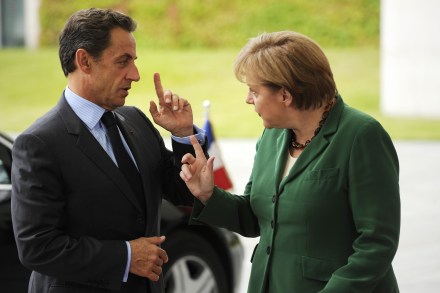
Right about now, Nicolas Sarkozy and Angela Merkel are having George Papandreou for dinner. There have been all sorts of rumours today about what Sarkozy and Merkel will demand from him. Thankfully, they seem to have abandoned plans to tell him to cancel the referendum. But they still seem keen to dictate the question and the timing to him. How that will go down with the Greek demos remains to be seen. One thing is clear, though: the euro is now destroying the whole European project. The European Union’s claim to be a force for peace, stability and democracy in Europe is rapidly disappearing into the Athens smog. The wholesale sacking of senior Greek military officers shows that there are real fears in Athens of a military coup.
The Greek land mines that Cameron must avoid

From our UK edition

When the topic of Greece comes up at PMQs, David Cameron will need to avoid stepping on three land mines. The first task is not to say anything about what is going on in Athens, or Rome for that matter, that will exacerbate market anxieties. The second is a diplomatic challenge, to avoid anything that would sour Britain’s pitch ahead of the G20. The third, and perhaps most difficult one, is to keep his own backbenchers on side.   An ever growing number of Tories doubt that a 17 member Euro and fiscal union is in Britain’s, or Europe’s, interests. Already, some Tory backbenchers are talking about going to Greece, if invited, to campaign for a No vote. Cameron will need to avoid antagonising this group.

The Euro masquerade

From our UK edition

So much rot has been said about the Eurozone crisis that you do wonder whether Merkel, Sarkozy et al have come to believe their own spiel. This is an economic problem and it can’t be solved by political will. Greece is bust and several French, German and Dutch banks were stupid enough to lend €130 billion to the Greek government that they're not going to get back. All the summits in the world cannot change this simple fact. These crisis talks are about bailouts for banks, not bail outs for Greeks. BNP Paribas is in for €37bn. Commerzbank of Germany is owed €15bn. And if Greece defaults, then insurance claims are triggered.

Sarko’s dour challenger

From our UK edition

One of France's dullest politicians is now odds-on to take up residence in the Élysée Palace next year. François Hollande, the former leader of the French Socialists, has emerged on top in a competition to take on Nicolas Sarkozy for the presidency. Six contestants vied for the Socialist nomination, including Ségolène Royal, Hollande's former partner who lost to Sarkozy in 2007. In the first round of the primaries yesterday, Hollande finished first ahead of current Socialist leader Martine Aubry. Here are the results based on 82 per cent of the votes cast:  The two will now face each other in a second round on Sunday, with Hollande the clear favourite. Policy-wise, the differences between Hollande and Aubry seem small.

Britain sues the ECB

From our UK edition

As the EU debt drama continues unspooling like a perversely watchable soap opera (the FT’s Neil Hume describes it as ‘eurozone crisis porn'), an intriguing sub-plot has emerged: Britain is suing the European Central Bank. The Treasury is unhappy with an ECB move to limit the kind of euro-denominated products that can pass through UK clearing houses, suspecting it’s a bid to shift financial activity from London to Paris/Berlin. So it’s taking legal action, the first of its kind by an EU member state. This is not the first UK-EU disagreement that has surfaced in recent months, underlining the tensions between Britain and the Continent as financial centres across Europe fight over a (shrinking) business pie.

Merkel & Sarkozy have only words

From our UK edition

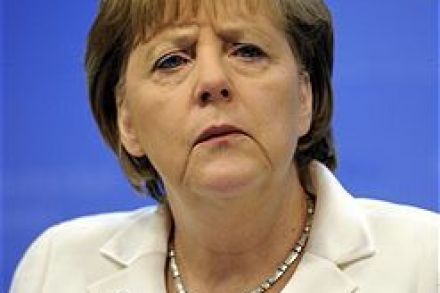
It was something of a mystery. Emergency conference calls about the future of the Eurozone were being made yesterday, but there was no news of those discussions. As it turned out, this was for the best of all possible reasons: there was no news to report. Angela Merkel and Nicolas Sarkozy announced no new measures to alleviate the sovereign debt crisis; rather, they merely declared “solidarity” with Greece and assured the markets that Greece would not be forced from the single currency. Their words seem to have assuaged the markets for the moment, but only the most brazen optimist would bet on the rally being long lived.

The Euro-crisis heats up

From our UK edition

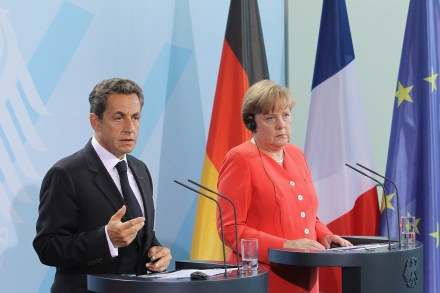
Angela Merkel, Nicolas Sarkozy and George Papandreou are in crisis talks about Greek debt. There are rumours that they are preparing an "orderly default" for Greece. But, officially, Merkel is still pressing ahead with implementing the existing Greek debt deals. This meeting also has a domestic context for Merkel. According to the FT, she is determined to stamp on the growing disquiet within her governing coalition over the Eurozone crisis and is pleading for calm resolve. It remains to be seen if she succeeds.  The danger of contagion within the Eurozone remains and concerns about the exposure of French banks persist, which is doubly worrying for Nicolas Sarkozy given the proximity of French banks to the French state.

Rick Perry: Texas Gaullist

From our UK edition

I'm sure Karl Rove is, on this at least, correct: Rick Perry's book will cause him problems for as long as he remains in the race for the Republican nomination. To put it gently, few Americans believe that Social Security and many other federal programmes are unconstitutional; even fewer are likely to vote for a candidate who was on record, as recently as last year, suspecting that they might be and that these matters were properly the purview of the 50 states, not Washington. So it will be interesting to see how, if at all, Perry is attacked in tonight's debate*. There is no shortage of large-bore ammunition. Against that, a book titled Fed Up! pretty accurately captures the mood in the United States even if disgruntled voters might differ from Perry on any number of specific issues.

The fallout from the DSK affair

From our UK edition

It was an eventful day in New York yesterday. The rape case against Dominique Strauss-Kahn collapsed and, soon after, an earthquake struck that corner of the States’ eastern seaboard — thankfully there have been no reported deaths and damage appears to have been light, although there were fears about the safety of an ageing nuclear plant after the tremors. Medieval chroniclers might have drawn equivalence between the two events: the natural disaster being the judgement of God on the human drama in court. DSK was the premier contender for the Socialist presidential nomination to fight the despondent Nicolas Sarkozy, a battle he might have won.

Gaddafi in Tripoli as the <em>entente cordiale </em>flourishes

From our UK edition

The imminent success of the Libya intervention was, to a remarkable degree, down to Anglo-French cooperation. Though the media has been keen to play up, and even conjure up, rifts and disagreements between Paris and London — and the hyper-active Nicolas Sarkozy can't help but act first and coordinate later — the fact is that the two states worked closer and better together than they have done for years. Probably not since the Suez operation have the British and French militaries cooperated so closely. But the intervention, even if it is coming to a (deadly and protracted) end did show up a number of deficiencies in materiel and command and control arrangements, as well as problems of political coordination.

This isn’t just any solution; this is an M&S solution

From our UK edition

Banks and financial institutions endured a painful day’s trading, following Angela Merkel and Nicolas Sarkozy’s announcement yesterday that the Eurozone should adopt a ‘Tobin tax’, a charge on financial transactions. Once again, M&S chose piecemeal changes over the grand structural scheme desired by markets. The Tobin tax was just one proposal of three. The other two were: to create “genuine economic governance of the Eurozone” under, for the moment, EU President Herbert van Rompuy. The second: to impose a ‘Golden Rule’ on the budgets of Eurozone members. The ‘Golden Rule’ will bind national parliaments to agree to limits on national debt levels and impose statutory requirements on mastering budget deficits.

Battle of the century

From our UK edition

The American historian Walter Russell-Mead has a cynical — but very possibly accurate — take on what the French are trying to persuade the Germans to accept with their plan for Eurobonds: 'France’s clear short term goal is to commit Germany to underwrite debts from weak EU states.  That not only staves off a crisis that threatens to engulf France; by putting Germany on as a co-signer for Greek, Italian and Spanish loans, France will ensure that Germany’s credit rating will not be better than France’s. The French will accept almost any German rules to limit the ability of countries like Greece to run up new debts.

Back to the drawing board as Eurobonds look dead in the water

From our UK edition

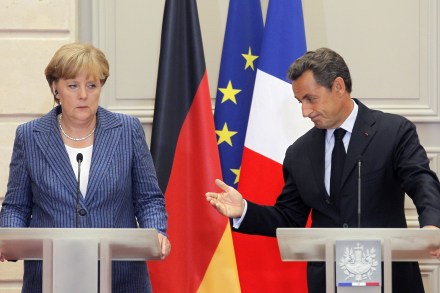
Watch her lips: no Eurobonds. Angela Merkel’s Finance, Minister Wolfgang Schauble has told Der Spiegel: "I rule out Eurobonds for as long as member states conduct their own financial policies and we need different rates of interest in order that there are possible incentives and sanctions to enforce fiscal solidity.” Merkel’s government is making its depositions ahead of tomorrow’s Eurozone summit, rebutting the moves made by other member states over the weekend to introduce Eurobonds, a step towards political integration. Those proposals were backed by Nicolas Sarkozy, with whom Merkel is meeting in private this afternoon.

A friendly gesture…

From our UK edition

The police received a savaging in parliament earlier. I lost count of the number of MPs who relayed their constituents' anger about riot police who stood by as buildings burned. Cameron’s defence – that the police response had been inadequate to adapt to a new threat posed by crime facilitated by social networking – did not allay the concern. By the end of the debate, there was consensus among many backbenchers that police officers should receive training in riot control as part of their basic training. The extraordinary incidents in London and elsewhere have been at the centre of the world’s eye, and the police have not escaped censure.

French with tears

From our UK edition

The civilised world has always needed a lingua franca, through which educated people of international outlook can communicate with each other. For centuries that language was Latin, first the language of theology, then of learning — Erasmus, Milton and Thomas More communicated with a wide community of scholars in Latin. Nowadays, the international language of commerce and culture is English, and from Peru to Shanghai the employees of multinationals talk in their barbarous English idiolects of blue-sky thinking and learning curves, just as their children chant along to the lyrics of West Coast rap. Between the age of Erasmus and that of Ricky Martin, there occurred the supremacy of the French language.

Cameron compromises, but Gaddafi might not

From our UK edition

What a difference four months of air sorties make. Back in the early days of the Libya intervention, David Cameron was unequivocal when it came to Muammar Gaddafi remaining in the country: there was "no future" for the dictator within its borders, he said. But now, on top of comments by William Hague yesterday, the Prime Minister is thought to be softening his stance. As the Independent says today, he has decided that "the time has come to find a way out of the conflict and back a French proposal to allow Gaddafi to stay in the country as part of a negotiated settlement with rebel forces." So, from no future for Gaddafi to some sort of future, and all while the bombs have been dropping. But France and Britain's change in tack is unlikely to have much effect on the ground.

Is Merkel getting her way?

From our UK edition

Below, courtesy of the Telegraph, is a leaked copy of the draft proposals on managing the Greek debt crisis.There are no measures to reduce Greece's debts to sustainable levels; subsidy is the preferred route. This will presumably hit German taxpayers the hardest, but Merkel has managed to obtain private sector involvement, a clear German objective in these discussions.  However, this course is likely to lead to Greece’s selective default as creditors buy back bonds. The European Central Bank has declared that it is happy to allow this and will continue to accept government bonds in the event of sovereign default.

Common Franco-German position on Greek debt

From our UK edition

As I wrote earlier this morning, rumours of a ‘common Franco-German position’ on Greek debt were circulating in the early hours. Details are now emerging. Nicolas Sarkozy has dropped plans to impose a 0.0025 per cent levy on Eurozone bank assets, which was opposed by Angela Merkel for being much too cumbersome. In return, it seems that Merkel is prepared to consider the French-led plan of bond rollover. Merkel is also keen that private sector holders of Greek bonds pay their share of this second bailout. According to the FT, she favours a bond-swap deal, whereby bonds that will mature in the next eight years are swapped for new 30 year bonds paying a lower rate of interest.

Aux Armes, Citoyens

From our UK edition

On the occasion of la fête nationale (not Bastille Day), here's Yves Montand with his greatest hit: Prevert & Kosma's wonderful Les Feuilles Mortes. Salutations to all French friends, readers and relatives today.

In for a penny, in for a trillion

From our UK edition

The news that the EU seeks a budget of £1 trillion between 2013 and 2020 inspired disbelief rather than ire. President Barroso’s almost childlike insistence that the proposal was ‘relatively small’ was amusing, certainly not alarming. It’s a classic EU trick: pitch for 5 per cent and a string of crazy financial measures (including a ‘Tobin tax’ on financial transactions) in the hope obtaining more modest gains of say 2 per cent. Barroso will also throw the odd concession into the bargain: the announcement of a £5.4bn saving on the Commission’s staffing costs represents a concession. But, Barroso has his work cut out to secure even a 1 per cent rise on this occasion.