Foreign policy

The coalition outlines its national security concerns

From our UK edition

What a curious creature this National Security Strategy is. For some reason, I expected something more than a 39-page document in the same mushy pea colour scheme as the coalition agreement. But that is what we've got – and it doesn't really tell us much. The centrepiece of the document comes on page 27 (reproduced below), with a neat, three-tier guide to the security risks facing this country. At the highest priority level are atrocities such as "chemical, biological, radiological or nuclear attack by terrorists," and "hostile attacks upon UK cyberspace". Further down, there are mentions for "organised crime" and "disruption to oil or gas supplies," among others. But, before we get there, there is – as Nicholas Watt notes – a good deal of waffle.

Tories defying the profligate European Union

From our UK edition

Anyone who thought the new intake of Tory MPs were a bunch of automatons should take a look at the House of Commons order paper today. MPs have been asked to sign away 60 percent more of British taxpayers’ money to Brussels, in defiance of British public opinion. For years, they have done so without qualms. But the Conservatives, who were so rightly outraged at the way Labour whipped through the Lisbon Treaty, are challenging this. In an age of austerity, when we’re cutting child benefit and asking if Britain can afford to be a world-class military power, why should MPs sign off a 60 percent increase in the amount of money transferred from British taxpayers to the EU authorities?

The Strange Case of Woodrow Wilson

From our UK edition

Contra Jill Lepore in the New York Times, you don't need to watch Glenn Beck to dislike Woodrow Wilson. Nor do you need think there's any connection between one "professor-President" and the chap currently occupying the Oval Office. Radley Balko lays out the standard libertarian case against Wilson here and, frankly, it makes a pretty convincing argument that, even by the lofty standards of the field, Wilson was one of the most unpleasant men ever to hold the Presidency. And that's before you consider Jim Crow and his penchant for launching extra-constitutional wars... Lepore is correct that some of these libertarian objections are actually points of similarity between Wilson and modern conservatives. But I think a more interesting question than Why does the right hate Wilson?

A hard-headed case of <em>déjà vu</em>

From our UK edition

It was as if we’d been transported back a week – here was William Hague talking about ‘hard-headed foreign policy’, the very phrase that David Miliband had used before he swanned-off into the wilderness in a floral shirt. The details of the two speeches had much in common – an emphasis on free trade, a promise to garner new strategic and economic partnerships in South America and the Near East, balance in the Israeli and Palestinian dispute, global solutions to climate change and a promise to export human rights. Hague differed in not mentioning liberal interventionism and laying historical and partisan claim to free trade, arguing that the European Commission’s protectionist bent was ‘backward-looking and doomed to fail’.

Forget the culprit, the MoD leak suggests that Fox doesn’t have Cameron’s confidence

From our UK edition

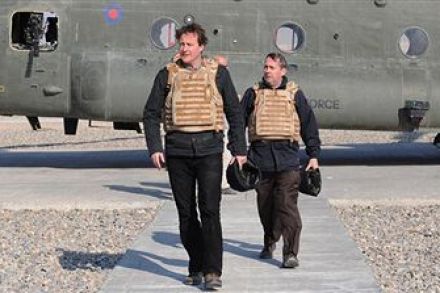
Liam Fox is sombre rather than sombrero. A man to reckon with, you’d have thought - determined to fight dangerous cuts to Britain’s over-extended defence budget and an apostle of the Tory right. Which makes yesterday’s leak all the more extraordinary. The question is not who leaked this incendiary letter, but why Fox wrote it. The night before an important National Security Council meeting, and Fox has an important point to convey. Why not ring the Prime Minister? Go round to No.10 for chat? He is the Secretary of State, but he has to communicate matters of confidence and competence between himself and the PM with such formality, and in such impassioned language. The idea that Fox wrote it to leak it is preposterous.

Obama’s Hit Squad: Above and Beyond the Law

From our UK edition

I think it's reasonable to say that those Americans who hoped for some improvement - even if only of the marginal variety - from Barack Obama on the civil liberties front have often been pretty disappointed. But because American conservatives - at least those conservatives gathered in the Republican party - have no interest in these quaint notions either it's not something that's become a dominant theme of his presidency. And, as Mike Crowley says, it's probable that the President calculates that the upside from pleasing the people who care about these things isn't worth the trouble if, god forbid, something happens and he can be portrayed as "soft" on terrorism (watch for David Cameron to slip away from campaign rhetoric here too). Nevertheless there are limits.

The penny drops

From our UK edition

David Miliband is a tease. The speech he just gave was one of his best: it was self-deprecating, had gravitas, humour, and he spoke down to the Tories, telling William Hague what statesmanship was about. A monstrous conceit, CoffeeHousers may argue, but a Labour leader needs a bit of that; to make out that he's the real leader-in-waiting, up against lightweights. There was his trademark little bit of grit in the speech: he praised the troops, the Afghan mission and criticised Cameron for reducing British diplomacy to trade missions (Con Coughlin made the same point in a Spectator cover piece recently). My point: that this was a measurably better speech than the one his little brother made on Saturday. And I'll bet it's better than the speech Red Ed will make tomorrow.

The defeated brother delivers a winning speech

From our UK edition

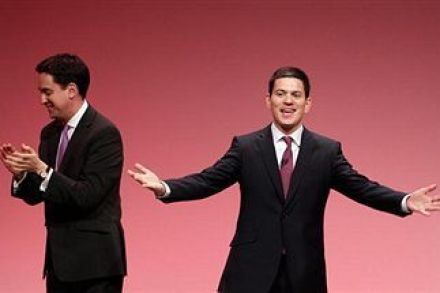
David Miliband's address to the Labour conference ended as it began: with a  standing ovation. Sentimentality and sympathy, perhaps – but it was also deserved. This was a speech that his younger sibling will be hard pressed to match tomorrow. Indeed, I doubt even MiliD has matched it himself before now It began, of course, with an attempt to massage out the tensions of the past few days. There were some gags about how Miliband had draft speeches for Saturday and Tuesday on his computer - "so I've got a couple of speeches to draw on." And he implored Labour to unite behind his brother – "we have a great new leader and we've got to get behind him." He added, by way of a fraternal backslap, "I'm incredibly proud of my brother". So far, so smooth.

‘It’s a bit of a riddle’

From our UK edition

Perhaps Donald Rumsfeld was right: the Coalition should not have gone for the 'hard slog' in Afghanistan (or Iraq). Hindsight suggests that Rumsfeld had foresight in his desire that a shock and awe campaign be followed by a light presence and eventual withdrawal - the blood baths that have ensued from intense deployment might have been avoided.  I hope the two times Secretary for Defence Secrte addresses those issues in his memoir, Known and Unknown, due to be published in January three months after Bush’s.

Ashton’s latest ruse

From our UK edition

I've obtained this list of Baroness Ashton's proposed recommendations for the next wave of EU diplomatic appointments. CoffeeHousers' will notice there are no Brits on it.

Preparing for a Nuclear Iran

From our UK edition

That's the message of the US's forthcoming $60bn arms-deal with Saudi Arabia. Or so says David Rothkopf anyway: [T]he reason that the U.S. government -- that would not have done a deal like this in the years right after 9/11 -- is willing and even a little eager to move ahead with the deal now is that the War on Terror is being overtaken among top U.S. concerns by the advent of a nuclear Iran.  Now, you may quibble by pointing out that Iran does not yet have nuclear weapons. But this is a purely academic argument. This deal is the latest example of behavior suggesting that the nuclearization of Iran is all over but for the bomb building in the eyes of U.S. and regional strategists. [...

The coalition’s inept EU referendum lock

From our UK edition

At least this government is honest. ‘There will be,’ Europe Minister David Lidington says, ‘no referendum on the transfer of competence or power from the UK to the EU during this Parliament’. The government will ensure that there are no more EU power transfer treaties; but, as Douglas Carswell, Tim Montgomerie, and Bill Cash all note, the Lisbon Treaty is self-ratifying. The EU has already picked the coalition’s lock and garnered new powers for itself – notably the extension of the EU arrest warrant. The EU could be an economic superblock with the muscle to influence the globe strategically and culturally. But its current political operation is unnecessary and deplorably un-democratic.

Buchan on Foreign Policy

From our UK edition

Sandy Arbuthnot in The Three Hostages: "Lord!" he cried, "how I loathe our new manners in foreign policy. The old English way was to regard all foreigners as slightly childish and rather idiotic and ourselves as the only grown-ups in a kindergarten world.  That meant that we had a cool detached view and did even-handed unsympathetic justice.  But now we have got into the nursery ourselves and are bear-fighting on the floor.  We take violent sides, and make pets, and of course if you are -phil something or other you have got to be -phobe something else.  It is all wrong.  We are becoming Balkanised." Discuss, paying special attention to Iraq and Afghanistan. To what extent, if any, do Arbuthnot's views retain some merit?

Thomas Friedman: World Actually Quite Mountainous

From our UK edition

And not so flat as a certain Thomas Friedman Jr had us believe not so long ago. Nevertheless, Friedman has a point: American leadership may look rather different in the future: In recent years, I have often said to European friends: So, you didn’t like a world of too much American power? See how you like a world of too little American power — because it is coming to a geopolitical theater near you. Yes, America has gone from being the supreme victor of World War II, with guns and butter for all, to one of two superpowers during the cold war, to the indispensable nation after winning the cold war, to “The Frugal Superpower” of today. Get used to it. That’s our new nickname. American pacifists need not worry any more about “wars of choice.

A question of judgement

From our UK edition

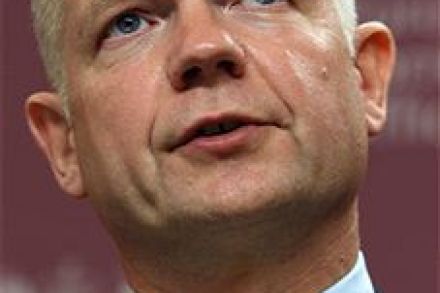
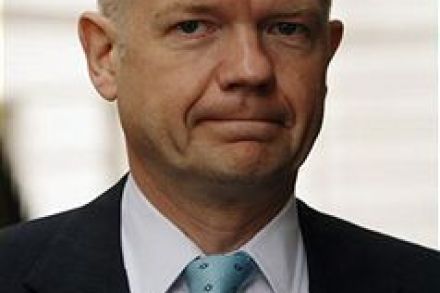
Up until today, the Hague-Myers story was confined to scurrilous rumour on Guido’s blog and the occasional cautious article in the Telegraph or the Mail; the rest of the media were uninterested. But, as James notes, Hague’s two extraordinarily frank statements, particularly yesterday’s impassioned denial to ‘set the record straight’, have forced the issue into the mainstream political debate. The personal always becomes political. What of William Hague’s judgement? John Redwood condemns Hague’s ‘poor judgement’ in personal matters before going on to cast aspersions on his policy judgements, particularly those relating to the EU.

The Today Programme has its Hague cake and eats it too

From our UK edition

The Today Programme this morning demonstrated the problem with putting out an official statement on your private life: it makes the media feel that they have official sanction to discuss the matter. There were three separate discussions of Hague’s statement on the programme this morning. In a classic case of the BBC trying to both have its cake and eat it, one of the segments spent several minutes debating whether they should be talking about the matter at all. Hague’s problem is that the press is now obsessed with this story; it isn’t going to let it go even after this extraordinarily personal statement.

Britannia ruled the waves

From our UK edition

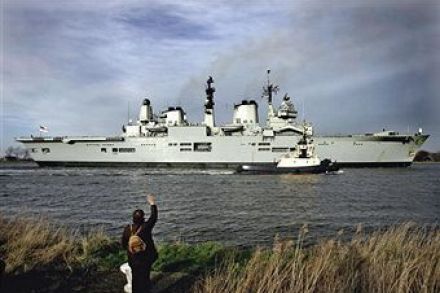
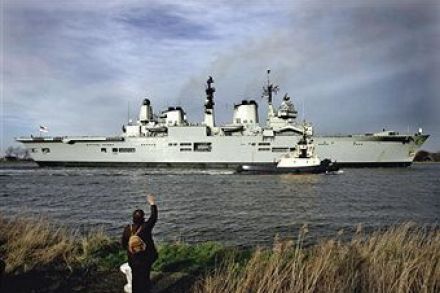
As Pete wrote this morning, the plan to share aircraft carriers with France is controversial. It seems that concerns over sovereignty, job losses and differing strategic interests reduce to the one issue that no government has addressed: the protectionist system of defence procurement, which hampers the operational effectiveness of our armed forces. Typically forthright, Douglas Carswell identifies the problem: ‘Seems like protectionist defence procurement isn’t quite giving us sovereign capability the way we were promised, eh? Had we ordered much of the new carriers to be built overseas, we could have had them at a fraction of the £5 billion cost.

Strategic differences

From our UK edition

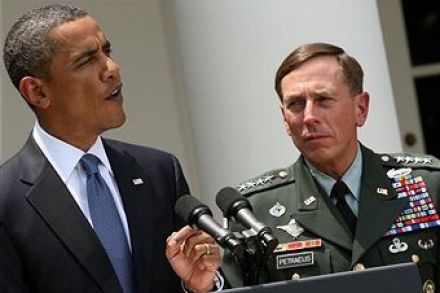
When President Obama asked General Petraeus to take over the Afghan command after General McChrystal’s Rolling Stone implosion, there was much speculation that the two men would clash over the date for America to begin withdrawing troops. Obama had set down July 2011 as the starting point but Petraeus was almost certainly going to want more time than that. In Petraeus’s Meet the Press interview on Sunday, Petraeus made clear he might argue that withdrawal cannot begin that quickly 'MR. GREGORY:  I just want to clarify this.  Did — could you reach that point and say, “I know that the process is supposed to begin, but my assessment as the commander here is that it cannot begin now”? GEN.

Ambassador, you’re spoiling us

From our UK edition

The European Union’s creeping barrage continues. Brussels has appointed the urbane looking Joao Vale de Almeida as ambassador to Washington; Vale de Almeida hopes that Henry Kissinger will call him if the old campaigner wants to talk to Europe. It is perverse that Britain is saving money by closing embassies and downscaling around the globe whilst also paying its share to install Senor Vale de Almeida in the swanky environs of the Beltway. In this era of devolution, cost-cutting decentralisation, the European Union is beginning to behave like a state, and an opulent one at that. In the past fortnight it has once again suggested that it should raise taxes.

Officials: Better than 50 percent chance that Israel will strike Iran next year

From our UK edition

The Iran issue has dropped down the news agenda in recent months. But that doesn’t mean it has gone away. Even with the difficulties that Iran’s nuclear programme has faced, any decision on whether to try to use force to stop Iran becoming a nuclear-ready power will have to be taken in the next year or so as Jeffrey Goldberg’s brilliantly reported cover piece in the Atlantic reminds us. Goldberg writes, “I have interviewed roughly 40 current and past Israeli decision makers about a military strike, as well as many American and Arab officials. In most of these interviews, I have asked a simple question: what is the percentage chance that Israel will attack the Iranian nuclear program in the near future?