Europe

Owen Paterson: A referendum on the EU is inevitable

From our UK edition

It is becoming increasingly clear what the Conservative party expects of its Prime Minister. If he is going to agree to 17 eurozone countries pushing ahead with the Franco-German plan for fiscal union, he needs to secure a new deal for Britain in exchange.   Just what this new deal should look like is a matter of intense debate in Conservative circles. If France and Germany turn the eurozone into a ‘fiscal union’, what does that mean for Britain’s standing in the European Union? At the weekend, Iain Duncan Smith suggested that the nature of the EU would change so much that a referendum would be necessary. No. 10 quickly ruled that out. Cameron confided to Cabinet colleagues on Monday that he feared another referendum would bring down the coalition.
Cameron attacked from all sides on Europe

From our UK edition

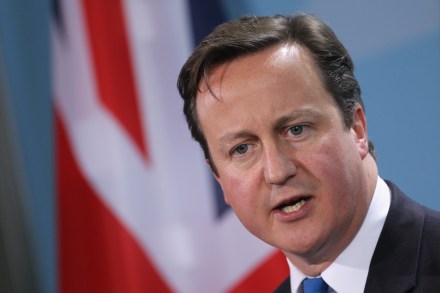
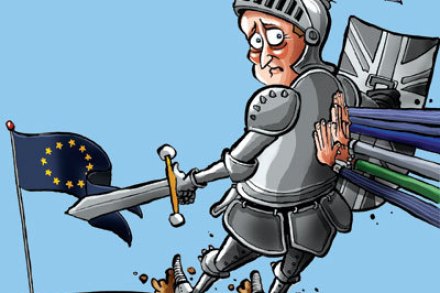
David Cameron’s usual insouciance gave way to something approaching shouty panic as Europe dominated exchanges at PMQs. 8 Conservative MPs, all of them hostile to varying degrees, asked questions about Cameron’s intentions at the Brussels summit on Friday. This may not have surprised him, but the word around the Commons tearooms is that Cameroons are blaming Speaker Bercow for calling so many antagonistic MPs to their feet. It looked like a co-ordinated attack; and it's no surprise that an opportunistic Boris has since taken to the airwaves renewing his call for a referendum. Cameron’s article in this morning’s Times may have been intended to quell disaffection by looking decisive, but it seems to have had the opposite effect.

Cameron’s plan

From our UK edition

Much ado about a Cabinet split over Europe this morning. The Financial Times has interviewed Ken Clarke, whose europhile instincts are well known — something he shares with the senior Lib Dems. Clarke tells his eurosceptic colleagues not to expect powers to be repatriated from the EU at Friday’s summit. Meanwhile, David Cameron has written a piece in today’s Times (£), reiterating that he will veto any treaty that damages British interests. He also says that his ‘requests will be practical and focussed’. And therein, apparently, lays the split. The word ‘requests’ might open the possibility of repatriation.

Cameron ramps up his rhetoric

From our UK edition

The Conservative backbench disquiet on Europe has been building over the last few days, forcing David Cameron to quell the disaffection. He said earlier this evening: ‘When I go to Brussels I will be there to defend and promote British Interests, and the most important British interest right now is to sort out the problem in the Eurozone that is having the chilling effect on our economy that I have spoken about. That obviously means Eurozone countries doing more together and if they choose to use the European Treaty to do that than obviously there will be British safeguards and British interests and I will be there to protect that.

Fiscal union would hit eurozone credit ratings

From our UK edition

There is predictable euro-rage today at Standard and Poor's warning that there's a 50/50 chance that the six AAA eurozone countries could see their credit rating downgraded. But if the eurozone does push ahead with fiscal integration, it will — obviously — have an impact on the credit worthiness of the stronger eurozone economies. One of the reasons that the German bund auction went so badly on November 23 was because of concerns that Germany would end up having to backstop the debts of other European countries. Fiscal union would require Germany to do just that for now and evermore. No 'good solutions' to the eurozone crisis exist. We are in the land of least worst options.

Mutiny in the air

From our UK edition

David Cameron’s European problems seem to be mounting. The usual suspects — Carswell, Redwood, Jenkin et al — have been only too happy to take the airwaves and talk of this ‘great opportunity’ to repatriate powers. Those sentiments are growing across the backbenches. The Guardian quotes an ally of Iain Duncan Smith saying that he and his friends ‘do not accept the prime minister's argument that the changes will only affect the eurozone. Of course the changes will have an impact on Britain.’ The mounting disquiet appears to have been created, to an extent, by the PM hedging his bets and lowering expectations.

Yes, Virginia, History Matters: Eurozone Edition

From our UK edition

Broadly speaking, there are two ways of viewing the eurozone crisis: it's a problem of economics or a problem of politics. Neither explanation quite suffices, of course, since it is both but the emphasis you place on economics vs politics plays a part in how you'll view the situation and how likely you are to think there's any kind of solution that can satisfy the politics and the economics of the situation. Which is by way of suggesting that plenty of American commentators seem to think the problem is easy to solve and the main thing lacking in europe is the political will to do something about it. (Exhibit A: James Surowiecki of the New Yorker).

The referendum question Pt. 2

From our UK edition

Earlier this morning, Number 10 briefed that fiscal union in the eurozone would not trigger a referendum in this country because sovereignty will not be transfered from London to Brussels — a pre-requisite for any vote. The problem for Cameron is that some of his backbenchers say there should be a referendum. Bernard Jenkin was on the Daily Politics earlier, insisting that fiscal integration marks a new era in the history of the Eurozone, which he dubbed ‘Maastricht Plus’. On the other hand, some eurosceptic backbenchers caution that now is not the time to hold a referendum — stability in the eurozone is the order of the day.

Club Rules, Brussels Edition

From our UK edition

Ben Brogan's latest post offers a revealing glimpse into the oddness of the eurosceptic mind. He begins: To the dismay of many of his colleagues preoccupied by the euro crisis, the Prime Minister has been adept at nurturing strong personal relationships with Angela Merkel and Nicolas Sarkozy. Instead of confrontation he has engaged constructively with them, to the extent that they listen to him and are willing to consider his attempts to press the British interest. The German chancellor was delighted to discover that Mr Cameron was not the swivel-eyed euro loon she had feared, but a charming and reasonable young man. The French president meanwhile bonded with mon ami Dave over Libya and – pace the odd shouty moment – likes doing business with him.

The referendum question

From our UK edition

As French and German officials make final preparations ahead of tomorrow’s meeting on fiscal union, it’s worth reconsidering the coalition’s triple referendum lock. James Kirkup has an incisive post on the issue, describing a potential government split. The division was evident on TV this morning: Iain Duncan Smith told Dermot Murnaghan that a referendum would be held ‘if there is a major treaty change’, while Nick Clegg told Andrew Marr that only ‘an additional surrender of sovereignty from us to Brussels’ can spark a vote. Kirkup argues that IDS reflects the broader sceptic position on the Tory backbenches: that the PM has promised a vote on all substantial treaty changes.

The importance of being earnest | 4 December 2011

From our UK edition

The absence of growth and the importance of credibility are recurring themes in this morning’s papers. John Lord Hutton has told the BBC that revised growth figures make pension reform even more urgent, and he added that the deal that was put before trade unions was ‘perfectly credible’. Meanwhile, David Cameron has insisted that ministers increase their pension contributions by an average of 4.2 per cent (more than the 3.2 average across the public sector) to show that ‘we are all in this together’. Pensions also feature in an Independent on Sunday interview with Tim Farron, the Lib Dem President.

Austerity is not enough

From our UK edition

The Euro crisis is terrifying, as Peter Oborne rightly says in today’s Telegraph. But what scares me even more is the paucity of the debate. Right now, the summitry is aimed at saving the euro as if this were an end in itself. Merkel’s logic (‘if the euro fails than Europe fails’) is dangerously simplistic: there are millions out of work, including half of young people in Spain, and they won’t be helped if their dole money is paid in euros. Recovery is needed. Jobs are needed. The euro has always been a project that puts politics first and economics second, with disastrous consequences. It cannot now be solved by political willpower or political cliches. The bailouts are mounting, and failing.

The Gospel according to Delors

From our UK edition

An old enemy of England nestles in the pages of today’s Daily Telegraph. Charles Moore travelled to Paris to meet Jacques Delors, the architect of the euro and advocate of Europe’s ‘social dimension’. Moore found defiance where one might have expected humility, perhaps even repentance. Delors insists that the fault was in the execution not the design of the euro.

A tale of two cities | 2 December 2011

From our UK edition

Nicolas Sarkozy is grudgingly admired by French socialists as a political fighter, capable of thriving even in the most desperate situation. David Cameron is coming to understand what they mean. It is the best of times and the worst of times between Paris and London. Two months ago, David Cameron and Nicolas Sarkozy assumed the victor’s garlands in Benghazi; today, they met at odds, if not yet in animosity, over the contested logic of ever closer union in Europe. Sarkozy appears to have got his wish: the 17 countries of the Eurozone will deepen their economic and political relations in an attempt to save the single currency — and with it, he hopes, France’s economic and political strength on the international stage.

Merkel’s fiscal union won’t solve the euro’s problems

From our UK edition

Few people have been as vindicated about the failings of the euro as Marty Feldstein, who was chairman of the Council of Economic Advisers under Reagan. In 1997 he wrote a piece for Foreign Affairs called 'The EMU and International Conflict'. In it, he argued that far from furthering peace and stability in Europe, the Euro would actually endanger it. Watching the events of the past few months, few could disagree with him. Feldstein has now returned to the debate pointing out that none of the current fixes being suggested will solve the single currency's problems.

Sarko’s renaissance

From our UK edition

When David Cameron sits down for lunch with Nicolas Sarkozy today, he is bound to ask his host how the presidential election is going. In response, President Sarkozy is likely to break into one his wide-faced smiles, and begin moving about energetically, as he tends to do when he is excited. Forget the polls that put Francois Hollande ahead in a two-way race. It is too early to tell what people really think and, crucially, it won't be a two-person race. It is a five-person, two-round election. And so far, Sarkozy is doing very well. Besides Sarkozy and Hollande, four other candidates could make a difference to the outcome: Marine Le Pen, François Bayrou, Eva Joly and Jean-Luc Mélenchon.

Meanwhile, in Europe…

From our UK edition

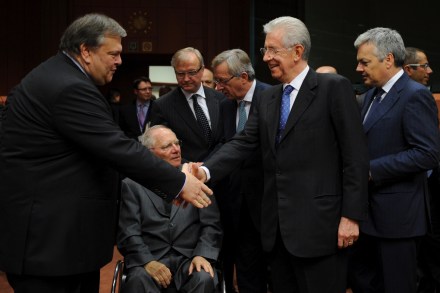
There probably hasn't been a meeting of European finance ministers as important as the one tonight. The euro is still at risk; with new governments in Spain, Italy, and Greece incapable of calming the markets, and Angela Merkel unwilling to let the ECB act. In a speech in Berlin, Polish foreign minister Radek Sikorski put it clearly: ‘I fear German power less than I am beginning to fear German inactivity.’ It is a fear shared in London and Paris as well. The 17 finance ministers will discuss the range of options on the table: from setting up an EU Treasury to the possibility of eurobonds or establishing a supra-national process to monitor national budgets.

On the road to break-up?

From our UK edition

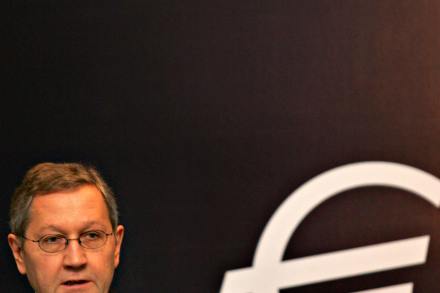
Before we plunge into the Autumn Statement, we really ought to mention the poison cloud hanging over Brussels today. European finance ministers, including George Osborne, are meeting there later — and it's certainly not going to be good for their collective health. Klaus Regling, the head of the European Financial Stability Facility (EFSF), is expected to tell them that there's basically no chance of them boosting the bailout fund to €1 trillion in the near future, as was promised at the end of last month. Back then, David Cameron urged eurozone leaders to bring a ‘big bazooka’ to the fight. They have barely managed a cap gun. This is far from surprising.

Cameron may have more leverage in Europe than he thinks

From our UK edition

There's just over a week to go until the crunch EU summit on 8-9 December, so David Cameron has to decide how best to play his cards — and quick. The problem, as Daniel Korski has pointed out, is that Britain faces the risk of ‘structural isolation’ in Europe in the short-term. To counter this, Cameron effectively has two options. First, work with allies on both sides of the euro divide to seek political assurances — formal or informal — against the formation of a two-tier Europe with a more integrated eurozone in the driving seat. Or, second, press ahead with UK-specific carve-outs from the EU structure.

Tobin tactics

From our UK edition

The biggest bone of contention between the UK and its EU allies these days is the ‘Tobin tax’, the idea of levying a tax on financial transactions. To the UK this is folly. Unless it is levied globally, a tax will force business to move elsewhere. And there is a greater chance of Silvio Berlusconi being elected ECB chief than the Tobin tax being levied globally.   Based on the experiences of Sweden in the 1990s, the tax will achieve none of what its proponents believe it will — and at a considerable cost to Britain's and Europe's economy, as companies look to list elsewhere to avoid it. As Ryan Bourne from CPS points out, even the European Commission found that the tax may hurt the economy. The EC thought it could reduce Europe's GDP by up to 1.