Europe

Europe’s culture clash

From our UK edition

Two weeks ago Luigi Di Maio, Italy’s vice-premier and Labour Minister and the top politician of the Five Star Movement (M5S), appointed a new commissioner for the UN cultural organisation Unesco. He chose the dog--whistling, bum-slapping sex--comedy actor Lino Banfi, star of How to Seduce Your Teacher, Policewoman on the Porno Squad and other films. The M5S was launched online by the 1980s comedian Beppe Grillo. It is run on the basis of a private computer operating system called Rousseau. Most Italians look at the M5S as either a breath of fresh air, a necessary gesture of defiance, or a ridiculous episode that will pass. But you need a sense of humour for that. French President Emmanuel Macron has lately shown himself unable to take the Italian government in his stride.

Merkel’s immigrant boom wreaks havoc in Germany’s prisons

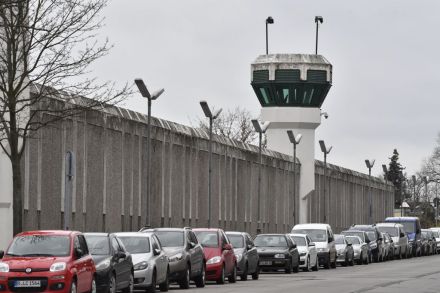
Angela Merkel’s decision to allow more than one million migrants into Germany has caused a crisis in Germany’s prison system. About half the prisoners in Berlin and Hamburg are now foreign-born, according to the latest figures in the German press, and in prisons across the country, German is becoming a foreign language. This surge in outsiders on the inside coincides neatly with the 2015 decision to allow in migrants from the Middle East, Africa and Asia. All regions of Germany report a ‘very strong increase’ in the number of foreign and stateless prisoners, according to data from the past three to five years. Prisons throughout Germany are overcrowded and struggling to handle the influx in population.

germany prisons

Europe’s blind spot

From our UK edition

In Paris in December, I sat with a journalist friend in a café on the Boulevard Auguste-Blanqui and listened to him explain to me why a no-deal Brexit would be a catastrophe for Britain. It had to do with an article his newspaper had published about the Mini. You might think they were typically British cars, he said, but the plant where they were made in Cowley belonged to BMW! The steering wheels were assembled in Romania! The tail lights came from Poland! So? I asked. Brexit was about leaving the EU, not making globalisation un-happen. Who do you think wants to close the Mini plant? Britain does not want to damage its export sector any more than Romania or Poland wants to shut down a factory that provides the livelihoods of thousands.

High life | 10 January 2019

From our UK edition

Gstaad The funny thing is that I was at school with a man called Ted Widmer, and I recently read that one Ted Widmer is a ‘distinguished lecturer’ at a New York university and a senior fellow at the Carnegie Council for Ethics in International Affairs. The Ted I knew was anything but ethical and dressed rather strangely. Never mind. Whether or not he was a schoolmate, Widmer has written a treatise on the year 1919 and called it ‘1919: the Year of the Crack-up’. It’s very good. Basically, he says that what took place in 1919 shaped the world for the rest of the century. One hundred years later, his crack-up looks to me like a tiny fissure — a chink —yet in a funny way it did shape the rest of the century.

How terror changed Europe’s Christmas markets

From our UK edition

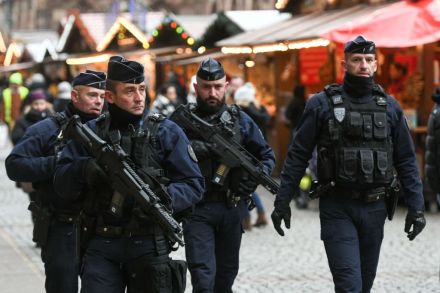
The traditional Christmas market is one of the great sights in any European capital at this time of year. But as with all traditions it evolves over time. A few evenings ago, I went to visit the Duomo in Milan and walked through the beautiful Christmas market in the square surrounding it. It was all there: the Christmas lights, the chalet-like huts selling warm food and drink, the fake snow. And, of course, the crash barriers. For since December 2016, when Anis Amri hijacked a truck in Berlin, shot the driver and then ploughed the vehicle into the local Christmas market (killing eleven more people) crash barriers have become a necessary feature of any European Christmas market.

Portrait of the Week – 15 November 2018

From our UK edition

Home Theresa May, the Prime Minister, defended a 500-page technical draft of the agreement on withdrawal from the European Union. She met immediate opposition from the Democratic Unionists, from Jacob Rees-Mogg and from Boris Johnson. Mr Johnson’s brother Jo (a Remainer) had earlier resigned as a minister, calling Mrs May’s handling of Brexit a ‘failure of British statecraft on a scale unseen since the Suez crisis’. The BBC reported that several cabinet ministers had expressed doubts about her Chequers plan back in July. Jeremy Corbyn, the Labour leader, insisted that Brexit could not be stopped, but Keir Starmer, Labour’s shadow Brexit secretary, said the option of a new referendum was still ‘on the table’.

Trump had an opportunity to redefine American foreign policy. He blew it

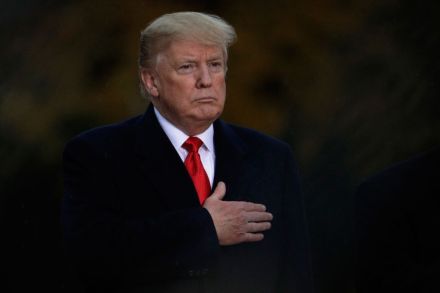
Donald J. Trump is home from his whirlwind weekend trip to commemorate the 100th anniversary of the First World War’s end. Even by The Donald’s formidable china-breaking standards, this was a doozy which will be discussed with opprobrium by the Transatlantic smart set for some time. President Trump seemed to go out of his way to upset his French counterpart and host Emmanuel Macron, who’s hit a political rough patch and needed some brotherly love. That bromance is dead and buried, however, and Trump fired off a mocking tweet at Macron as he boarded Air Force One for Paris that denounced the French president’s backing of a European army as ‘very insulting.

donald trump compiègne

The Eurosceptic Queen

From our UK edition

There has been much inconclusive speculation on the Queen’s views on Brexit. In 2016, the Sun asserted that she was in favour (later overruled by Ipso as ‘significantly misleading’). Last year, pro-EU commentators claimed that the blue hat with yellow stars she wore to open Parliament showed coded support for Remain. For now, we are none the wiser. What we do know, however, is that the monarch must be finding things a good deal easier on the way out than on the way in. Rewind to 1972 and a damp May evening at the Palace of Versailles.

Are the Sweden Democrats far-right? Jimmie Akesson interviewed

From our UK edition

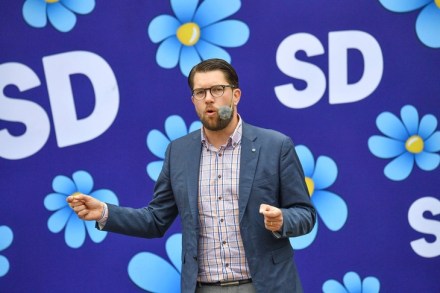
In the newspapers today, there is much talk of Sweden turning to the 'far-right.' The Times has a picture of skinhead nutters on the march, giving the impression that Swedes are about a day away from goose-stepping down Drottninggatan. The myth of Sweden going all Nazi is a myth that’s hard to puncture because no one has a good word to say about the Sweden Democrats, who are hoping to finish first. They'll not end up in government, because no one would enter coalition with them. But their electoral success baffles the outside world. There is no agreed definition of "far-right" and the term is lazily used: dramatic, but serves to cloud understanding of what's happening in Europe.

Matteo Salvini is lucky to be the enemy of the Italian justice system

From our UK edition

As Machiavelli noted: in order to prevail, a successful prince needs Fortuna as well as Virtù. Matteo Salvini, who has replaced Silvio Berlusconi as Italy’s dominant politician, has got them both. In any normal country, it would surely be unthinkable that the deputy leader of a new government elected specifically to stop refugees being ferried across the Mediterranean from North Africa to his country should face trial for actually doing so. But as the Italians themselves are the first to admit: ‘Italy is not un Paese normale (a normal country)’. Its judicial system, for example – they know from bitter experience – is incompetent, arbitrary and politicised, and widely regarded not just as the enemy of the people but of justice itself.

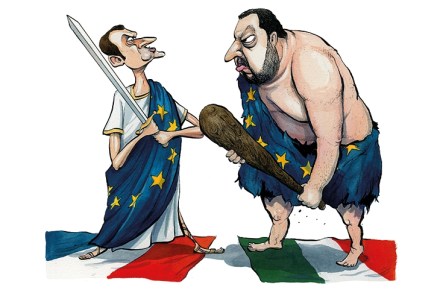
Macron vs Salvini: the ideological battle for Europe’s future

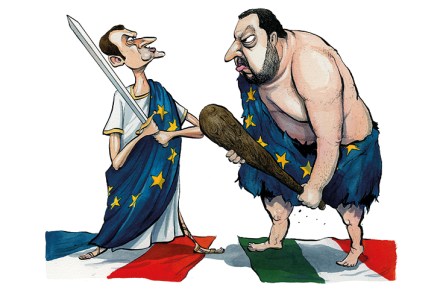
The first sign that Matteo Salvini was destined to do battle with Emmanuel Macron came in June, a few days after he was named Italy’s interior minister. Salvini, whose party, the League, wants to cut immigration drastically, announced that a German-registered rescue ship carrying 629 aspiring migrants from Africa would not be allowed to dock in Sicily. Macron reacted with disgust. ‘The policy of the Italian government,’ a spokesman for his political movement announced, ‘is nauseating.’ Salvini responded that if the French wanted to show their open–heartedness, they might make good on their unfulfilled pledge to feed and shelter some of the 100,000 African migrants Italy had until recently been receiving each year.

salvini macron spectator cartoon

Macron vs Salvini

The first sign that Matteo Salvini was destined to do battle with Emmanuel Macron came in June, a few days after he was named Italy’s interior minister. Salvini, whose party, the League, wants to cut immigration drastically, announced that a German-registered rescue ship carrying 629 aspiring migrants from Africa would not be allowed to dock in Sicily. Macron reacted with disgust. ‘The policy of the Italian government,’ a spokesman for his political movement announced, ‘is nauseating.’ Salvini responded that if the French wanted to show their open--heartedness, they might make good on their unfulfilled pledge to feed and shelter some of the 100,000 African migrants Italy had until recently been receiving each year.

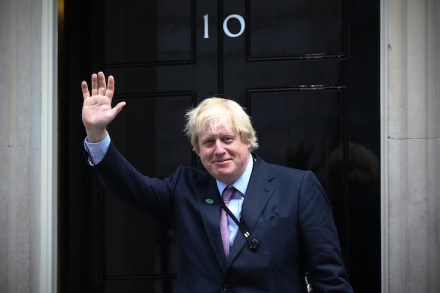
Brexit means Boris

From our UK edition

A few months before he died in 2007, Bill Deedes asked if I would come to see him at his home in Kent and bring Boris Johnson along with me. I was writing a biography of Bill at the time, and I knew he was miserable because he had broken his hip and could no longer come up to London. Boris jumped at the idea and I remember our lunch as the last time I saw Bill exuberantly happy. Boris knew instinctively what a 93-year-old journalist who was struggling to write his weekly column needed, and filled him in hilariously on the London political and media gossip. The only slight awkwardness came when Bill stressed his admiration for David Cameron, and Boris’s impenetrable eyes momentarily turned just a little beady.

L’Europe, c’est moi

From our UK edition

I meet Bernard-Henri Lévy in a colossally luxurious hotel on a tree-lined avenue just behind the Elysée Palace. The French philosopher is half-reclining on a sofa, with one ankle tucked under his thigh, beneath an ornamental bookcase bearing a bust of Voltaire. He wants to discuss his new play, Last Exit Before Brexit, which will receive its world premiere at Cadogan Hall, London, on 4 June, under the auspices of the Hexagon Society. The play takes the form of a 100-minute monologue. What’s it about? ‘A group of anti-Brexit intellectuals decide to organise a last-chance event in the symbolic city of Sarajevo. They ask me to deliver the keynote speech.

Brexit is fast becoming a Tory no-win

From our UK edition

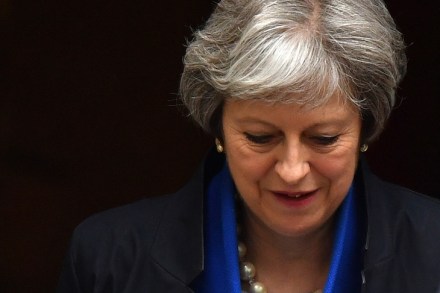
Theresa May’s Brexit dilemma is becoming more acute. Last week, she failed to garner the support of the Brexit inner cabinet for a so-called ‘new customs partnership’ with the European Union. Even so, May can’t and won’t drop the idea. She’s convinced that it is critical for solving the Irish border issue, and thus unlocking a deal. But the bad news for Mrs May is that opinion has hardened against her scheme (which would see the UK collecting tariff revenue for the EU even after Brexit). Boris Johnson has publicly attacked it as ‘crazy’ and in no way ‘taking back control’. Tellingly, Downing Street didn’t feel it could slap him down for this.

The Spectator Podcast: Red London

From our UK edition

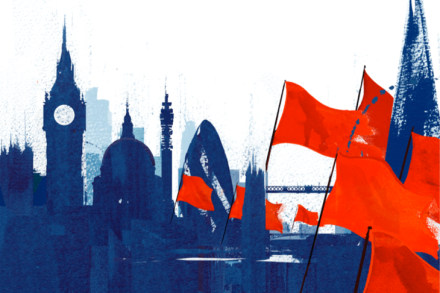
In this week’s episode, we talk about red London – just how badly will the Tories do in the upcoming local elections, and why do people love Sadiq Khan? We also talk about the end of Macron’s political honeymoon, and the death of the Grand Tour. As national headlines are dominated by Jeremy Corbyn, local Labour candidates are preparing for a sweeping victory through London’s upcoming local elections. Will Heaven, the Spectator’s Managing Editor, writes in this week’s cover that ‘the Tories are braced for disaster’. Why is London turning red?

Communal listening | 5 April 2018

From our UK edition

To Herne Bay in Kent for the UK International Radio Drama Festival: 50 plays from 17 countries in 15 languages broadcast over five days to the festival audience. It’s an opportunity to find out what radio plays sound like in other countries, but also to experience a different kind of listening. About 25 of us were invited into a suite of rooms furnished with flock wallpaper, floral sofas and armchairs to take us back to the great age of radio listening in the 1950s. A kettle boils in the background; buttered scones on a tiered rack are sitting ready for us to pounce on at the next pause between plays.

Churchill was all in favour of a united Europe — as long as it didn’t include Britain

Dr Felix Klos is an extremely personable, highly intelligent American-Dutch historian who has undertaken much archival research, worked extremely hard and is an excellent writer. In trying to persuade us that Churchill favoured Britain joining a federal Europe, however, he comes up against several immovable obstacles. The most serious of these is that in the four years that Churchill was prime minister, between 1951 and 1955, he personally, regularly and decisively blocked all movement towards Britain joining any of the European federal institutions that existed. However engaging Klos may be, and however well written his book, he is utterly wrong in his central thesis.

A new Europe | 25 January 2018

From our UK edition

The occasion was a central European conference on the subversive disinformation campaigns of Putin’s Russia (which, incidentally, are real, subtle, and potentially effective). The speaker was an American warning that the central European democracies were in imminent danger of succumbing to the lures of authoritarian populism, even of abandoning democracy itself, under this influence. He cited the probable election of the media billionaire Andrej Babis as prime minister in Czech elections as one sign of this democratic collapse. A heavy sigh came from a European participant, standing next to me: ‘Why do Americans exaggerate so?

Russian fake news is causing trouble in Latvia

From our UK edition

In the historic heart of Riga, Latvia’s bustling capital, there’s a boulevard that doubles as a timeline of this proud country’s turbulent past. When Latvia was part of Tsarist Russia, it was called Alexander Street. In 1918, when Latvia won its independence, it was renamed Freedom Street. In 1940, when the Red Army invaded, its name was changed to Lenin Street. In 1941, when the Wehrmacht marched in, it became Adolf Hitler Street. When Latvia was swallowed up by the Soviet Union, it became Lenin Street once more, and in 1991, when Latvia regained its independence, it became Freedom Street again. 2018 marks the hundredth anniversary of Latvian independence. There are celebratory events all over Latvia throughout the year.