Europe

View from the EU

From our UK edition

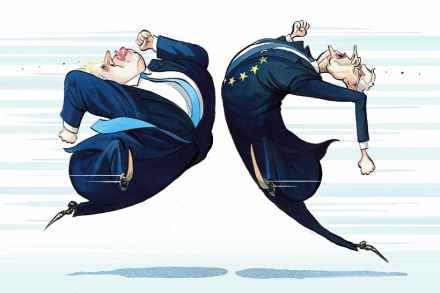
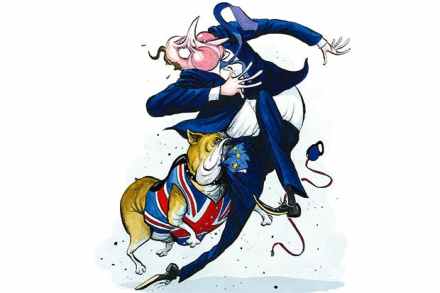
The conviction has been spreading among French people in recent days that les Britanniques have just elected Donald Trump. The papers are filled with meditations on British anxieties over lost empire, descriptions of Boris Johnson’s hair and the wildest speculations about what he might do as Prime Minister. Every squib about European overregulation that Johnson wrote during his stint as a Brussels correspondent for the Telegraph in the 1980s and 1990s has by now been vetted, stripped of its humorous intent and found wanting. Johnson exaggerated the threat of European regulations to prawn cocktail-flavoured crisps! Nowhere did he cite a single EU directive banning the large-sized condoms that an Englishman requires!

Who’s afraid of no deal?

From our UK edition

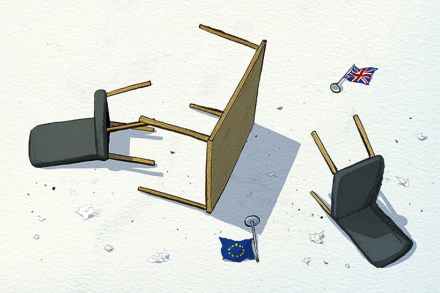
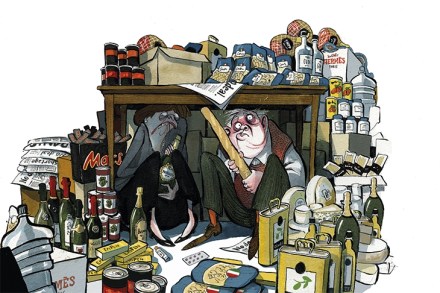
How bad would a no-deal Brexit really be? This is now perhaps the most important question in politics, and the one provoking greatest disagreement. The answer will help decide whether parliament allows Brexit to happen, and whether Tory MPs bring down their own government. If they think calamity would follow, patriotic rebels might risk a general election to stop the Tories. But what if it would not be so bad? And is there any way of finding out? Almost everyone accepts it will cause problems, but views range from manageable to ‘national suicide’. It is difficult to predict complex events without historic precedent, but there are other reasons for the divergent views. The first is that there is not a single ‘no deal’, but a whole spectrum.

The moment the European project first went wrong

From our UK edition

At a time when the EU is at its least popular and, worse still, least respected, it is worth reflecting on how the idea for a united Europe developed – and where it went wrong. The Spectator’s reprint last week of Christopher Booker’s 2014 article ‘How the first world war inspired the EU’ is a timely reminder of the real genesis of the EU. Yet it was only after the Second World War amid fear of a renascent Germany, that the concept of an 'ever-closer union' became the shibboleth of European construction. It was here that the European project took a mistaken turn. The First World War led to France and Britain's economies becoming closely aligned. This partnership involved inter-allied commissions to oversee the distribution of wheat, sugar, coal and credit.

The enduring power of the Special Relationship

The resignation of Theresa May, continuous Brexit chaos, and probable anti-Trump protests will all present a lively backdrop to President Trump’s upcoming state visit to the UK. Despite the US and the UK appearing to move toward inward-looking foreign policies in recent years, new survey data show that the public in both countries share more of a global outlook than their leaders might realize. Trump was elected on an ‘America First’ platform and has applied tariffs to trading partners, questioned the utility of alliances, and continues to push for more restrictive immigration policies. May was elected on a promise to deliver the UK’s departure from the EU, with cutting back on immigration a key part of that promise.

special relationship

Why the green wave didn’t hit Sweden

From our UK edition

The European parliament election campaign in Sweden was unlike any other in its history, characterised by several scandals and conflicts amongst individual candidates – both within and between the major parties. The elections in Sweden – as elsewhere – were also an ideological struggle between parties calling for more or less EU integration. But perhaps surprisingly, the green wave witnessed in other countries around Europe didn't hit Sweden. Swedish voters largely opted for parties who called for the EU to have less influence. Compared to 2014, the results of the election rewarded centre-right parties who expressed soft Euroscepticism – seeking EU reform while remaining firmly in favour of continued membership.

High life | 9 May 2019

From our UK edition

New York   Here’s a question for you: if your wife, husband, girlfriend, boyfriend, toy boy even, lied repeatedly to you about a serious matter such as fidelity, would you continue to trust them? I suppose some fools would, but most wouldn’t. So here’s another question: how can the British people even countenance voting for those they entrusted with implementing their 2016 decision to leave the bureaucratic dictatorship that is the EU? Duh! Actually, I’d be in the UK by now and trying to stir things up, but I’m stuck in the Bagel with pneumonia, bronchitis, and all sorts of other bugs that caught up with me while in pursuit of the high life.

Notre-Dame is a sign of the times

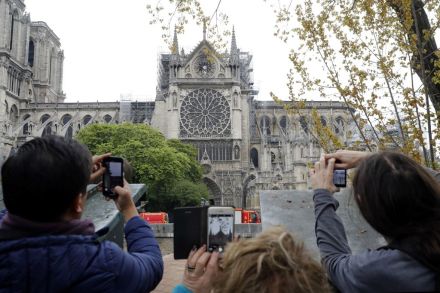
Notre-Dame is the symbolic heart of Paris and France, and a symbol of European Christianity second only to the Vatican in Rome. The apocalyptic destruction of a monument of such beauty and significance would be a sign of the times at any time. In our time, however, no one seems sure of what the sign means. I doubt I was alone in my first response. When I saw footage of the falling, burning spire, I assumed that this was an act of terrorism rather than, as seems most likely, an accident caused by renovation work. This is a sign of the times, even though it would be incautious to admit it in polite society.

notre-dame sign

EU elections could be a golden opportunity for Brexiters

From our UK edition

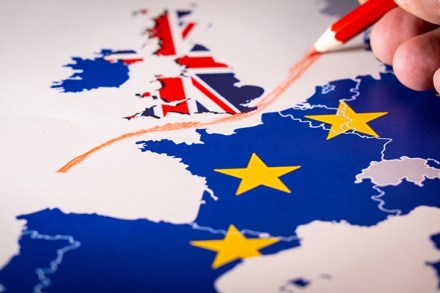
A Brexit delayed until Halloween will be regarded as a nightmare for many. It must seem to the people who voted to leave the EU that escaping the bloc is slipping further and further away. The extension confirms their fears that the government and Brussels are prepared to re-write the rules in order to avoid a no-deal scenario, having previously pledged there would be no extension at all. One of the immediate issues now will surely be the EU elections on the 23 May, which many parties were loath to take part in. But, in some ways, the EU elections could be very helpful for Brexiters. And they could end up with more allies in Brussels than they currently have in Westminster.

You win, parliament. Now revoke Article 50

From our UK edition

Dear Remainer parliament. Although we’re the voters who spurned the petition for this very course of action, we the undersigned formally request that you please revoke Article 50 at your earliest convenience. For Philip, Oliver, Dominic, Amber, Greg, et al (forgive the familiar first names, but over the last few months we’ve come to feel we know you so terribly well), this appeal from your nemeses may come as a surprise. After all, it was to appease us knuckle-draggers that you invoked the Article in the first place. Apologies for seeming so fickle. But in what Charles Moore has aptly dubbed Europe’s contemporary ‘empire’, all roads lead not to Rome but to Brussels.

Where Brexit failed

From our UK edition

One of the many tragedies of Theresa May’s premiership is that, having come up with a coherent policy on how to enact Brexit, she spent her prime ministerial career failing to follow it.  The words she used in her speech at Lancaster House in 2017 seemed clear enough: ‘No deal is better than a bad deal.’ It made sense to repeat this in the last Tory manifesto. She was to seek a free trade deal with the EU, but if that proved impossible, then Britain would be leaving anyway. In the event, the EU has not merely failed to offer a good deal, it has refused to offer any trade deal at all — only a withdrawal agreement that might or might not lead to a trade deal in future but which in the meantime threatens to trap Britain in the customs union indefinitely.

Europe’s Nato problem

From our UK edition

There are four major power blocs in the world — the United States, Russia, China and the EU. Of these, only the EU does not provide for its own defence and security. Remarkably, nearly 75 years after the end of the second world war, Europe is still heavily dependent upon the United States for its defence. But it is hardly surprising that, in the Trump era, pressure has grown for an autonomous European defence policy. The question of how Europe is to be defended in the post-Brexit era has yet to be examined. The EU has, for some years, been seeking ‘strategic autonomy’, though it is never wholly clear precisely what that means.

Europe’s culture clash

From our UK edition

Two weeks ago Luigi Di Maio, Italy’s vice-premier and Labour Minister and the top politician of the Five Star Movement (M5S), appointed a new commissioner for the UN cultural organisation Unesco. He chose the dog--whistling, bum-slapping sex--comedy actor Lino Banfi, star of How to Seduce Your Teacher, Policewoman on the Porno Squad and other films. The M5S was launched online by the 1980s comedian Beppe Grillo. It is run on the basis of a private computer operating system called Rousseau. Most Italians look at the M5S as either a breath of fresh air, a necessary gesture of defiance, or a ridiculous episode that will pass. But you need a sense of humour for that. French President Emmanuel Macron has lately shown himself unable to take the Italian government in his stride.

Merkel’s immigrant boom wreaks havoc in Germany’s prisons

Angela Merkel’s decision to allow more than one million migrants into Germany has caused a crisis in Germany’s prison system. About half the prisoners in Berlin and Hamburg are now foreign-born, according to the latest figures in the German press, and in prisons across the country, German is becoming a foreign language. This surge in outsiders on the inside coincides neatly with the 2015 decision to allow in migrants from the Middle East, Africa and Asia. All regions of Germany report a ‘very strong increase’ in the number of foreign and stateless prisoners, according to data from the past three to five years. Prisons throughout Germany are overcrowded and struggling to handle the influx in population.

germany prisons

Europe’s blind spot

From our UK edition

In Paris in December, I sat with a journalist friend in a café on the Boulevard Auguste-Blanqui and listened to him explain to me why a no-deal Brexit would be a catastrophe for Britain. It had to do with an article his newspaper had published about the Mini. You might think they were typically British cars, he said, but the plant where they were made in Cowley belonged to BMW! The steering wheels were assembled in Romania! The tail lights came from Poland! So? I asked. Brexit was about leaving the EU, not making globalisation un-happen. Who do you think wants to close the Mini plant? Britain does not want to damage its export sector any more than Romania or Poland wants to shut down a factory that provides the livelihoods of thousands.

High life | 10 January 2019

From our UK edition

Gstaad The funny thing is that I was at school with a man called Ted Widmer, and I recently read that one Ted Widmer is a ‘distinguished lecturer’ at a New York university and a senior fellow at the Carnegie Council for Ethics in International Affairs. The Ted I knew was anything but ethical and dressed rather strangely. Never mind. Whether or not he was a schoolmate, Widmer has written a treatise on the year 1919 and called it ‘1919: the Year of the Crack-up’. It’s very good. Basically, he says that what took place in 1919 shaped the world for the rest of the century. One hundred years later, his crack-up looks to me like a tiny fissure — a chink —yet in a funny way it did shape the rest of the century.

How terror changed Europe’s Christmas markets

From our UK edition

The traditional Christmas market is one of the great sights in any European capital at this time of year. But as with all traditions it evolves over time. A few evenings ago, I went to visit the Duomo in Milan and walked through the beautiful Christmas market in the square surrounding it. It was all there: the Christmas lights, the chalet-like huts selling warm food and drink, the fake snow. And, of course, the crash barriers. For since December 2016, when Anis Amri hijacked a truck in Berlin, shot the driver and then ploughed the vehicle into the local Christmas market (killing eleven more people) crash barriers have become a necessary feature of any European Christmas market.

Portrait of the Week – 15 November 2018

From our UK edition

Home Theresa May, the Prime Minister, defended a 500-page technical draft of the agreement on withdrawal from the European Union. She met immediate opposition from the Democratic Unionists, from Jacob Rees-Mogg and from Boris Johnson. Mr Johnson’s brother Jo (a Remainer) had earlier resigned as a minister, calling Mrs May’s handling of Brexit a ‘failure of British statecraft on a scale unseen since the Suez crisis’. The BBC reported that several cabinet ministers had expressed doubts about her Chequers plan back in July. Jeremy Corbyn, the Labour leader, insisted that Brexit could not be stopped, but Keir Starmer, Labour’s shadow Brexit secretary, said the option of a new referendum was still ‘on the table’.

Trump had an opportunity to redefine American foreign policy. He blew it

Donald J. Trump is home from his whirlwind weekend trip to commemorate the 100th anniversary of the First World War’s end. Even by The Donald’s formidable china-breaking standards, this was a doozy which will be discussed with opprobrium by the Transatlantic smart set for some time. President Trump seemed to go out of his way to upset his French counterpart and host Emmanuel Macron, who’s hit a political rough patch and needed some brotherly love. That bromance is dead and buried, however, and Trump fired off a mocking tweet at Macron as he boarded Air Force One for Paris that denounced the French president’s backing of a European army as ‘very insulting.

donald trump compiègne

The Eurosceptic Queen

From our UK edition

There has been much inconclusive speculation on the Queen’s views on Brexit. In 2016, the Sun asserted that she was in favour (later overruled by Ipso as ‘significantly misleading’). Last year, pro-EU commentators claimed that the blue hat with yellow stars she wore to open Parliament showed coded support for Remain. For now, we are none the wiser. What we do know, however, is that the monarch must be finding things a good deal easier on the way out than on the way in. Rewind to 1972 and a damp May evening at the Palace of Versailles.

Are the Sweden Democrats far-right? Jimmie Akesson interviewed

From our UK edition

In the newspapers today, there is much talk of Sweden turning to the 'far-right.' The Times has a picture of skinhead nutters on the march, giving the impression that Swedes are about a day away from goose-stepping down Drottninggatan. The myth of Sweden going all Nazi is a myth that’s hard to puncture because no one has a good word to say about the Sweden Democrats, who are hoping to finish first. They'll not end up in government, because no one would enter coalition with them. But their electoral success baffles the outside world. There is no agreed definition of "far-right" and the term is lazily used: dramatic, but serves to cloud understanding of what's happening in Europe.