Eu

Ukip’s Patrick O’Flynn on the ‘genius’ Nigel Farage and why Douglas Carswell’s votes won’t set party policy

From our UK edition

Interviews with Ukip bigwigs used to happen in pubs. But times are changing. When I meet Patrick O’Flynn — the party’s economics spokesman, and until recently chief spin doctor — it’s in a juice bar. O’Flynn, a former political editor of the Daily Express who studied economics at Cambridge, is one of those driving Ukip towards professionalism. Ukip, he says, is the only party he’s ever joined, and it is ‘not part of the Conservative family’. That is why he rates its chances in northern Labour seats: ‘We didn’t close down any coal mines or steelworks and we’re not known as the patrician Home Counties rich people’s party.

The bluffing game between Cameron and Merkel begins…

From our UK edition

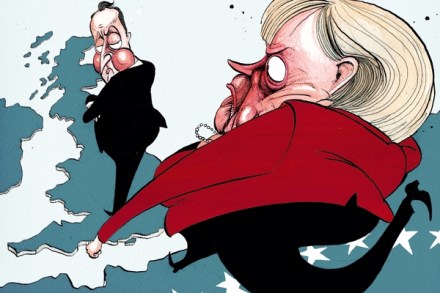
We should all get used to reading stories about how Angela Merkel has warned David Cameron that if he persists with X, Y or Z she’ll no longer be able to support Britain staying in the EU. It is the nature of a negotiation that those involved in it will, at points, suggest that they will walk away if the other party continues to demand something. The skill is, obviously, to know whether the other person is bluffing or not. Now as Mats Persson points out, Merkel’s comments are not as definitive as they are being portrayed as in some places. But there is no getting round the fact that Merkel is determined to protect the principle of free movement while Cameron—ideally—would like to impose limits on it.

Portrait of the week | 30 October 2014

From our UK edition

Home The last British combat troops turned over Camp Bastion in Helmand to Afghan forces and withdrew from Afghanistan after 13 years and 453 deaths. Michael Fallon, the Defence Secretary, spoke of ‘whole towns and communities being swamped by huge numbers of migrants’. He later withdrew the word ‘swamped’, but David Blunkett, a former Labour home secretary who used the word 12 years ago, said: ‘I believe that both Michael Fallon and I were right to speak out.’ This came after Angela Merkel, the Chancellor of Germany, responded to an idea of David Cameron, the Prime Minister, that European Union migration could be renegotiated; she said: ‘Germany will not tamper with the fundamental principles of free movement in the EU.

How to fight Ukip

From our UK edition

In the 2005 general election this magazine supported the Conservatives, with one exception — we urged voters in Medway not to vote for a deeply unimpressive Tory candidate by the name of Mark Reckless. Our then political editor, Peter Oborne, went so far as to write a pamphlet in support of the Labour rival, Bob Marshall Andrews, who had a commendable record of sticking it to Tony Blair. Reckless, by contrast, had nothing to commend him. He lost by just 213 votes — suggesting that The Spectator’s intervention had been decisive. But nothing, it seems, will prevent Reckless from being elected as Ukip’s second MP in two weeks’ time. The Ukip momentum in Rochester & Strood now looks unstoppable.

How Italy failed the stress test (and Emilio Botín didn’t)

From our UK edition

Continuing last week’s theme, it was the Italian banks — with nine fails, four still requiring capital injections — that bagged the booby prize in the great EU stress-testing exercise, followed predictably by Greece and Cyprus, while Germany and Austria (with one fail each) fared better than some of us had feared. The most delinquent European bank turned out to be the most ancient, Banca Monte dei Paschi di Siena, which was judged to have a capital shortfall of €2.1 billion as a result of a very modern set of problems. Founded in 1472 as a kind of charitable pawnbroker, the bank which eventually became Italy’s third largest had a more or less blameless 527-year record until it listed on the Italian stock exchange in 1999.

Listen: David Cameron tells MPs why he won’t pay EU bill

From our UK edition

The House of Commons is in a febrile, nervy mood this afternoon. No-one is quite happy with anyone else. David Cameron raised a cheer when he told MPs that he will not pay the €2bn bill apparently sprung on him by the European Commission, but he had very little to say when pressed by Labour on how this surprise was quite so surprising given Treasury ministers were mentioning it in letters months ago. Ken Clarke made backbenchers glower and opposition MPs howl with glee when he told the Chamber he sympathised with the Prime Minister for being surprised by something everyone in the Foreign Office and Treasury had known about for months. Just to endear himself to the members around him, Clarke also defended the European Arrest Warrant.

Tricky Commons session looms for Cameron on EU bill

From our UK edition

It's been a while since David Cameron had to give such a difficult feedback statement to the House of Commons after a European summit. Even his last tricky address, on his failure to block Jean-Claude Juncker as president of the European Commission, could at least be spun as the Prime Minister valiantly standing up for the right principle. But at this afternoon's session in the Commons, the Prime Minister will face complaints from MPs not just about how impossible Europe is but about how some parts of the Westminster machine knew about the so-called unexpected bill but others did not. So the questions Cameron will face will be: can you avoid paying this bill? Who can we blame, not just for the original situation, but the fact that officials apparently failed to pass the information on?

David Cameron has no choice but to defy Brussels

From our UK edition

If the European Commission had come to Britain demanding another £90 million because this country’s economy had performed better than expected, it would have been a political headache for David Cameron. The money would have been handed over and Ukip would have slapped it on to its election leaflets. But the Commission’s demand for £1.7 billion extra from Britain is so outrageous that it provides Cameron with a political opportunity. He can refuse to pay and hold up all other European business until the demand is dropped, rallying the country to his side as Margaret Thatcher did over the British rebate. One Cabinet Minister says excitedly of the row with the Commission, ‘This provides us with an opportunity to tell them where to get off’.

8 ways the EU might spend that 1.7 billion surcharge

From our UK edition

So the EU wants Britain to pay a 1.7 billion surcharge for the heinous crime of having an economic recovering. How dare we object? Just think of all the good uses that money could be put to by the men in Brussels. After, all £1.7 billion could: 1) Serve the interest on Greece's debt for 29 days 2) Serve the interest on Spain's debt  for 19 days 3) Serve the interest on Italy's debt for 7 days 4) Keep the £150 million per annum Eurocrat Express – the specially chartered train service for channelling officials back and forth between Brussels and Strasbourg – going for 11 years 5) Pay the £8.

The EU’s gift to Nigel Farage – Brussels demands £1.7 billion more from Britain

From our UK edition

With truly dreadful timing, the European Commission has sprung David Cameron with a demand for £1.7 billion in extra British budget payments to the EU. The commission says this amount is due because the British economy has performed better than forecast. But this unexpected demand is for serious money, an almost 20 per cent increase in the British contribution. If Britain pays up, Christmas will have come early for Nigel Farage and Ukip. This explains why all three Westminster parties have been so quick to denounce the demand as unacceptable. There are mutterings of legal challenges and the like. The money is due by December 1. But politically, I don’t think the government can afford to pay.

The UKIP effect: killing the thing you love

From our UK edition

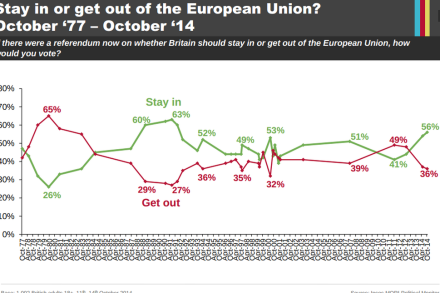
This chart, courtesy of Mike Smithson, shows Ipsos-Mori's polling on British membership of the European Union. It shows support for leaving the EU is no higher now than it was 20 years ago. I'll wager this surprises you. As you can see, there has always been a constituency for leaving the EU. Public enthusiasm for the european project has always been conditional. Despite that, the unhappiness of a known known has generally proved more attractive than the uncertainty of a known unknown. (This, ahem, is also true of certain other constitutional questions with which we have wrestled recently.) But how can this be? How can UKIP be soaring in the polls even as public support for their greatest proposal sags?

How Cameron could make the EU a winning issue (and why he won’t)

From our UK edition

[audioplayer src="http://traffic.libsyn.com/spectator/TheViewFrom22_23_Oct_2014_v4.mp3" title="James Forsyth, Mats Persson and Matthew Elliott discuss Europe" startat=60] Listen [/audioplayer]Imagine if David Cameron actually meant it. Imagine if he really did follow through with his implied threat to campaign for Brexit in the absence of better terms from Brussels. You can picture the televised address. An oak-panelled background with a large union flag hanging sedately in the corner, the PM with that furrowed house-captain expression he sometimes does. The script pretty much writes itself. ‘All of you know how hard I tried to secure a new deal. I was often criticised for being too conciliatory, but it was my duty to do whatever was in my power to reform the EU.

It’s not just Ukip that’s changing Cameron’s mind about immigration

From our UK edition

[audioplayer src="http://traffic.libsyn.com/spectator/TheViewFrom22_23_Oct_2014_v4.mp3" title="James Forsyth, Mats Persson and Matthew Elliott discuss Europe" startat=60] Listen [/audioplayer]It is easy to mock David Cameron on immigration. Under pressure from the public and from Ukip, he’s having to hot-foot it to a tougher position on the free movement of labour within the European Union. Ideas dismissed as unworkable only a few months ago are now on the table. But it’s not all political positioning. There really is a serious case for Britain to be treated differently from eurozone countries when it comes to freedom of movement. Whoever ends up in government after the next election, Britain’s relationship with the EU is going to have to change. Why?

The one economic indicator that never stops rising: meet the Negroni Index

From our UK edition

This dispatch comes to you from Venice — where I arrived at sunset on the Orient Express. More of that journey on another occasion, I hope. Suffice to say that if you happen to have been wrestling with the moral choice of bequeathing what’s left of your tax-bitten wealth to ungrateful offspring or spending it on yourself, don’t hesitate to invest in a last fling on this time capsule of elegant extravagance. Made up of rolling stock built in the late 1920s, the train itself symbolises everything that 20th-century Europe was good at — engineering, craftsmanship, style, cross-border connections — when not distracted by political folly and war.

Cameron could win in 2015 if he took EU withdrawal seriously … but he won’t

From our UK edition

Imagine if David Cameron actually meant it. Imagine if he really did follow through with his implied threat to campaign for Brexit in the absence of better terms from Brussels. You can picture the televised address. An oak-panelled background with a large union flag hanging sedately in the corner, the PM with that furrowed house-captain expression he sometimes does. The script pretty much writes itself. ‘All of you know how hard I tried to secure a new deal. I was often criticised for being too conciliatory, but it was my duty to do whatever was in my power to reform the EU. I have to tell you today that the Brussels institutions are not interested in — are perhaps not capable of — the reforms that I believe the British people want.

The UK doesn’t need Barroso’s ‘positive’ messages about the EU

From our UK edition

What a godsend to Ukip José Manuel Barroso must be.  On his recent short visit to the UK he not only managed to tell the British public that limits to immigration (desired by the overwhelming majority of the British public) would be ‘illegal’.  He also managed to tell us that if we left the EU, Britain would have ‘zero’ influence in the world. I do wonder who bureaucrats like Mr Barroso think they are going to persuade.  Are they simply relying on swaying or scaring us on the presumption that we have no historical knowledge or memory?  Because this latest message can’t possibly work, can it?  Most British people don’t feel we were an impoverished, backward and weakly nation before the EU came along and saved us.

Turkey in Europe? Now there’s a migrant backlash waiting to happen

From our UK edition

Well, I don’t know how José Manuel Barroso came across in the broadcast accounts of his address to Chatham House today but in person the man was geniality itself and rather impressive with it. He shares the mildly irritating tendency of EU bigwigs to attribute to the European Union developments that would have happened without it – recalling that within memory, Europe had moved from totalitarian regimes in half of its states to a democratic and peaceful unity. But in general, he gave the impression of trying to be as straight as he could with his answers. In laying stress on Britain’s freedom to stay outside the eurozone and the Schengen area, he rather skated over the reality that would-be EU entrants don’t have any choice in the matter.

Nick Clegg’s pro-European arguments lack the nuance needed to win over the electorate

From our UK edition

At his press conference this morning, Nick Clegg told Jason Groves, ‘Do you really think Washington is going to bother picking up the phone if we can’t even punch above our weight in our own back yard?’ This must be one of the most absurd bits of political hyperbole in recent years. There’s an argument to be had about whether or not Britain would be less influential in Washington if it left the EU. But the idea that the Americans wouldn’t bother to even pick up the phone to a country that’s a permanent member of the UN Security Council is just risible. One of the real problems for pro-Europeans is that they are so inclined to hyperbole when it comes to the consequences of Britain leaving the EU.