Empathy

The benevolence trap

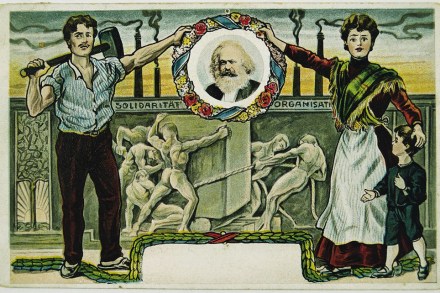
On May 12, the Canadian evolutionary psychologist Gad Saad published a book called Suicidal Empathy: Dying to be Kind. It’s a smart book, immensely pertinent to a time, like ours, that is awash with this diseased form of self-infatuated fellow feeling. Dr. Saad is correct: “Suicidal empathy is a civilization malady that has entered every nook and cranny of our lives.” One of the peculiarities of the malady that Dr. Saad diagnoses is its persistence. Socialism – which is the generic name of this intoxicating and addictive drug – has failed everywhere it has been tried. No matter. The world manufactures new versions of Greta Thunberg, AOC and Bernie Sanders faster than they can be repudiated. Democrats, Dr. Saad observes, are the party of empathy.
benevolence

The troublesome idealism of Simone Weil

From our UK edition

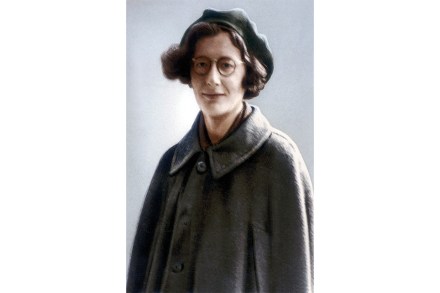
The French philosopher Simone Weil, who died of self-starvation and tuberculosis in a Kent sanitorium in 1943 at the age of 34, remains a conundrum. ‘Mais elle est folle!’ had been the spluttering response of Charles de Gaulle the previous year, during her short wartime period analysing reports for the Free French in London. Her simple brief was to précis the ideas coming in from the Resistance movement on how to reconstruct France after liberation. The result – which was posthumously published, as were most of her writings – turned out to be a major work of original philosophy, Enchainement (The Need for Roots), running to hundreds of pages, a testimony to Weil’s lifelong need to go further than anyone could ever have required into what she saw as the truth of things.

Nordic dream or nightmare?: The Mark, by Frida Isberg, reviewed

From our UK edition

Imagine a society, a high-minded psychologist tells his curmudgeonly father, ‘in which people are like cars. They have to go in for inspection once a year’ in order to assess their emotional fitness for the shared highway of life. As for the ‘psychopathic percentage’ whose ‘moral disorders’ lead them to fail this spiritual MoT, never fear: state-funded therapy will get them on the road again. And should they refuse? Surely, as we learn later in The Mark, everyone longs to stand ‘on the right side of history’. The Nordic dream of close-knit, high-trust, mutually supportive welfare societies has always had its internal critics: mavericks, naysayers and backsliders, who prize autonomy beyond, even against, community.

Is there such a thing as too much empathy? 

From our UK edition

Back in the 1970s, a less politically correct age, there was a standby formula for television advertising known as 2Cs in a K, which would feature two women by a washing machine engaged in unlikely conversation about some wondrous new detergent. Since The Spectator is a family publication, I shall pretend that 2Cs in a K stood for two ‘consumers’ in a kitchen, although it did not. If you are still trying to puzzle this out, the male equivalent is two dicks near a fence, a routine in which one man implausibly explains to his neighbour the many virtues of a particular woodstain, say, or one of those natty electric pressure washers which allow you to jetwash your patio while pretending you are wielding a flamethrower during the Tet Offensive.

Marianne Williamson can out-empathy Joe Biden

She only officially entered the presidential race on Saturday, and already critics are counting Marianne Williamson out. To be fair, I understand why. On paper — and off paper for that matter — she is not your traditional candidate. The author and spiritual advisor made waves in 2020 with her eccentric debate moments, including her focus on the moon landing and her insistence on harnessing love for political purposes to defeat Donald Trump. But this time around, Williamson and her ethereal diction might be able to seize on one of President Biden’s major weaknesses: his incredible lack of empathy. During the 2020 election, one of the media’s major selling points for their favorite hair-sniffer was that he was a person who cared.

marianne williamson empathy

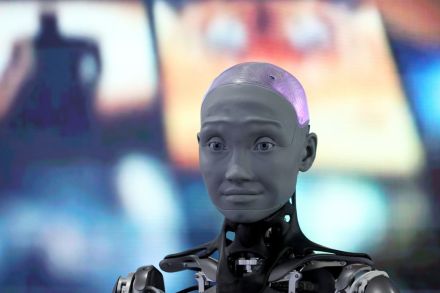
Big tech wants us to empathize with robots

It seems like we can’t help getting attached to robots. It also seems like the people making the robots are counting on that. In the 2015 video game Fallout 4, one of the factions with which the player can align him- or herself is “the Railroad,” an organization that helps seemingly sentient androids escape from the lab in which they’re created. A friend of mine mocked me mercilessly for aligning myself with the “SJWs” of the Railroad and insisted that the androids — who spoke eloquently of their emotions, friendships, and aspirations — actually had the same moral worth as a toaster. I laughed, but secretly still felt I’d made the right choice. Surely it was always better to err on the side of greater empathy.