Emmanuel macron

On D-Day, Macron has learned nothing and forgotten everything

No one wants to hear a lecture on ‘liberty and democracy’ from a finance guy turned technocrat. Especially not at a service commemorating the dead of the D-Day landings. In the last 30 years, finance guys and technocrats have enriched themselves at the voters’ expense, abused the notion of economic liberty, and wrecked social contracts across the West. Thank you for your service, as the voters never say. The 75th anniversary of D-Day should be a time for remembering the true meaning of freedom and democracy — and for honoring the thousands of young men who died in foreign fields so that we might inherit those privileges. Instead, we got Emmanuel Macron’s side-eyed hectoring of Donald Trump at Thursday’s memorial service.

macron d-day

Marine Le Pen’s return is good news for Emmanuel Macron

From our UK edition

If there's one politician in Europe as triumphant as Nigel Farage right now it's Emmanuel Macron. The European election results were not, as many outside France have declared, a humiliation for the French president. On the contrary, they were a success. Publicly the Elysée described the result as "honourable", but in private the president was reportedly cock-a-hoop. "Basically, we've won, it's a triumph and Macron is jubilant," said one of his staff. While his LREM party may have trailed Marine Le Pen's NR by a narrow margin (23.3 per cent to 22.4), Macron's eyes were on another opponent. Seven years ago the centre-right Les Republicains [LR] were the ruling party in France; today they are a fringe outfit, which won just 8.

The rise and fall of Emmanuel Macron

From our UK edition

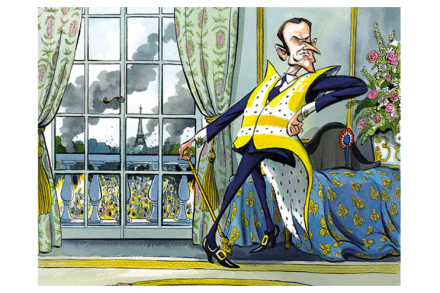
It was Morten Morland who drew the first comparison between Emmanuel Macron and the story of the emperor’s new clothes. His cartoon is a deadly allegory, and not just for the vanity of Macron. Because the point of the story is not just that the emperor is a vain idiot, but that those who pretend otherwise are idiots, too. The result of the election in France is really a no-brainer. Twenty-one million people voted, 21.9 per cent for Macron. The list backed by the recently thought extinct Marine Le Pen attracted 23.9 per cent. Greens, mainstream conservatives, various leftists and numerous crackpots shared the rest. The vote against Macron: 78.06 per cent.

France’s results are a humiliation for Macron

From our UK edition

It was with a mounting sense of disbelief that I counted the votes this evening in my commune in southern France. I’d expected a repudiation of President Emmanuel Macron, but not on this scale. “Catastrophe,” said the centrist deputy mayor as he scanned the voting tallies. At the end of the count, Macron’s list managed an embarrassing 14 per cent, against Le Pen’s, on 36per cent; a result that was repeated in countless other communes from north to south. Macron has his strongholds too, but Le Pen ended uk finishing first across all France with 23.3pc of the vote to his 22.4pc. Did Macron have a ground game, that nobody had ever noticed? Or were the voters taking the chance to blow a loud raspberry?  It looks like the later. Macron voters stayed home.

Could France’s far left and far right come together again?

From our UK edition

As the European elections approach, Europe’s oldest liberal democracies – Britain and France – are in turmoil. Taking the long view, Britain’s problems are circumstantial and exceptional. France’s, by contrast, are renewing with more extreme political traditions that have risen and fallen, but never disappeared, over the last two centuries. Gavin Mortimer's blog on Coffee House describes the seemingly paradoxical synthesis of far-left and far-right voters contemplating casting their ballot for the same party – the former National Front, now Marine Le Pen's Rassemblement National. Yet as with so much in French politics this is far from novel.

France – and Europe – could become the frontline in Algeria’s latest crisis

From our UK edition

As the European parliament elections approach, the continent’s navel-gazing is ever more myopic. Even its two most outward focused states, France and Britain, are consumed by domestic crises. And yet in Europe’s backyard – across the Mediterranean, in Algeria – radical change is taking place with potentially serious ramifications for the European Union and France. Every Friday since February the authoritarian Algerian regime has been the target of tens of thousands of peaceful demonstrators on a scale unknown since the country’s troubled independence from France in 1962. The spark was 82-year-old Abdelaziz Bouteflika’s announcement that he would seek a fifth term as president, despite being chronically debilitated by a stroke since 2013.

Is Emmanuel Macron’s EU project about to meet its Waterloo?

From our UK edition

Emmanuel Macron, the once golden boy of European politics, could be about to suffer his first electoral humiliation. A black mood has settled over the president. Ministers have been ordered to campaign and tweet as if their jobs depend on it. Which they might. The president himself, dressed habitually like a funeral director, is on his normal hyper-manic schedule. But he fails to inspire and his electoral traction is barely visible. The spectre haunting the Elysée is that in less than three weeks, Macron’s Napoleonic European project, the so-called EU Renaissance, intended to federalise diplomacy, fiscality and defence, will meet its Waterloo. The president’s luck seems exhausted. Where once nothing could go wrong, now nothing goes right. He has no political instincts.

Macron’s bid to woo the yellow vests risks opening a battle on two fronts

From our UK edition

As France and the world grieved over the Notre Dame fire, French national politics rolled on behind the scenes. President Macron was scheduled to broadcast to the nation on his reform programme following the national consultation (Grand Débat) that has been underway for three months in the hope of quelling the five-month-old yellow vest protests. The fire an hour before forced him to cancel the presidential message. But because the details of the reforms were in the pre-recorded speech – and because France is France – the outline of the programme leaked heavily. This was not a bad case of ‘a good day to bury bad news’; Macron was furious. But the national outpouring obliged him to delay the official announcement. What then is in that programme?

Out of the ashes | 17 April 2019

From our UK edition

‘Great edifices, like great mountains, are the work of centuries,’ wrote Victor Hugo in Notre-Dame de Paris. ‘The man, the artist, the individual, is effaced in these great masses, which lack the name of their author. Human intelligence is there summed up and totalised.’ The foundation stone of the cathedral of Our Lady of Paris was laid 850 years ago, but it was the work of generations, and took 200 years to complete. It soon became one of the greatest churches in Christendom and, as such, was ripe for desecration by the Jacobin fanatics of the French Revolution. In 1793, its altar was torn out in a ceremony that was too grotesque even for Robespierre.

What might Macron’s ‘even more beautiful’ Notre Dame be like?

From our UK edition

24 August 2024 At the opening today of the rebuilt Notre Dame Cathedral, after the disastrous fire in April 2019, President Macron defended his decision to retask it with a new mission as a “house for all faiths, and also for those who have no faith.” “Notre Dame is a symbol of France, it has been reconstructed as a symbol of France, and so it is perfectly normal that its magnificence be accessible to everyone,” the president said. The new Notre Dame was even better than the old one, he said. The new Notre Dame is controversial and has divided critics. They have accused it of being little more than a tourist attraction. Wasn’t it ever thus? While it will continue to be free to admire the building from the outside, entry within shall now attract a hefty fee.

Notre-Dame is a sign of the times

Notre-Dame is the symbolic heart of Paris and France, and a symbol of European Christianity second only to the Vatican in Rome. The apocalyptic destruction of a monument of such beauty and significance would be a sign of the times at any time. In our time, however, no one seems sure of what the sign means. I doubt I was alone in my first response. When I saw footage of the falling, burning spire, I assumed that this was an act of terrorism rather than, as seems most likely, an accident caused by renovation work. This is a sign of the times, even though it would be incautious to admit it in polite society.

notre-dame sign

The shame of Notre Dame

From our UK edition

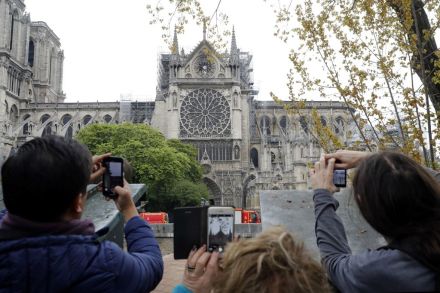
The conversation in France changed abruptly last night. Perhaps the blaze in Paris was the wake-up call that France needed. My neighbours, and all of France, seem deeply shocked. Almost numb. The fire seems to have touched a nerve. Whether this sentiment is transient remains to be seen. Notre Dame cathedral will be rebuilt. It may even be better than ever. From an inferno in the heart of French Catholicism, it will be resurrected to inspire new generations of believers, and a million tourists a month. The means are not lacking. Hundreds of millions have been pledged. The rest will follow.

Will France cut taxes and boost the economy in response to the protests?

From our UK edition

For 21 weeks now the Gilets Jaunes have taken to the streets of French cities to protest. It began as a demonstration against high and rising fuel taxes. These tax increases hit families getting children to school and the adults to work, and cut the earnings of the self-employed working from their vans and cars. The higher fuel taxes and slower speed limits were part of President Macron’s policy to curb carbon dioxide emissions. For his trouble the protesters put out of action a majority of the speed cameras, showing him what they thought of his wish to control their lives. The street actions have been stoked by some angry students and by committed protesters of the extreme left and right, but many of those protesting are doing so for the first time.

Emmanuel’s folly

From our UK edition

 Montpellier An embattled, incompetent leader distrusted and disliked by a vast majority of voters. A wobbly economy that might be tipped into recession by Brexit. A re-energised opposition. Huge street protests. Squabbling with European partners. The government is paralysed, the opposition is emboldened — and the nation stands humiliated, as the world looks on in horror wondering how a leader who was so popular two years ago could get things so wrong. Not Theresa May, but Emmanuel Macron, the politician who may be the greatest Brexiteer of them all. As the saga of British withdrawal enters its final chapter, Macron has emerged as the loudest advocate for pushing Britain out the door, deal or no deal, consequences be damned. Why does he behave in this way?

Theresa May must stand up to Emmanuel Macron’s Brexit posturing

From our UK edition

In this the 115th anniversary week of the Entente Cordiale, the French president and the British Prime Minister will meet twice, today at the Elysee Palace and tomorrow at the European Council in Brussels. But neither of those meetings will be to celebrate their countries friendship. When May goes to Paris and then to Brussels, she will instead be a woeful supplicant in the Brexit feuilleton. And the one thing the vicar’s daughter can count on is that she will be subjected to a severe bout of Macron lesson-giving and severe sermonising, as is his wont. And yet Macron is hardly in a position of strength. Both leaders are battling domestic crises that come to a head this week. The British PM’s Brexit woes are only too well known.

Emmanuel Macron has saved himself from political crisis – for now

From our UK edition

Back in December, Emmanuel Macron was a man on edge. His poll numbers were spiralling down the toilet; hundreds of thousands of French who felt alienated from their government were taking to the streets to shout down the French elite in cities and towns across the country; and fires were burning all around Paris. Police officers and protesters-turned-rioters were on the frontlines trading rocks and rubber bullets, resulting in hundreds (if not thousands) of arrests. Macron, the blue-eyed, fresh-faced technocratic politician who marketed himself during the 2017 presidential contest as the Fifth French Republic’s aspiring saviour, was left twiddling his thumbs in the presidential mansion wondering how to address the turmoil around him.

Portrait of the Week – 7 March 2019

From our UK edition

Home Two 17-year-olds were stabbed to death in London and Manchester, bringing the number of teenagers killed in knife crime this year to ten. Theresa May, the Prime Minister, said that there was ‘no direct correlation between certain crimes and police numbers’. Next day, Cressida Dick, the Metropolitan Police Commissioner, said: ‘There is some link between violent crime on the streets obviously and police numbers, of course there is.’ The owners of Giraffe and Ed’s Easy Diner are to close 27 of their 87 restaurants. The family that has owned the British sports-car maker Morgan for 110 years is selling it to an Italian venture capitalist firm, Investindustrial. The philosopher A.C.

Europe’s Nato problem

From our UK edition

There are four major power blocs in the world — the United States, Russia, China and the EU. Of these, only the EU does not provide for its own defence and security. Remarkably, nearly 75 years after the end of the second world war, Europe is still heavily dependent upon the United States for its defence. But it is hardly surprising that, in the Trump era, pressure has grown for an autonomous European defence policy. The question of how Europe is to be defended in the post-Brexit era has yet to be examined. The EU has, for some years, been seeking ‘strategic autonomy’, though it is never wholly clear precisely what that means.

What Macron’s spat with Italy is really about

From our UK edition

Who needs the Comédie-Française when there is Emmanuel Macron in the Élysée? France's recall last week of its ambassador from Italy for consultation was pure theatre on the part of the president. And it was a decision more for the benefit of his domestic audience than for the coalition government in Rome. In a statement explaining why Christian Masset had been ordered home, the foreign office said that for several months France has been subjected to outrageous statements that have created a 'serious situation which is raising questions about the Italian government’s intentions towards France.' France blamed the recall on Luigi Di Maio, the Italian deputy prime minster, who flew to Paris last week to meet members of the Yellow Vest protest movement.

Why doesn’t Emmanuel Macron like Britain?

From our UK edition

Why is Emmanuel Macron raging against Britain? The French president has returned to the subject of the British once again in the course of his Great National Debate. To be honest, thus far this has been something of a great Macron soliloquy, as he finds it difficult to stop talking. It was inevitable that during one of his lengthy televised discourses (there have now been three) he would turn once again to his new favourite subject, and so he did.