Education

The battle for the middle ground

From our UK edition

The New Statesman has interviewed Douglas Alexander, who appeals, as Andrew Adonis has, to Liberal Democrat voters to back Labour to inaugurate what he terms a ‘New Dawn for Labour and progressive politics.’ Progressive is a vague term, but the best definition for it is reform to encourage social mobility. In this morning’s Times, former Fabian Stephen Pollard argued that only the Tories can guarantee this. For the time, Pollard says, he will vote Conservative and all because of Michael Gove’s schools reform.   ‘Mr Gove has promised that within four years of a Tory government, all parents will have the option of sending their child to an independent school offering to educate the child free.

Cameron’s secret weapon is amiability

From our UK edition

David Cameron has just taken his first real “kicking” of the campaign from a parent of a disabled child. Handled it brilliantly, I think. The parent is angry, understandably, about the problems he has finding a normal school for his wheelchair-bound son. The Tories are suspicious of the “inclusion” agenda – often a code for denying special-needs children the extra tuition that they deserve. But, as the father of a severely disabled son, Cameron knows more about this subject than almost anyone else in Westminster.   “It should be your choice, sir” he said: and he’s right. The voucher system would make a disabled child worth north of £22,000 a year to teach – four times more than an able-bodied pupil.

The Tories in a PR pickle

From our UK edition

Clegg won’t join without proportional representation; Cameron says he won’t countenance such a ‘con’. Indeed, it runs deeper than that. Iain Martin has canvassed Tories from across the party and found that Cameron will get short shrift if he tries to reform the voting system at all. There is another consideration. This election has the potential to blow traditional party structure out of the water. Labour’s right will be marginalised by the unions’ grip over the party and Liberal Democrats like David Laws and Clegg (up to a point) have more in common with the One Nation Tories than they do with out and out left wingers like Kennedy and Cable.

Meeting real people, the staple of campaigning

From our UK edition

David Cameron is visiting Hampshire today, hitting both Labour and Lib Dem held seats. In a visit to Southampton University, he was confronted by a feisty Lib Dem supporting student who accused him of planning changes that would make it more difficult for working class kids like her to go to university. Cameron dealt with the question well. He said that the Tories would keep bursaries and that there simply isn’t the money to abolish tuition fees. He also pointed out that currently only 40 odd children on free school meals go to Oxford and that Tory plans to bust open the state monopoly in the provision of education would improve the quality of state education and thus social mobility.

The Tories must sell their most radical policy: the Gove schools plan

From our UK edition

The Spectator’s endorsement of David Cameron started with his ‘free schools’ policy – and we could have ended there. We said that this is, in itself, enough reason to vote Conservative. This week’s Economist has produced one of the best explanations of this policy, and its potential.  This is important because this election campaign shows that, while the public are indeed minded to oust Gordon Brown, they’re not terribly excited by the Tory offering. The Gove schools plan is something which, if properly expressed, cannot fail to capture the imagination. In my limited experience of persuading people why they should vote, I find the schools policy always works.

The little platoons are mobilising

From our UK edition

There’s a great example of people power on the letters page of today’s Guardian. Last week, a bunch of the educational establishment wrote to the paper decrying the Tory plans to bust open the state monopoly in education and let parents, teachers and voluntary groups set up new schools. Today, 650-odd parent groups have written back, explaining why they want to set up their own schools and give to the many what is now preserved for the few: the right to choose a good school for their child.   There isn’t anything equal about schooling in Britiain at the moment.

Cameron has a policy agenda to change Britain – he should tell us about it

From our UK edition

Cameron has not, alas, broken free of the never-ending opinion poll bungee jump which is the story of his leadership of the Conservative Party. Cleggmania is a bubble – but the thing about bubbles is that one can never quite tell when they will burst. The Tories, who have lost the most votes due to this bubble, will have their needles out. But in my News of the World column today I suggest they focus on policy because they do have hard ideas that could radically change Britain. Cameron missed a trick by failing to mention his single best policy, Gove's school reform, last week.  On immigration, his plan for reducing it is the most radical promise on the market, and his linking it with welfare shows maturity and sophistication.

A Choice Revolution

From our UK edition

Reihan Salam has a characteristically excellent post on school choice that has some bearing on the Conservatives' proposed reforms in England. Reihan's talking about the US and the suggestion that Milwaukee's voucher programme hasn't delivered as much as one might like, but his general argument applies to this side of the atlantic too. Bottom line: choice is not enough. Or, to put it another way, choice is a beginning, not an end*. As he puts it: [C]hoice-based reform at its best creates an opportunity for educational innovators to create new models, deploy new technologies, etc. The ultimate goal is to create a flourishing educational marketplace that goes beyond the binary choice of going to school A or school B.

The case for voting Conservative

From our UK edition

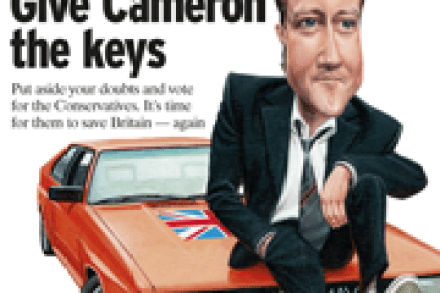
Why vote for Cameron? The reasons for voting against Gordon Brown are so numerous that the positive pro-Tory reasons for voting are often lost. This week's Spectator gives you all the ammo you need to win around wavering friends, colleagues and family. We have restricted ourselves to the ten most compelling points. I summarise them below: 1. School reform. In itself, it's enough reason to vote Tory. Gove has specifically promise that within four years of a Tory government everyone will have an independent school offering to educate their kid for free. This should have been a 1981 Tory proposal, but Keith Joseph lost a battle with the civil service (after he recruited a young Cambridge graduate named Oliver Letwin to help him fight it). 2.

A heckle which might reverberate across the campaign

From our UK edition

Mark the date: the first major heckle of the election campaign happened today, and Gordon Brown was the victim.  The perp was one Ben Butterworth, and he was angry at how his children can't get into their choice of state school – a frustration which will be shared by thousands of parents across the country.  I wonder what they'll think when they see that Brown ignored the man. The Tories will seize on this with considerable joy.  Their plans for widening school choice are – as the leader says in tomorrow's magazine – the best reason for voting Conservative.  Mr Butterworth might just have made himself the poster boy for that argument.

The speed of schools reform

From our UK edition

Michael Gove is always worth listening to when he speaks on schools reform – offering passionate rhetoric supported by detailed policy. But this morning he excelled himself. If you want a clear sense of what the Tories have in mind for making "opportunity more equal," then I'd recommend you track down a copy of his presentation. I'll try to link to it, if it appears online later. One point that jumped out at me was when Gove said a Tory government would introduce a bill "within days" of entering power, aimed at "making it harder for bureaucracies to block the creation of new schools".  He added that he'd hope to get this signed off before Parliament breaks up for the summer.

Truesay! A Motto for Our Times

From our UK edition

My friend and colleague Jo Phillips has been roaming the country promoting the must-read book of the forthcoming election. Why Vote? -- which she has co-authored with David Seymour, the former political editor of the Mirror Group, who won't mind me calling him a veteran political commentator. The book is a jaunty affair, designed to appeal to people who have been put off the political process (so just about everybody).  I know she has been struck by the general "what have politicians ever done for anyone?" response as she tours the nation. But when she pointed out to one group of young people the benefits that politicians had brought us (universal health provision and education, for example, and the right to vote itself) they were stopped in their tracks.

Closing the gap between state and independent education

From our UK edition

I do hope that Oxford will finally be free from government claims of snobbery soon. We learn today that the proportion of state school pupils it admits has fallen from 55.4 percent to 53.9 percent - but, as the university says, this is in line with the (appallingly low) proportion of state school pupils achieving three As. The problem lies with the schools, not the universities, and it helps no one to pretend otherwise. Here's one figure that you won't read in the ongoing "Oxford snobbery" story: in 1969, only 38 per cent of Oxford's places went to privately-educated children. Why? Because the private schools in those days were not places of educational excellence, but of social preference. The decline of state education, relative to private, is the problem here.

Ed Miliband’s new investment vs cuts battleground

From our UK edition

Ed Miliband certainly isn't one for holding back, is he?  In an interview with today's Guardian he discusses what we might expect from the Labour manifesto, and there's some pretty noteworthy stuff in there: a People's Bank based around the network of Post Offices; an increase in the minimum wage; a reduction in the voting age to 16; things like that. But, as Sunder Katwala suggests over at Next Left, the most eye-catching passage is when Miliband discusses Free School Meals for all: "The manifesto could well include a pledge to provide free school meals for all children, Miliband says. 'I think a lot of people would like free school meals.

The Tories’ Second-Best Recruiting Sergeant…

From our UK edition

Things have come to a pretty pass when the Secretary of State for Education endorses ignorance and scoffs at knowledge pretending, one is given to understand, that it's just a kind of posh irrelevance favoured only by the terminally stuffy and fuddy-duddy and out-of-touch. Such, however, seems to be the case for you poor English folk, lumbered as you are with the grim Mr Edward Balls. I'd thought Boris must be exaggerrating matters in his Telegraph  column today. As the Mayor puts it: "Speaking on the radio, Spheroids dismissed the idea that Latin could inspire or motivate pupils.

Establishing free schools will be a difficult – but worthwhile – challenge

From our UK edition

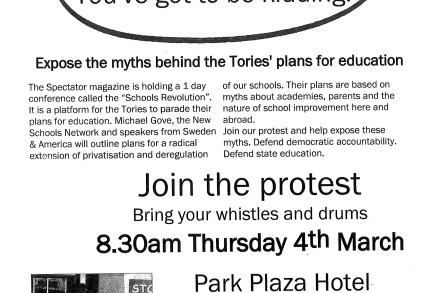
The small crowd of demonstrators from a group calling itself the Anti-Academies Alliance who gathered outside the Spectator conference on The Schools Revolution yesterday gave an indication of the opposition that Michael Gove and the Conservatives would face, were they to win the election and attempt the radical overhaul of which the British education system is so obviously in need. The thing that came across in our brief but passionate debate with the protestors was their opposition to independence, wherever it may raise its head in schools. Choice, to these people, is anathema. Undeterred, Gove’s speech majored on the virtues of independence.

Facing the protesters

From our UK edition

Given that school choice will only benefit those who cannot afford it at present, who could be against it? The answer is the Socialist Educational Alliance, who have decided to stage a protest at The Spectator's conference on school liberalisation on Thursday. They have produced a leaflet (see left, and click to enlarge). "Bring your whistles and drums" it says - 8.30am. I wonder if Ed Balls will join them, as he appears to agree with the thrust of their argument. "Defend democratic accountability," says the flier. This is the language which Labour left use: "democratic accountability" is code, of course, for political/bureaucratic control. Perhaps my friend Polly Toynbee will be there too, with a placard saying "what do parents think they know about schools?

Shady characters

From our UK edition

A great deal of time in Neel Mukherjee’s A Life Apart and Max Schaefer’s Children of the Sun is spent in gents’ public toilets — cottaging being a key feature of both debuts — and yet such is the elegance and intelligence of their prose, the reader comes away feeling educated rather than soiled. A great deal of time in Neel Mukherjee’s A Life Apart and Max Schaefer’s Children of the Sun is spent in gents’ public toilets — cottaging being a key feature of both debuts — and yet such is the elegance and intelligence of their prose, the reader comes away feeling educated rather than soiled.

Some reasons to be cheerful about Cameron and the Tories

From our UK edition

By way of a response to the comments on my post yesterday, here are some reasons to be cheerful about Cameron and the Tories. The poll lead dropping to six points is indeed a wake-up call, and Cameron probably worked out a while ago that things were going a bit Pete Tong. Indeed (Short the UK), there are signs that he has already started to act. Look at last Monday: three strong election videos, without a politician in sight. The perfect remedy to the Tragedy of Cameron's Head poster. The policy of allowing management buy-outs of government departments is bold, radical and entirely in keeping with Cameron's general policy of empowering the many, not the few.

Background politics

From our UK edition

The Conservatives are at pains to emphasise that 'it's not where you're from but where you're going that's important.' A trite but pertinent phrase: background is neither a pre-requisite nor an impediment to a political career, nor should it be. Upbringing is important when it informs values. Many of the Shadow Cabinet have travelled together from the chapel pews of Eton to the Tory front bench; consequently, the Tories are wary of linking politics to background and experience. On the whole that is sensible, the exception is Michael Gove's personal history, which is central to his Swedish market based education reforms.