Ed miliband

Which Miliband?

From our UK edition

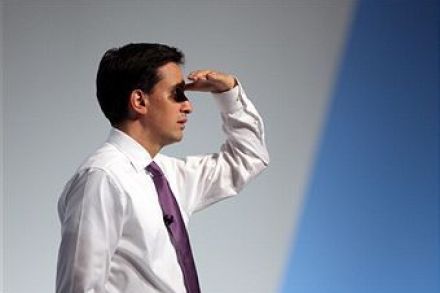
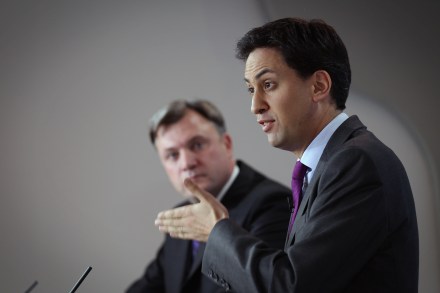
Don't be too hard on the Independent leader writer and proof readers. Ed or David Miliband? It's an easy mistake to make. John Humphrys got it wrong on the Today programme back in May, and even Ed's own deputy, Harriet Harman, slipped up. "I hope we will have David, er, Ed, Ed Miliband elected as Prime Minister at the next election," she told Woman's Hour during the Labour conference in September. At least Harman corrected herself, as the Independent now have on their website. This Daily Mail article from June still carries the wrong caption. But this affliction is even more widespread than that. Back in July, YouGov showed 1,265 people a picture of Ed Miliband. 80 per cent correctly identified him and 8 per cent said they weren't sure who it was.

A belaboured EU position

From our UK edition

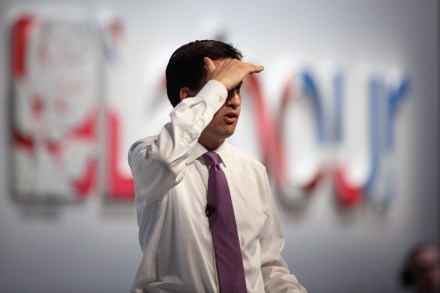
While the Coalition is split over Europe, Labour does not look like they are in a much better position. Ed Miliband told the BBC that he was in favour of the Euro; Ed Balls would presumably tackle anyone to avoid that becoming the party's policy. Meanwhile Douglas Alexander, Labour's brainy Shadow Foreign Secretary, has yet to make a game-changing intervention. Their predicament is obvious. Should Labour accept the narrative of renegotiation but opt for different areas to opt out of than those favoured by the Tories? Or should they, like William Borroughs, stand astride history and scream "stop", arguing for a pro-European position? Seemingly caught between the two views, the party's criticism of the government is like those two old-age pensioners in Woody Allen's joke.

Cameron’s attempt to re-moralise the economy

From our UK edition

One of the great challenges facing Britain is how to re-moralise society. A country where individuals, or businesses, can't tell the difference between right and wrong has fundamental problems. The Times reports today that David Cameron is planning to start talking about the need for "moral markets". There'll be those on the right who don't like this, who feel it is pandering to Ed Miliband's distinctions between predator and producer capitalism. Others will feel that it is impractical. Then there are those who'll counter that the only responsibility of business is to maximise profits. But this is important territory for Conservatives to be on.

PMQs or St Paul’s protest?

From our UK edition

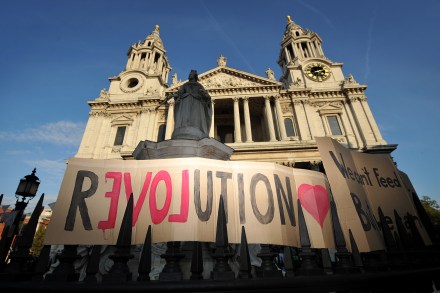
The Hair Shirt walked abroad at PMQs today. Those attending the Square Mile sleepover finally forced their agenda into the political mainstream. The question is, what is their agenda? A protest that doesn’t define its programme allows others to define it for them. And today both party leaders tried to harness the anti-capitalist spirit for their own political ends. Ed Miliband claimed to be scandalised by a recent, and arguable, surge of 49 per cent in directors’ pay. He demanded that the PM take action. Cameron seemed equally appalled at the news that fat cats have been getting fatter during the recession. But he wasn’t taking any sermons from Labour.

Cameron versus Balls

From our UK edition

The real clash at PMQs today was between Ed Balls’ heckling and David Cameron’s temper. Balls was in a particularly chirpy mood. He started off his impression of an Australian slip fielder as soon as the Prime Minister arrived at the despatch box. The flat lining gesture made an early appearance, along with his signals telling Cameron to calm down.   But the moment when Balls seemed to really get under Cameron’s skin was when he pointed at the overwhelmingly male Treasury bench as Cameron talked about the importance of getting more women on boards. Two questions later, Cameron responded to a Balls’ heckle by saying that ‘the shadow Chancellor is wrong, even when he’s sitting down.

Labour aren’t capitalising on the government’s woes

From our UK edition

Ipsos MORI's latest monthly political monitor is just out, and it doesn't bring much good news for either the government or the opposition. 63 per cent of respondents are dissatisfied with the government and 54 dissatisfied with David Cameron — both the highest proportions since the election. On the public's number one issue — the economy — just 36 per cent say the government's done a good job. And even wose, a whopping 77 per cent say they've done a bad job of keeping unemployment down — hardly surprising considering unemployment has risen by 100,000 since the election. But while all this presents a great opportunity for Labour, other numbers show how bad a job they're doing at taking advantage of it.

Miliband fails to connect

From our UK edition

Easy-peasy at PMQs today. All Ed Miliband had to do was slice open the Coalition's wounds on Europe and dibble his claws in the spouts of blood. But his attack had no sense of bite or surprise. And his phraseology was lumpen. He used all six questions gently stroking the issue of Europe rather than driving a nail through it.  He asked about growth. He asked about the '22 committee. He asked about Nick Clegg's "smash-and-grab" phrase to describe the repatriation of powers. He asked about the social chapter. He asked about everything he could think of, and it was clear he couldn’t think of the right thing to ask. At the climax he sounded like a nursery-assistant scolding Cameron for "pleading not leading" on Europe. Desperately flaccid oratory.

Cameron battles it out

From our UK edition

David Cameron came out swinging today at PMQs. Knowing that Ed Miliband would try and exploit the Tory rebellion over Europe on Monday night, Cameron went for the Labour leader. He called him a "complete mug" and mocked him as being detached from reality. At the end of the exchange, Osborne gripped Cameron's shoulder in congratulation – a sign that the pair knew that they needed a strong performance today to calm their backbenches. The other notable aspect of PMQs was its emphasis on the new political battleground: women. The Labour MP Gloria Del Piero asked the PM why the government was more unpopular with women than men, which gave Cameron a chance to rattle off the government's female-friendly initiatives.

Cameron outfoxed in PMQs

From our UK edition

Alive or dead? At PMQs today we discovered whether Dr Fox is still an active toxin within Cameron’s government. Ed Miliband, using that special quiet voice he likes to try when he’s got a deadly question, described the affair as ‘deeply worrying’, and asked how on earth the prime minister could have let it all happen. Cameron, evidently relieved that Fox is already a stuffed and mounted exhibit in the Museum of Former Big Beasts, pointed out that his minister had resigned. ‘Not something that always happened under Labour.’  It turned very tetchy all of a sudden. Miliband, apparently miffed, struck out with this hoity-toity harangue. ‘Some advice for the Prime Minister,’ he said. ‘In this week of all weeks.

Europe bubbles to the surface in PMQs

From our UK edition

A particularly fractious PMQs today. Ed Miliband started by asking questions about Liam Fox which, frankly, seemed rather out of date given that Fox has already resigned. Cameron swatted them away fairly easy, mocking Miliband with the line "if you’re going to jump on a bandwagon make sure it is still moving". But when Miliband came back on the economy, Cameron was far less sure footed. The Labour leader had one of those great PMQs facts: despite the government having issued 22 press releases about the regional growth fund in the last 16 months only two firms have received any money for it. A visibly irritated Cameron then said that all Miliband "wants to do is talk down the economy" which drew hoots of derision from the Labour side.

Miliband’s challenge

From our UK edition

One of the striking things about politics at the moment is that Ed Miliband is proving adept at spotting issues that are going to become big — think the squeezed middle, energy prices — but is failing to drive home this advantage. There’s scant evidence that, for instance, the voters regard Miliband as the solution to the problem of rising energy bills. I suspect that the coalition’s plans to make it easier for people to switch tariff and supplier will cut through with the public more than Miliband’s speeches on the issue. In part, this is the natural advantage of incumbency — governments can actually do things. But the challenge for Miliband’s operation is to make him appear a more effectual figure.

This will Occupy Boris

From our UK edition

A few months ago I hosted a debate at my think tank with one of the key Tahrir Square leaders. After his talk about Egypt, he warned the audience: the protests that toppled Hosni Mubarak were not just an Egyptian or Middle Eastern phenomena; it could – and, he said, would – spread to the West. For the youth of today, he argued, feel disempowered, empoverished and betrayed. As protests spread from New York to London and other European capitals, it seems that Egyptian protester may have been right. Today's efforts to occupy the London stock exchange failed but protesters remain on the grounds of St Paul's Cathedral. Whatever happens in the next days, protests like these are likely to appear, disappear and appear again.

Salmond’s bonnie boat

From our UK edition

Meanwhile, Alex Salmond's journey is going depressingly well. The SNP conference starts in Inverness on Thursday and a ComRes poll today suggests 39 per cent are in favour of independence, against 38 per cent against the idea. Not a freak: a poll last month by TNS-BMRB produced the same results. Hardly an overwhelming endorsement, but a reminder that the unionists are in trouble in Scotland. The Scottish Tories are in so much trouble that one leadership candidate is suggesting the party renames itself because its official title strikes so many as oxymoronic. For all his Scottish lineage, David Cameron leaves Scots cold – as the general election demonstrated.

Labour failing to regain economic credibility

From our UK edition

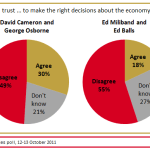
Labour may have a narrow leads in the polls, but they continue to lag behind the Tories on the public's number one issue: the economy. Today's ComRes poll finds that just 18 per cent trust Eds Miliband and Balls "to make the right decisions about the economy", compared to 30 per cent for Cameron and Osborne. Worse, the two Eds don't even have the confidence of the majority of Labour voters: only 48 per cent trust them on the economy. YouGov also find Labour behind when it comes to the economy. 30 per cent think the Conservatives would handle it best, while just 26 per cent think Labour would. And that's despite the fact that 58 per cent of the public think the Coalition is managing the economy badly.

Miliband and Balls, in tandem

From our UK edition

So, CoffeeHousers, are Eds Balls and Miliband a gruesome twosome or the most sparkling partnership since Torvill and Dean? I ask only because they're really pushing the double-act shtick today. There's their first-ever joint interview in the Evening Standard, for instance, in which they reminisce about the Shadow Chancellor's 30th Birthday party, among other things. And then there was their joint appearance to officially launch Labour's 'plan for growth' campaign this afternoon. They were talking policy, but there was also a strong emphasis on their personal relationship: eye contact, anecdotes, that sort of thing. Blair and Brown we are not, they seemed to be saying. As for the policy, if you heard Ed Balls' speech to the Labour party conference, then you've heard it before.

The Voters, Damn Them, Refute the Tory Right

From our UK edition

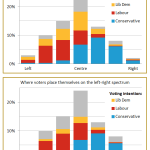
At the risk of careering round an old argument, Jonathan, the graphs you've produced on political affiliations are yet another reminder, if ever one were needed (and it is) that the Tory right's argument that Cameron would have won a majority if only he'd run a blue-meat campaign is dreadfully mistaken. As you can see, more voters identify with the left than the right. This was Tony Blair's legacy and the ground upon which Cameron was compelled to fight. I suppose it is possible that Cameron could move right without alienating voters who consider themselves - accurately or not - centrists but I suggest this is not probable.

The centre ground’s there for the taking

From our UK edition

YouGov recently repeated its occassional exercise of asking people where they'd place themselves, the parties and the leaders on the left-right spectrum. Anthony Wells reported some of the findings on Saturday: Cameron is seen as slightly less right-wing than his party, while both the Tories and Labour appear to have moved away from the centre-ground since the election. One thing these YouGov numbers allow us to do is see where on the spectrum the parties get their support from. First, how people voted in 2010 and then how they say they'd vote now: This looks broadly as you'd expect, with Labour dominating among left-wing voters and the Tories doing likewise on the right.