Ed miliband

How George Osborne took on Ed Miliband on the cost of living

From our UK edition

In addition to his effective attack on Labour's welfare policy, George Osborne used the Autumn Statement to take on Ed Miliband on another key electoral battleground. Over the past few months, the Labour leader has been trying to convince voters that he has the solution to their cost of living woes. His biggest offer so far has been the Living Wage, which sounds lovely to voters because it involves them being paid more money, but actually doesn't work (something Miliband is clearly sufficiently aware of to stop him pledging to make a living wage mandatory). The coalition already had its own offer in the form of the rise in the personal tax allowance announced in March's budget, but that got little airtime as everyone was upset about pasties and caravans.
Ed Miliband’s Leveson response shows his weakness: he’s a follower, not a leader. – Spectator Blogs

From our UK edition

The biggest risk in punditry is the determination to see what you want to see. Confirmation bias is an ever-present clear and present danger to solid thinking. Nevertheless, though keeping this in mind, I wonder if Ed Miliband's reaction to the Leveson Report has been wise, far less a response that will help him win the next election. By "wise" I mean wise in a purely political sense, not "wise" as in appropriate, sensible or well-judged. The Labour leader's demand that Leveson's recommendations be implemented is, in its way, remarkable. This, after all, is a 2,000 page report published in four volumes. And yet within this mountain of ponderous, muddle-headed thumb-sucking Mr Miliband has not been able to - or has chose not to - identify a single passage with which he might quibble.

Leveson report: David Cameron left in a minority over press regulation

From our UK edition

Following this afternoon’s statements I am certain that David Cameron is in a minority in the House of Commons in not wanting to create a statutory back-stop for a press regulator. But, so far, no one can explain how even an alliance of Labour, the Liberal Democrats and the Eustice Tories can force the Prime Minister to provide parliamentary time for a bill that he doesn’t want. Cameron got the tone and content of his statement right. I’m reassured that Cameron appreciates that while he set up an inquiry, he didn’t outsource his judgment to Lord Justice Leveson. He is also surely correct that a press law, however brief, would have worrying consequences. Just before the statement, a visibly agitated Miliband walked over to Cameron to talk to him.

PMQs sketch: PM paints Work Programme a marvellous success

From our UK edition

While Leveson packs his sun-cream and flip-flops and prepares for a holiday in Australia, the nation holds its breath in anticipation of his report. One lucky citizen, the prime minister, is permitted a sneak glance at the findings of the great inquisitor into press malpractice. At 11.45 this morning, the monumental hardback landed with a thump on Number 10’s doormat. David Cameron barely had time to turn to the index and see how many name-checks he’d been given before he was whisked off to the Commons to answer questions from Ed Miliband. It was not a great occasion. The opposition leader challenged Cameron on the failure of the Work Programme, (b. June 2011), to terminate long-term unemployment. Reports yesterday revealed that just 3.

Miliband’s false ‘millionaires’ tax cut’ attack

From our UK edition

Messrs Miliband and Balls performed their pre-autumn statement double act today. If for some inexplicable reason you missed it, the Labour chiefs launched their Q&A with an attack on the government for its decision to cut 50p income tax rate to 45p: 'The Government is about to give an average of £107,500 each to 8,000 people earning over a million a year. Not £40,000, but £107,500. To 8,000 millionaires. David Cameron and George Osborne are giving them this money. But it’s coming from you. 'You are paying the price of their failure and them standing up for the wrong people. David Cameron and George Osborne believe the only way to persuade millionaires to make work harder is to give them more money.

David Cameron’s tricky position on the Leveson Report

From our UK edition

Politics is gearing up for the publication of the Leveson Report next Thursday. It was telling that when Boris Johnson picked up politician of the year at The Spectator Parliamentarian of the Year awards, he didn’t use the occasion to list of his achievements in London or to reminisce about the Olympics but rather took the opportunity to decry the possibility of statutory regulation of the press. On the other side is Ed Miliband, whose party is committed to backing whatever Leveson comes up with. It is unclear yet what Nick Clegg and the Liberal Democrats will do. But there are a large chunk of Tory MPs who appear to have come round to the idea of statutory regulation.

PMQs: Ed Miliband goes mainstream

From our UK edition

A muted PMQs today. But Cameron opened a fresh offensive which may prove to be a blunder. The leaders began by discussing the Gaza crisis in bland and soporific tones. The absence of heat and noise from the debate indicates how little it affects Britain. And how little Britain affects the debate. Cameron and Miliband were in virtual agreement throughout. And they were keen to urge everyone, other than themselves, to work harder to create peace. Cameron suggested that Obama should make the Middle-East a key objective of his second-term, just as one might make weeding the raspberries a key objective of the coming weekend. Miliband noted that ‘confidence in the two-state solution is dwindling.

David Cameron under attack from voters, Ed Miliband, David Davis and Angela Merkel on Europe

From our UK edition

The Sunday Papers and the broadcast shows are packed with accounts of Britain’s fractious relationship with the European Union, and what that means for David Cameron. The Observer gives space to a poll, the headline of which says that 56 per cent of Britons would ‘probably or definitely’ vote to leave the EU against 30 per cent who would probably or definitely vote to remain in the union. The Independent on Sunday carries a ComRes poll on the more immediate question of next week’s EU budget discussions. The findings will give Mr Cameron a headache: 66 per cent of voters want the budget ‘cut rather than frozen’. The voters will be disappointed: a cut is a fantasy. Even a freeze is looking unlikely because recipient countries are likely to oppose it.

Five points from ‘Super Thursday’

From our UK edition

1). Independents and the changing face of politics. The election of 12 independent police commissioners (at the latest count) in Dorset, Gwent, North Wales*, Hampshire, Warwickshire, West Mercia, Kent, Avon & Somerset, Lincolnshire, Norfolk, Surrey and Gloucestershire is cause for celebration. The aim of elected Police and Crime Commissioners is to localise power in communities, making it more accountable and therefore, one hopes, improve the quality of the service. Independent commissioners are, theoretically, the purest form of this. The same applies to George Ferguson, the newly elected independent mayor of Bristol. Their success also expresses the fact that this was a profoundly anti-politics election.

Labour’s Andy Sawford wins Corby from Conservatives in by-election

From our UK edition

Labour have won Corby from the Conservatives, and with a larger swing than most pundits were predicting. Its majority of more than 7,000 means that Labour now holds the seat with a larger majority than it did after the 2001 election. The Tories are already pointing to several factors to explain the scale of their defeat. It’s mid-term and the fact that Louise Mensch had quit the seat having won it last time to move to New York definitely hurt them. But it is still a poor, if not spectacularly so, result for them. I suspect it will lead to increased jitters on the Tory benches as MPs work out what a 12.7 per cent swing would do to their majorities. For Labour, it is an encouraging sign.

Government responds well to energy price fixing claims

From our UK edition

It is a busy day on the economic front, with new inflation figures (which are expected to show an increase) to be released at 9.30am and Ed Davey, the energy secretary, to address the House about further allegations (published in the Guardian this time) that the wholesale price of gas has been fixed by traders. The claims were made by a whistleblower, Seth Freedman, who used to work at ICIS Heren, an agency that reports on gas prices. The Financial Services Authority and the energy regulator, Ofgem, have both swung into action to investigate Freedman’s allegations. It is only natural that the government would state its response to the House and outline the regulatory authorities’ plans.

Waiting for Leveson

From our UK edition

One issue that is in the background of nearly every political conversation at the moment is the Leveson Inquiry and how David Cameron will respond to its recommendations when it reports in the next few weeks. What Cameron does will do a lot to shape the political and media mood between now and the next election. Cameron is keen not to be seen to pre-judge the matter, hence his warning to Tory Cabinet Ministers recently to watch what they say about it, and is playing his cards close to his chest. But those close to him are well aware that there’s a danger that Miliband and Clegg—who have The Independent reveals been holding talks on the matter—will come out almost immediately for what Leveson proposes. This could leave the Prime Minister looking isolated.

Ed Miliband talks a good game on the Living Wage

From our UK edition

Ed Miliband's One Nation circus moves on to tackle low pay this week, with the Labour leader calling for more companies to pay their staff the Living Wage of at least £7.20 an hour. One of his most striking proposals comes from the Resolution Foundation's Commission on Living Standards, which is to force top companies to publish details of what proportion of their staff are paid below the living wage. Though Miliband isn't hinting at raising the statutory minimum wage to meet the living wage - clearly acknowledging the adverse impact that this hike could have on job creation when the economy remains so fragile - he still wants to name and shame organisations which fail to sign up to a voluntary scheme.

The test of Ed Miliband’s One Nation brand

From our UK edition

Labour has been pushing its One Nation branding campaign with quite some gusto in the past few days. Stephen Twigg announced at the weekend that 'One Nation Childcare' could include co-operative nurseries, and today Ed Miliband has given a speech on what One Nation means for mental health services, with the party launching a mental health taskforce. As well as trying to drop in as many mentions of the phrase as he could into his speech to the Royal College of Psychiatrists, Miliband continued to make direct links with One Nation's founder, Disraeli. He said: 'But just as Disraeli was right back in the nineteenth century that we could not build One Nation unless we addressed public health, so it is true today we cannot build One Nation unless we all speak out about mental health.

Labour prepares for the worst (good news on the economy)

From our UK edition

Whether or not he did accidentally suggest that he knew what tomorrow's GDP figures will be at Prime Minister's Questions, David Cameron did have a jolly good point about the way Labour responds to good news on the economy. He told Ed Miliband: 'It's only a bad week if you think it's bad that unemployment's coming down, it's only a bad week if you regret inflation coming down… every piece of good news sends that team into a complete decline, well, I can tell him, the good news will keep on coming.' As Fraser blogged at the weekend, Ed Miliband's strategy is predicated on the government continually cocking up.

PMQs sketch: Miliband gives up on Songs of Dispraise and attacks Cameron on competence

From our UK edition

Goodness, he’s enjoying himself. Ed Miliband is brimful of confidence these days and he handles himself like a master juggler at PMQs. He flicks out deft gags and acerbic asides while keeping the central question in the air. He’s having fun. And it’s a pleasure to watch. Greatly helpful to him is the government’s pledge to deliver at least one major and one minor cock-up every week. Last Wednesday it was Cameron’s improvised announcement that energy companies must give customers the lowest tariff. Today he tried to explain this. ‘There were 400 different energy tariffs last year,’ the PM told the Commons. ‘That’s totally baffling.’ ‘The only people baffled,’ said Miliband. ‘were his ministers last week.

‘Prisoners are not getting the vote’, Cameron confirms

From our UK edition

David Cameron was in a particularly irritable mood at Prime Minister's Questions today. But he did what he needed to do and made clear that ‘prisoners are not getting the vote under this government’. It seems there may be another Commons vote to further demonstrate the will of the House on this matter. If there is, it’ll be fascinating to see whether the Attorney General, who is far more concerned about upsetting the Strasbourg court than his Conservative colleagues, chooses to excuse himself. Ed Miliband enjoyed mocking the Prime Minister and the Chancellor in his questions; I’ve rarely seen the Labour leader more confident on his feet at PMQs. But Cameron, even on slightly poor form, now has a ready-made response: to point to the encouraging economic news.

Did David Cameron break an embargo on GDP figures?

From our UK edition

Last week David Cameron found himself in trouble after Prime Minister's Questions over a slip of the tongue about energy bills: this week he's managed to get himself into trouble over what looks like yet another slip of the tongue at PMQs. The Prime Minster appeared to suggest that tomorrow's GDP figures, which are under strict embargo, will be good news for the government. The heat was on for Cameron, as Ed Miliband was performing reasonably well, with some good jokes (including 'I asked him a question about the railways - I have to say the Chancellor shouts, it's not the ticket that needs upgrading, it's the Chancellor of the Exchequer').

Ed Miliband’s winning strategy

From our UK edition

Ed Miliband has adopted a rather simple strategy: do nothing, and wait for your opponents to screw up. It’s lazy, but undoubtedly effective. The Tories are playing along perfectly. The last week has given plenty ammunition for his new theme — which he repeated during his union Sponsored Walk yesterday — 'they think they are born to rule, but they are not very good at it.' The Sunday Times reports MPs' anger that No 10, the most visible part of Whitehall, is turning out to be one of the most dysfunctional. David Cameron’s odd fuel tariff announcement last week did have normally loyal Cabinet members wonder what on earth is going on in No 10.

It isn’t Miliband’s anti-austerity message that should worry the Tories but his pitch for small business support

From our UK edition

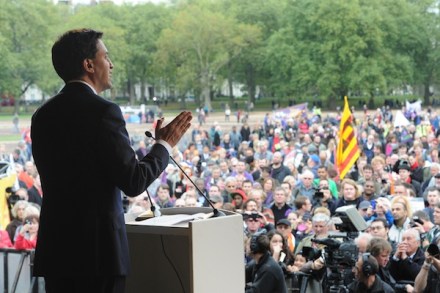
Ed Miliband’s speech to the anti-cuts rally today was well-pitched. The lines about how any government would have to make cuts guaranteed him the jeers that he needed to show that he wasn’t pandering to his audience. What should worry the Tories, though, is not the generic anti-austerity and pro-NHS rhetoric but the direct pitch for small business support. One of the big changes since the 1980s is that those who run small and medium sized enterprises now view the banks as part of the problem not the solution. This provides a significant political opening for Miliband, and one he is intent on exploiting. It’s worth noting that he was in the Tory territory of Bedford yesterday speaking to small businesses that feel they have been done over by the banks.