Economy

Saving the world | 25 November 2009

From our UK edition

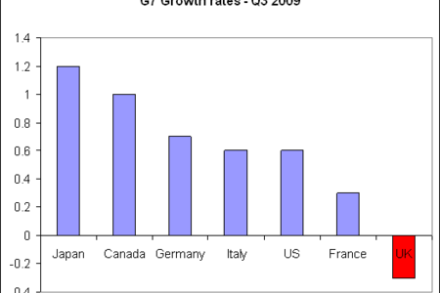
Today’s revised GDP data confirms that the UK remained alone of the world’s major economies in recession in the third quarter of this year*. The fact that the UK remains mired in recession long after most economies have recovered makes clear how uniquely badly positioned the UK economy was to handle a downturn.  While some investment banks continue to argue that this performance reflects the inability of the Office of National Statistics to calculate the data correctly, there is good reason to believe that this huge underperformance is grounded in reality. Economic history teaches that bank crises are amongst the worst things that can ever hit an economy. The collapse in credit availability and soaring bank margins have posed very substantial risks to economic growth.

There are more pressing financial concerns than this

From our UK edition

The two top dogs at the Treasury Select Committee, John McFall and Michael Fallon, give remarkably different reactions to the news that ministers withheld details of emergency loans to RBS and Lloyds for over a year. McFall argues that secrecy was necessary to avoid a run on the banks; Fallon expresses outrage that Lloyds’ shareholders were not privy to all information when considering the disastrous purchase of HBOS, urged on them by the Prime Minister.   Both have their points. Blind panic is the defining recollection of those autumnal days. If the situation had been exacerbated by full disclosure of the mess RBS and Lloyds were in then God alone knows what pandemonium would have ensued.

Brown goes for growth – fails

From our UK edition

So the dividing line persists.  Today, both Gordon Brown and David Cameron will talk about "going for growth" at the CBI's annual conference.  But it all, more or less, comes down to the same, dreary "investment vs cuts" line that we've heard countless times before.  According to the Times, Brown is going to say that growth is the best way of tackling the deficit, rather than those nasty Tory cuts.  And, what's more, "he hopes investment from China will drive the recovery". Of course, growth will have a role to play in reducing the deficit.  A vibrant economy will have a better chance of tackling record deficits and debt levels than a sinking one.  But to indicate that extensive cuts will not be necessary is disingenuous in the extreme.

Portillo: the Tories won’t succeed in cutting public spending – they’ll have to raise taxes

From our UK edition

Ever the contrarian, Michael Portillo makes a case that you don't hear from many on the right in his interview with Andrew Neil on Straight Talk this weekend.  George Osborne has given "a fair amout of detail" about the Tories' debt-reduction plans, he says, but that could be the wrong approach: "I wouldn’t seek probably to give very much more detail ....  You know, I was with Margaret Thatcher when she came in to Government in 1979, we faced a big public spending problem.  It was terrible.  It was a hard slog but she didn’t cut public spending.  I was Chief Secretary between ’92 and ’94 – big public spending problem – I was trying to cut public spending; I did not succeed in cutting public spending.

Fatal inexperience

From our UK edition

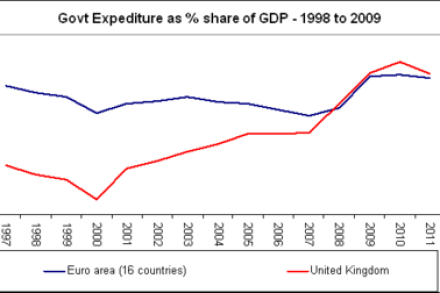
The Government debt mountain grew by a further £11.4billion in October. The UK now has one of the most expensive governments in the European Union – now materially above the Eurozone average and within touching distance of France and Sweden in spending above 50% of GDP.  Blaming large Government per se for economic problems is overly simplistic – larger Government spending countries like Sweden and Finland have managed to build export market shares and provided stock market returns over the past couple of decades that put the UK to shame. Spain now has thousands of miles of high speed railways and over 50% of their energy needs come from renewables.

The gathering storm

From our UK edition

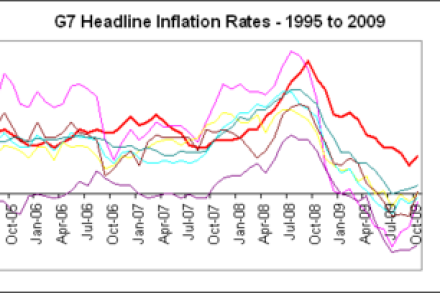
The UK inflation rate again “surprised” to the upside today, registering at 1.5%. As the above chart shows, the UK now has by some margin the highest inflation rate in G7. Were it not for the temporary VAT cut – which takes about 1% off the current CPI rate – the rate would be moving quickly above the Bank of England’s target of 2%. It would seem that the deflation threat, used as justification for the Bank of England deciding to finance the Government’s deficit this year through printing money, has not transpired. A severe recession and rise in unemployment has hit the economy, but this seems to be one where wages stagnate but the prices of what we consume continue to rise.

On the road to recovery? Don’t be daft

From our UK edition

I’d forgotten what it felt like to read positive news about the British economy. To be honest life is full of much more thrilling experiences, but my lack of enthusiasm is partially explained by the fact that a 6,000 employment rise is not proof of recovery. That half the population of Cranleigh have found employment over three months is seen as salvation puts Britain’s economic reality firmly into perspective. If you delve into the Labour Market Statistics the picture becomes clear. Unemployment was expected to rise and will continue doing so, but the employment figure is an anomaly. Britain is still visibly contracting, albeit at a decelerating rate. Vacancies fell by 1,000 and have never been at a lower level since records began in 2001.

G20: the way ahead ignores unresolved issues

From our UK edition

Home of golf and full of five star hotels, St. Andrews is a lovely spot for a weekend shindig, so it’s no surprise that the G20 have convened there for their latest navel-gaze.   This meeting was supposed to be the preserve of finance ministers, but you can’t keep a statesman down. Gordon Brown delivered an impromptu lecture on 'the way ahead' to ministers who have, by some fluke obviously, stewarded a return to growth in their respective countries. Brown is adamant that curbing stimulus packages and inaugurating exit strategies be co-ordinated globally. He spoke of the need to protect taxpayers’ investments with what he called a ‘social contract’.

The State We’re In

From our UK edition

Deficits aren't necessarily the end of the world but they're not your best chum either. This chart, pinched from Burning Our Money, is a handy reminder of where we are and the pickle we're in. Worse than Spain! Worse than the United States! Worse than Iceland! Worse than Ireland! Gordon Brown FTW. Sure, in the long run we're all dead. But we don't have to be dead quite so soon, do we? As always, the Nordics fare very well in this sort of caper. But look too at our friends in New Zealand - a model of how a non-Nordic, English-speaking country can still do pretty well for itself. Yet Alex Salmond never talks about the Kiwi example, even though, as Jim Telfer used to say, New Zealanders are "Scots who learnt how to win". Admittedly, he was talking about rugby.

Road to perdition

From our UK edition

It is another black day for Gordon Brown. The financial news from America, contrasted with continuing decline here, indicts Brown’s recession strategy. Playing the long game, Osborne is being vindicated, and Guido is correct that the ongoing UK recession negates Labour’s attack line on Osborne: the novice has trumped the alleged master. More damaging though is the resurfacing of Damian McBride and the ‘omerta’ of Brown’s inner circle, with its sordid and cynical connotations. The news that Nadine Dorries will receive £1,000 from McBride reflects poorly on the Prime Minister. Worse still, there is possibly more to come – Dorries has two suits outstanding, against Number 10 and Derek Draper respectively.

Once again, Britain stands alone

From our UK edition

It’s fortunate that pluck and stoicism are fundamental British characteristics and that we are at our best when backs are to the wall. Figures published today suggest that the US economy grew by an annualised 3.5 percent in the third quarter. Britain is now alone among developed countries in fighting a shrinking economy. So much for Mr Brown’s confidence last autumn and Alistair Darling’s growth forecasts. Even Italy is doing better. One crumb of comfort for Labour is that the American consumer has regained confidence thanks to government stimulus: sales of manufactured goods, such as cars covered by the government scheme, are up by 22.3 percent. This should have global consequences that benefit Britain.

The quangocracy laid bare

From our UK edition

At last the full facts about our burgeoning quango state are laid bare. The conclusion of a report published today by the TaxPayers’ Alliance is that it’s "big, bloated and more expensive than ever before." The TPA document provides the most comprehensive and up-to-date listing available of all 1,152 'semi-autonomous public bodies' operating in the UK, along with details of how many staff each employs and how much they spend. More than £90 billion of taxpayers’ money was spent on or channelled through quangos/SAPBs in 2007-8 (up £13 billion on the year before). That’s equivalent to £3,640 for every household in the land.

The Tories develop their <em>de facto</em> Glass-Steagall Act

From our UK edition

The most striking aspect about George Osborne's speech today is how it concentrates on retail banks - the banks you and I do business with - rather than the big investment banks.  He's expected to announce that retail banks should stop paying "excessive cash bonuses" to their senior staff, but should instead reward them with shares in the company and use the cash they would have dished out to increase the amount of credit in the economy.  This won't apply to investment banks. The separation rather recalls the American Glass-Steaghall Act, which split commercial banks from their riskier investment counterparts.  The thinking behind it was that the investment banks could then get up to all kinds of risky behaviour, without then impacting upon ordinary people's money.

The Tories now have a monopoly on the language of optimism

From our UK edition

So how big a blow was the news that we're still in recession to Gordon Brown?  Well, compare and contrast his latest podcast on the Downing Street website with David Cameron's article in the Sunday Times.  Brown's effort is necessarily defensive.  Gone is the "we're leading the world" bombast of a few weeks ago, to be replaced with a crude "pledge" to get the economy growing again by 2010: "My pledge to you is to make reform of the financial sector a reality, and to see Britain's economy return to growth by the turn of the year." While Cameron's effort is considerably more agressive, and concentrates on outlining a "pro-growth, pro-enterprise agenda".

So where does this leave Brown?

From our UK edition

Most people expected this morning's official GDP statistics to show that the economy has come out of recession.  But they didn't.  In fact, they had the economy shrinking by 0.4 percent in the third quarter of this year.  So the downturn continues – and it's the longest on record. We've always maintained on Coffee House that coming out of recession won't do much good for Brown.  But, obviously, staying stuck in one has far more dangerous implications for him (not to mention the country).  Obviously, the government won't be able to deploy the green shoots strategy now.  But with other major economies already out of recession, they'll struggle to deploy it in future.  You imagine the Tories will have a field day with this.

The case for cutting middle class benefits

From our UK edition

Great work by my former colleagues at the think tank Reform today. In their latest report, they've figured out that the cost of "middle class benefits" to the Exchequer is some £31 billion. In other words, £31 billion worth of maternity pay, child benefits, fuel allowance and other transfers are dished out to middle income earners each year - that's around a quarter of all spending on benefits. Writing in the Times, Andrew Haldenby says that these middle class benefits should be an obvious candidate for cuts. It's hard to disagree. If we're all in this together, then it seems slightly perverse that money is being given out to people who - in many cases - don't strictly need it.

The Tories’ Laffer-style radicalism

From our UK edition

In contrast to David Brooks’ optimism about Conservative economic policy, is Oliver Marc Harwich, former Chief Economist at Policy Exchange, who described George Osborne’s plans as “timid and unimaginative”. In a speech to the Centre for Independent studies, Dr Harwich remarked: “To be fair to the Tories, at their last party conference in Manchester George Osborne finally spelt out that a future Conservative government will be cutting public spending. But even the £23 billion over the next five years that Osborne announced amounts to little more than a rounding error in Britain’s public finances. Even in the face of the greatest economic crisis that Britain has experienced in decades, Tory policy remains timid and unimaginative.

Deconstructing David Blanchflower

From our UK edition

What with his new column in the New Statesman and his articles for other outlets, David Blanchflower – a former member of the MPC – really does seem to enjoy laying into the Tories.  Problem is, much of what he says fails to convince – so much so, in fact, that I thought I'd bash out a quick fisk of his Guardian article from last Friday.  Here's the full article with my comments in bold: We are in the midst of the worst recession most people alive have ever experienced, or will probably ever experience. It is already worse than the 1980s and it isn't over yet. The only comparison is to the 1930s (my parents, now in their 80s, can remember how bad it was).

Ongoing deflation

From our UK edition

This morning the inflation figures were released for September.  They show that the economy is in ongoing deflation, as it has been since March 2009, with the annual change in the Retail Prices Index (RPI) standing at -1.4 percent.  At the same time, the policy index used by the Bank of England to determine its interest rate and quantitative easing policies – the Consumer Prices Index (CPI) – saw its annual rate of inflation fall to 1.1 percent from 1.6 percent. Some press commentary suggests that the fall in CPI inflation to 1.1 percent suggests there is now a threat of outright deflation next year.  This is wrong.  The country is already in deflation.  The CPI is not a measure of the cost of living in the UK.

Brown’s double hit

From our UK edition

What is the true price of Gordon Brown’s economic incompetence and inept bank regulation? The soaring national debt is one. And if you own a mortgage, you’ll find that you’re paying another. The gulf between the Bank of England base rate and the average mortgage rate is now at a huge high – as banks rip off their customers, trying to fill the hole in their balance sheets. This is an under-discussed topic. The “action we have taken” (a phrase Brown uses to try to lay claim to the Bank of England’s base rate reduction) would have a far greater effect on the economy if the UK banking system was not (still) so badly broken. The below graph, from Citi, shows spreads (ie, gap between base rate and retail rate) on key UK mortgages from 1995.