Economy

Cutting the deficit sooner won’t risk the recovery

From our UK edition

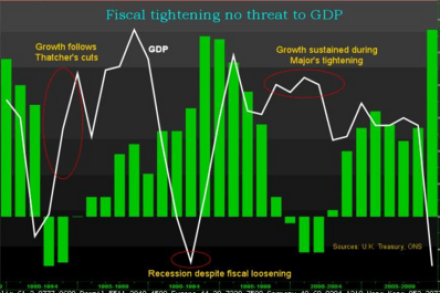
Would cutting spending “risk the recovery?” This claim is, literally, Gordon Brown’s re-election manifesto. He is hoping that the Tories haven’t learned to use numbers as weapons – so any economic message he has will not be effectively countered. In fact, his claim is very easily exposed as being bogus by a simple look at recent British economic history. Bloomberg’s Chart of the Day shows that economic growth in the past two recessions (white line) was not at all threatened by fiscal tightening (green graph). Even Goldman Sachs – which is acquiring a reputation as the Labour Party’s house broker – is conceding the central point.
Inflation nation<br />

From our UK edition

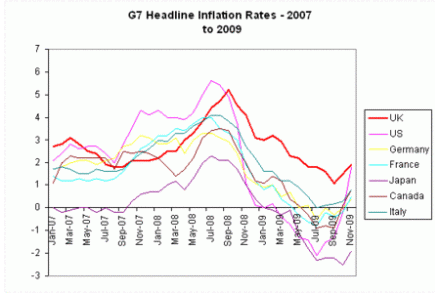
The inflation surge is now upon us. The CPI rate again “surprised” to the upside – Britain is the only major economy in the world to have inflation doing this. But given that the Bank of England’s printing presses have been working overtime to fund a fiscally irresponsible government then little wonder things are different here. To understand just how unusual the UK situation is, consider the below graph: despite suffering the longest recession in G20, we have one of highest rates of inflation in the developed world. The next few months will see this push higher, potentially reaching 4 percent in March and busting the 2 percent target.

The Tories should resist any temptation to go soft on debt

From our UK edition

Of all the findings from today's ICM poll for the Guardian, I imagine this one will concern the Tory leadership most: "Just two months ago, 49 percent of voters said they thought Cameron and Osborne would do better than Darling and Brown, but that figure is 38 percent today." They're still ahead of Brown and Darling – who are langushing on 31 percent – but the drop is still pretty striking.  What's more, it seems to go against conventional wisdom about fixing the fiscal mess we're in.  While they could still go further in setting out a few specifics, the fact is that the Tory pair have spent the last couple of months railing against the the twin debt and deficit burdens, and stressing the need for spending cuts.

How long until the plug is pulled?<br />

From our UK edition

Moody’s AAA sovereign monitor was published today, and whilst the UK’s AAA status remains ‘resilient’ the situation is far from rosy. The report states: ‘The UK economy entered the crisis in a vulnerable position, owing to the (overly) large size of its banking sector and the high level of household indebtedness. Both continue to weigh on economic performance. Net bank lending to the UK business sector has continued to contract through Q3 2009, and repairs to household balance sheets (i.e. the rising savings ratio) may weigh on demand for some time to come. The depth of the crisis has been mirrored by the ongoing deterioration of public finances (with gross debt/GDP having risen from 44% at the end of 2007 to an estimated 69% at the end of 2009).

Ever the optimist

From our UK edition

It seems absurd to describe our dour and jowly Prime Minister as an eternal optimist, but he is. Rachel Sylvester’s column contains this delicious snippet of gossip: ‘When Mr Darling said that Britain was facing the worst recession for 60 years, Mr Brown telephoned him to tell him the downturn would be over in six months.’ Prudent foresight, there's nothing like it.

Obama & Reagan

From our UK edition

I've remarked before that Barack Obama is, in many ways, American liberalism's long-delayed response to Ronald Reagan. This chart, found via Andrew Sullivan, comparing their Gallup approval ratings, is uncanny: Clearly, none of this is predictive, far-less guaranteeing that Obama will recover and romp to a second term as Reagan did. But what it does do is permit one to imagine both the upper and lower set of expectations one may reaonably hold for the rest of Obama's Presidency. (This has nothing to do with the wisdom of Obama's policies or one's approval of them). It's also a reminder to pundits everywhere that Presidents' ability to "make the political weather" is seriously limited.

Copenhagen dispatch

From our UK edition

I make my second foray into the climate debate with trepidation. But visiting Denmark a few days before COP 15, it is impossible to escape the subject. Whether I speak to friends, family or strangers on the bus, everyone has a view and wants to share it. TV coverage of the forthcoming climate talks is relentless and there is even a separate passport queue for COP participants at Copenhagen’s stylish airport.   The latest “story” to emerge has pitted the new Climate Change Minister, the former commentator Lykke Friis against the Speaker of Parliament, Thor Pedersen. Though they are both from the same centre-right/liberal party, Mr.

Countdown to Copenhagen

From our UK edition

How seriously are we to take Lord Stern on the economics of climate change? At the LSE yesterday, he rather hysterically claimed that the Copenhagen summit will be "the most important international gathering since the Second World War". Crucially, he added that the cost of dealing with the problem may reach 5 percent of GDP. Even so, "it would still be a good deal," he said. Really? Losing world economic growth condemns millions in the Third World to poverty: the globalisation of the last 15 years has been the greatest anti-poverty tool ever invented. So we should not be blasé about sacrificing growth, as if all it means is smaller cars for the rich. Poverty kills, and so will forfeited economic growth. Stern would argue that climate change also kills.

Turning Japanese

From our UK edition

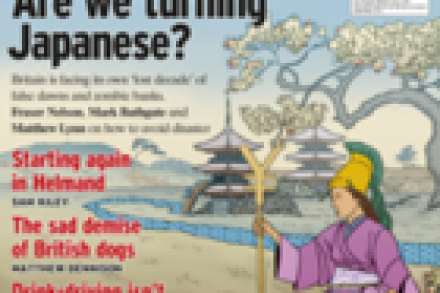
Is the British economy turning Japanese? Since asking the question last year on Coffee House, the evidence has been piling up – and it makes for a cover story in this week's magazine (which I have written with Mark Bathgate). The similarities are as follows: 1. Japan’s bust followed years of debt-fuelled growth which vain politicians saw as prosperity. 2. When the bust came, Japan’s government kept on spending. They did so in the name of Keynsian stimulus, thinking this would in itself kick start a recovery. All it achieved was to sink Japan deeper into debt. 3. Crucially, Japan didn’t do full disclosure on the collapsed banks. To fix the banks was, they figured, painful root canal surgery that this recession-struck country could do without. 4.

Saving the world | 25 November 2009

From our UK edition

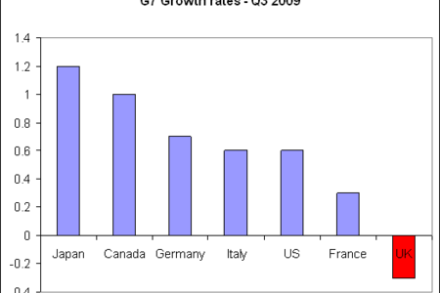
Today’s revised GDP data confirms that the UK remained alone of the world’s major economies in recession in the third quarter of this year*. The fact that the UK remains mired in recession long after most economies have recovered makes clear how uniquely badly positioned the UK economy was to handle a downturn.  While some investment banks continue to argue that this performance reflects the inability of the Office of National Statistics to calculate the data correctly, there is good reason to believe that this huge underperformance is grounded in reality. Economic history teaches that bank crises are amongst the worst things that can ever hit an economy. The collapse in credit availability and soaring bank margins have posed very substantial risks to economic growth.

There are more pressing financial concerns than this

From our UK edition

The two top dogs at the Treasury Select Committee, John McFall and Michael Fallon, give remarkably different reactions to the news that ministers withheld details of emergency loans to RBS and Lloyds for over a year. McFall argues that secrecy was necessary to avoid a run on the banks; Fallon expresses outrage that Lloyds’ shareholders were not privy to all information when considering the disastrous purchase of HBOS, urged on them by the Prime Minister.   Both have their points. Blind panic is the defining recollection of those autumnal days. If the situation had been exacerbated by full disclosure of the mess RBS and Lloyds were in then God alone knows what pandemonium would have ensued.

Brown goes for growth – fails

From our UK edition

So the dividing line persists.  Today, both Gordon Brown and David Cameron will talk about "going for growth" at the CBI's annual conference.  But it all, more or less, comes down to the same, dreary "investment vs cuts" line that we've heard countless times before.  According to the Times, Brown is going to say that growth is the best way of tackling the deficit, rather than those nasty Tory cuts.  And, what's more, "he hopes investment from China will drive the recovery". Of course, growth will have a role to play in reducing the deficit.  A vibrant economy will have a better chance of tackling record deficits and debt levels than a sinking one.  But to indicate that extensive cuts will not be necessary is disingenuous in the extreme.

Portillo: the Tories won’t succeed in cutting public spending – they’ll have to raise taxes

From our UK edition

Ever the contrarian, Michael Portillo makes a case that you don't hear from many on the right in his interview with Andrew Neil on Straight Talk this weekend.  George Osborne has given "a fair amout of detail" about the Tories' debt-reduction plans, he says, but that could be the wrong approach: "I wouldn’t seek probably to give very much more detail ....  You know, I was with Margaret Thatcher when she came in to Government in 1979, we faced a big public spending problem.  It was terrible.  It was a hard slog but she didn’t cut public spending.  I was Chief Secretary between ’92 and ’94 – big public spending problem – I was trying to cut public spending; I did not succeed in cutting public spending.

Fatal inexperience

From our UK edition

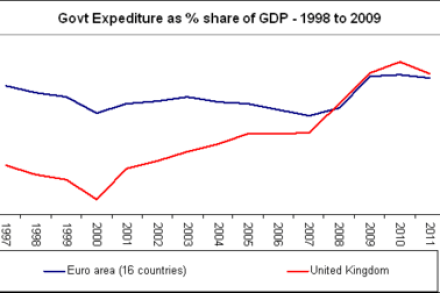
The Government debt mountain grew by a further £11.4billion in October. The UK now has one of the most expensive governments in the European Union – now materially above the Eurozone average and within touching distance of France and Sweden in spending above 50% of GDP.  Blaming large Government per se for economic problems is overly simplistic – larger Government spending countries like Sweden and Finland have managed to build export market shares and provided stock market returns over the past couple of decades that put the UK to shame. Spain now has thousands of miles of high speed railways and over 50% of their energy needs come from renewables.

The gathering storm

From our UK edition

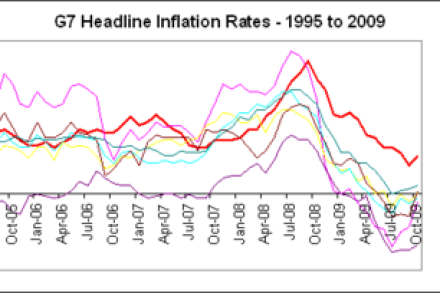
The UK inflation rate again “surprised” to the upside today, registering at 1.5%. As the above chart shows, the UK now has by some margin the highest inflation rate in G7. Were it not for the temporary VAT cut – which takes about 1% off the current CPI rate – the rate would be moving quickly above the Bank of England’s target of 2%. It would seem that the deflation threat, used as justification for the Bank of England deciding to finance the Government’s deficit this year through printing money, has not transpired. A severe recession and rise in unemployment has hit the economy, but this seems to be one where wages stagnate but the prices of what we consume continue to rise.

On the road to recovery? Don’t be daft

From our UK edition

I’d forgotten what it felt like to read positive news about the British economy. To be honest life is full of much more thrilling experiences, but my lack of enthusiasm is partially explained by the fact that a 6,000 employment rise is not proof of recovery. That half the population of Cranleigh have found employment over three months is seen as salvation puts Britain’s economic reality firmly into perspective. If you delve into the Labour Market Statistics the picture becomes clear. Unemployment was expected to rise and will continue doing so, but the employment figure is an anomaly. Britain is still visibly contracting, albeit at a decelerating rate. Vacancies fell by 1,000 and have never been at a lower level since records began in 2001.

G20: the way ahead ignores unresolved issues

From our UK edition

Home of golf and full of five star hotels, St. Andrews is a lovely spot for a weekend shindig, so it’s no surprise that the G20 have convened there for their latest navel-gaze.   This meeting was supposed to be the preserve of finance ministers, but you can’t keep a statesman down. Gordon Brown delivered an impromptu lecture on 'the way ahead' to ministers who have, by some fluke obviously, stewarded a return to growth in their respective countries. Brown is adamant that curbing stimulus packages and inaugurating exit strategies be co-ordinated globally. He spoke of the need to protect taxpayers’ investments with what he called a ‘social contract’.

The State We’re In

From our UK edition

Deficits aren't necessarily the end of the world but they're not your best chum either. This chart, pinched from Burning Our Money, is a handy reminder of where we are and the pickle we're in. Worse than Spain! Worse than the United States! Worse than Iceland! Worse than Ireland! Gordon Brown FTW. Sure, in the long run we're all dead. But we don't have to be dead quite so soon, do we? As always, the Nordics fare very well in this sort of caper. But look too at our friends in New Zealand - a model of how a non-Nordic, English-speaking country can still do pretty well for itself. Yet Alex Salmond never talks about the Kiwi example, even though, as Jim Telfer used to say, New Zealanders are "Scots who learnt how to win". Admittedly, he was talking about rugby.

Road to perdition

From our UK edition

It is another black day for Gordon Brown. The financial news from America, contrasted with continuing decline here, indicts Brown’s recession strategy. Playing the long game, Osborne is being vindicated, and Guido is correct that the ongoing UK recession negates Labour’s attack line on Osborne: the novice has trumped the alleged master. More damaging though is the resurfacing of Damian McBride and the ‘omerta’ of Brown’s inner circle, with its sordid and cynical connotations. The news that Nadine Dorries will receive £1,000 from McBride reflects poorly on the Prime Minister. Worse still, there is possibly more to come – Dorries has two suits outstanding, against Number 10 and Derek Draper respectively.

Once again, Britain stands alone

From our UK edition

It’s fortunate that pluck and stoicism are fundamental British characteristics and that we are at our best when backs are to the wall. Figures published today suggest that the US economy grew by an annualised 3.5 percent in the third quarter. Britain is now alone among developed countries in fighting a shrinking economy. So much for Mr Brown’s confidence last autumn and Alistair Darling’s growth forecasts. Even Italy is doing better. One crumb of comfort for Labour is that the American consumer has regained confidence thanks to government stimulus: sales of manufactured goods, such as cars covered by the government scheme, are up by 22.3 percent. This should have global consequences that benefit Britain.